

During a Cabinet of Ministers meeting chaired via a digital system by President Serdar Berdimuhamedov, preparations were reviewed for one of the key spring events, the international forum TurkmenTravel 2026, to be held from 14 to 17 April 2026.
The agenda includes specialised seminars and round table sessions organised jointly with UN Tourism, along with a scientific practical conference on innovation in the tourism industry. President Serdar Berdimuhamedov instructed that the forum be organised at a high level and that Turkmenistan’s tourism potential be presented in line with government priorities.
The forum will bring together tour operators, airlines, hospitality representatives, and experts in cultural heritage and ecotourism. Around 100 foreign delegates and more than 60 participants from Turkmenistan’s tourism sector are expected. The business programme will feature presentations of new tourism products, discussions on international cooperation, and showcases of modern technological solutions.
A special focus will be placed on ecotourism, ethnographic routes, and health and wellness tourism, alongside B2B and B2G meetings aimed at strengthening cooperation between public institutions and the private sector. The event is organised by the Ministry of Culture, the Union of Industrialists and Entrepreneurs, and the Chamber of Commerce and Industry of Turkmenistan, in partnership with Talvas Yoly and Oguz Forum and Expo.
UNESCO Sites and Heritage
Turkmenistan possesses a rich UNESCO inscribed heritage, including three major World Heritage cultural sites, Ancient Merv, Kunya Urgench, and the Parthian Fortresses of Nisa, as well as the transboundary Cold Winter Deserts of Turan and the Silk Roads Zarafshan Karakum Corridor. Its intangible heritage includes traditional Turkmen carpet making, the Kushtdepdi song and dance rite, and dutar craftsmanship and performance, reflecting the country’s Silk Road legacy and living traditions.
E‑visas and easier entry
Turkmenistan is following the path of other Central Asian countries by opening up to tourism. A law adopted in April 2025 introduces electronic visas and simplifies entry procedures for foreign visitors. Travellers will be able to apply through a simplified online system without a letter of invitation, a move expected to boost tourism revenues and trade, in line with regional examples such as Kazakhstan, Kyrgyzstan, Tajikistan, and Uzbekistan, as previously reported by Travel Tomorrow.
A country of under‑explored potential
Turkmenistan has significant untapped tourism potential. According to QRA Centre, “within the Central Asian region, Turkmenistan stands out as a country where historical continuity and natural diversity converge, yet its tourism potential remains only partially explored.”
The country combines ancient centres of civilisation, key Silk Road sites, Islamic era architecture, and distinctive natural landscapes, forming a strong foundation for cultural and educational tourism.
Natural highlights include the Darvaza Gas Crater, often referred to as the “Gates to Hell”, and Yangykala Canyon, alongside major Silk Road heritage sites such as Merv and Nisa. Merv is among the largest and best preserved oasis cities of the Silk Road, while Nisa reflects early Parthian statehood and Kunya Urgench showcases the achievements of Khorezm architecture.
@dukeandrs #darvaza #darvazacrater #crater #turkmenistan #turkmenistan🇹🇲 ♬ Keep On – Jacob Yoffee
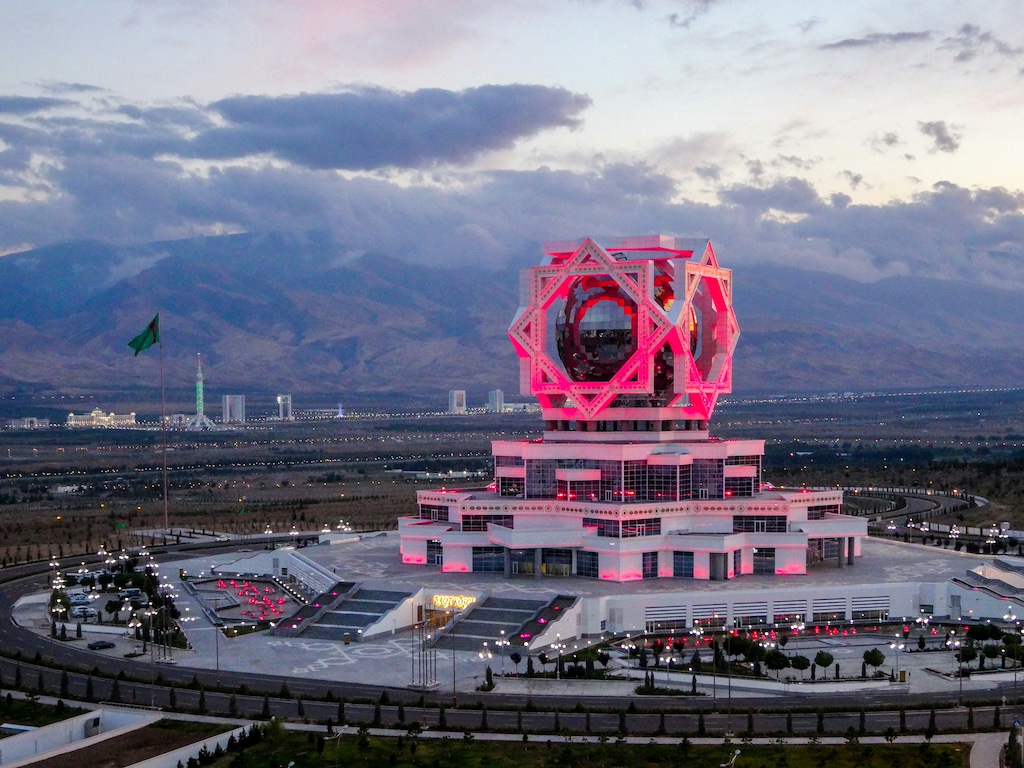
The capital, Ashgabat, is internationally known for its white marble architecture and holds a Guinness World Record for the highest density of marble clad buildings, making it a distinctive urban tourism destination.
On the Caspian coast, the Avaza National Tourist Zone offers resort tourism and conference facilities and has hosted major international events. It is considered a key pillar of Turkmenistan’s recreational development strategy, with hotels, parks, and leisure infrastructure, according to official sources.
According to the Turkmen Ministry of Foreign Affairs, “the Turkmen part of the Caspian Sea has immense potential for the development of wellness, recreation, and ecological tourism.” Tourism is increasingly seen as an important sector contributing to the country’s socio economic development.
The Avaza National Tourist Zone in Balkan Province is attracting around 150,000 visitors annually, according to The Caspian Post.
Health and balneological tourism also plays a role, particularly at Mollagara and Archman sanatoria, which draw on mineral waters, therapeutic mud, and specialised rehabilitation treatments. According to the government website, the Mollagara resort includes medical facilities, accommodation, and rehabilitation services, forming part of a broader health tourism offer.
Caspian Coast and cooperation with Kazakhstan
If Turkmenistan continues to open its tourism sector, cooperation with neighbouring Kazakhstan could help transform the Caspian coast into a stronger destination for European and Asian travellers.
In Kazakhstan, Aktau has seen growing visitor numbers and infrastructure development, including new hotels and a planned airport in Kendirli. More than 350,000 tourists were recorded in the first nine months of 2025, according to regional data cited by Astana Times. This trend suggests potential for complementary itineraries linking Aktau and Mangystau with Avaza and Turkmenbashi.
Historical and Natural heritages
Turkmenistan’s natural and cultural assets remain largely under explored. The Darvaza Gas Crater, located around 260 km north of Ashgabat, has been burning since the 1970s and remains one of the country’s most recognisable attractions. Yangykala Canyon, in the Balkan region, offers striking multicoloured cliffs and remote desert landscapes.
The Silk Road cities of Merv, Nisa, and Kunya Urgench form the backbone of cultural tourism itineraries, supported by UNESCO recognition.
Among the most distinctive elements of Turkmenistan’s heritage are the Akhal Teke horses and traditional carpet weaving. Turkmen carpets are widely regarded for their deep red colours, high knot density, and intricate geometric patterns, while the Akhal Teke horse is often cited among the world’s most striking breeds.
Seljuk Heritage
Seljuk history plays an important role in the broader Turkic world. The Oghuz Seljuks laid the foundations for an empire that later influenced the rise of the Ottoman Empire.
One of the most significant monuments of this period is the Mausoleum of Sultan Sanjar in Merv. This masterpiece of medieval Islamic architecture houses the tomb of Ahmad Sanjar and is notable for its monumental scale and distinctive dome, once covered in turquoise tiles. During his reign, Merv became one of the most important cultural and economic centres of the Silk Road.
With TurkmenTravel 2026, the country has an opportunity to align policy, tourism development, and international promotion. Combined with potential cross Caspian cooperation, this could help position Turkmenistan as a distinctive Silk Road destination.