

Global air passenger bookings grew by six percent in March and April 2026, for travel between June and September 2026, despite market headwinds caused by the war in Iran and high oil prices, according to new data from the International Air Transport Association (IATA).
The year-on-year increase was most marked in the Asia Pacific region, where bookings rose by 32%. In contrast, Middle East bookings fell by 50%. Travel within each region outpaced reservations for longer haul trips as “evidently, more passengers choose to travel shorter distances,” the IATA release said.
In North America, bookings for travel beyond the region remained in line with 2025, while bookings for within-region travel are up seven percent. Meanwhile, European travel beyond the borders of the region has shrunk by eight percent and reservations for travel within the region are up only two percent.
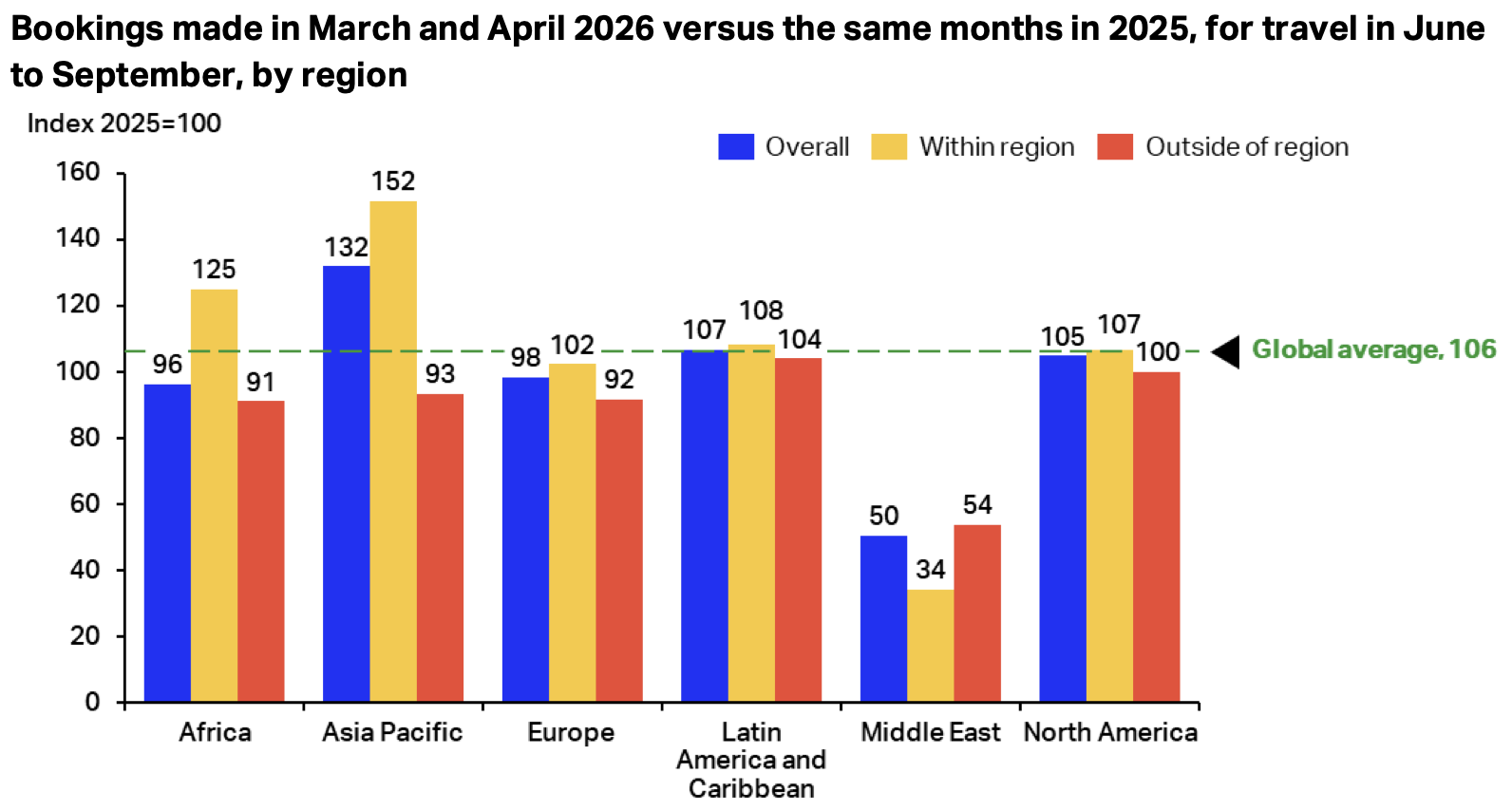
It was a similar picture elsewhere. In Latin America and the Caribbean, overall demand increased by seven percent, with within-region bookings up eight percent, and outside of the region up four percent.
Bookings for within-Africa travel are up strongly, by 25% year-on-year, albeit from a lower base. Bookings for travel outside the region are down nine percent, “driven predominantly,” the IATA said, “by a decrease in bookings to the Middle East and Asia Pacific.”
The news echoes a report published by Airports Council International (ACI) EUROPE earlier this month, revealing that European air passenger traffic had expanded by 3.8% in March 2026, despite the ongoing geopolitical impasse blocking fuel supplies in the Middle East’s Strait of Hormuz.
Olivier Jankovec, Director General of ACI EUROPE, said that “the first month of the Middle East war has once again highlighted the resilience of demand for air transport in the face of another major geopolitical shock.” He also highlighted intra-European traffic flows that had been supported by the loss of direct connectivity to Middle East region, and pointed out that while “traffic flows connecting onward to Asia rapidly adapted through alternative direct and indirect routings.”
Jankovec called the market “extremely dynamic.” Representing 375 members, IATA agrees. In its latest report, it also noted that passenger booking patterns are liable to shift in times of crisis or uncertainty, as consumers tend to wait until closer to the date of travel before making reservations. The IATA therefore expects to see the situation “continue to evolve, and there is still time for travel to destinations outside of the home region to catch up, especially if geopolitical conditions were to improve.”