


Travellers from the United Kingdom, United States, Canada and other visa-exempt countries are facing renewed uncertainty over when they will have to obtain an ETIAS travel authorisation to enter much of Europe, with the European Union yet to announce a specific launch date for the repeatedly delayed system.
The European Travel Information and Authorisation System (ETIAS) is not currently operational and no applications are being accepted. The EU says travellers will be informed of the specific start date several months before the system goes live, meaning there is currently nothing visitors need to do before travelling.
Planning to #TravelToEurope in summer? You may hear about two new EU border systems: EES and ETIAS.
— EU Home Affairs (@EUHomeAffairs) June 29, 2026
The Entry/Exit System (EES) is fully operational since 10 April 2026. ETIAS is a travel authorisation expected to start in the last quarter of 2026.
Learn the differences 👇 pic.twitter.com/JKLAcOjB87
The EU’s official information continues to indicate that ETIAS is expected to start operations in the last quarter of 2026. However, the absence of a specific date, combined with persistent difficulties surrounding the implementation of the bloc’s Entry/Exit System (EES), has raised further questions over whether that timetable can be maintained.
As Travel Tomorrow reported in early July, EU officials had already been discussing the possibility of delaying ETIAS beyond 2026, with the Financial Times reporting that eu-LISA, the EU agency responsible for managing the system, no longer considered the planned timetable achievable.
From €7 to €20
When ETIAS eventually enters into operation, nationals of visa-exempt countries, including the UK, US, Canada and Australia, will have to obtain authorisation before travelling to 30 European countries for short stays.
Applications will be made online through the official ETIAS website or mobile application and will cost €20, following the EU’s decision to increase the previously planned €7 fee. Travellers under 18 or over 70, as well as certain family members of EU citizens, will be exempt from paying the application fee.
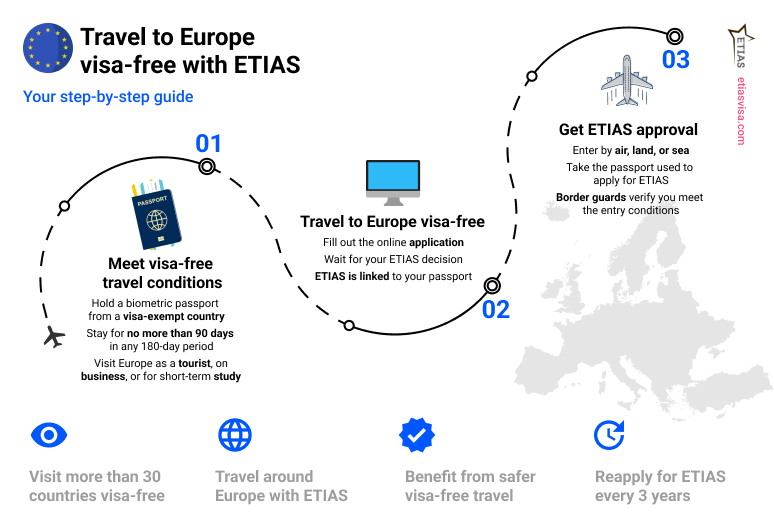
Once approved, an ETIAS authorisation will generally remain valid for three years or until the passport used for the application expires, whichever comes first. It will allow multiple visits for stays of up to 90 days within any 180-day period, although an ETIAS authorisation will not in itself guarantee entry.
Most applications are expected to be processed within minutes, although cases requiring additional checks can take considerably longer. Applicants will be required to provide passport and personal information as well as details relating to issues such as previous travel to conflict zones or criminal convictions.
Until the system becomes operational, travellers should be particularly cautious about websites claiming that ETIAS applications can already be submitted. The EU explicitly states that it is not currently collecting applications.
ETIAS and EES: What is the difference?
The continuing uncertainty has also highlighted confusion between ETIAS and the EU’s separate Entry/Exit System. Although the two systems form part of Europe’s wider overhaul of external border management, they serve different purposes.
ETIAS is a pre-travel authorisation for travellers who currently enjoy visa-free access to participating European countries. They will have to apply online before starting their journey, but ETIAS does not change their visa-free status and is not considered a visa.
@mjelitetravel A cruise ship ran aground on the Rhine last month and we're heading into the worst part of the season. Plus ETIAS delayed to 2027, 1,400 flights delayed in Europe this weekend, and I'm headed to France next week. Comment RHINE if you want to know more. Follow for weekly travel news. #RiverCruise #RhineCruise #EuropeTravelTips #TravelNews ♬ Headline News/Reports 76(1553791) – Takashi
The EES, by contrast, operates at Europe’s external borders and applies to non-EU nationals travelling for short stays, whether they require a visa or benefit from visa-free travel. It digitally records travellers’ entries and exits, replacing manual passport stamping, and collects information including facial images and fingerprints. ETIAS itself does not collect biometric data.
In simple terms, ETIAS determines whether a visa-exempt traveller has obtained the required authorisation before travelling, while EES records when eligible non-EU travellers actually enter and leave participating European countries.
EES problems add to uncertainty
The distinction is particularly important because the troubled implementation of EES has become closely linked to concerns over the readiness of ETIAS.
As Travel Tomorrow reported in July, the EES became fully operational on 10 April 2026 following a phased introduction, but its implementation has been accompanied by significant disruption at some European airports and border crossings.
Airlines and airports have warned of lengthy queues during peak periods, with first-time biometric registrations placing additional pressure on border-control infrastructure. European Commission President Ursula von der Leyen acknowledged in July that there was “still a lot to do” to address the technical difficulties.
The problems have prompted aviation organisations to call for greater flexibility in applying EES procedures during periods of severe congestion, while some countries and airports have sought temporary measures to reduce disruption.
The EES and ETIAS are technically interconnected, with the EU having always planned for EES to become operational before ETIAS. EU guidance describes the two as separate but complementary systems designed to strengthen the management and security of Europe’s external borders.
With ETIAS having already faced repeated postponements, its final implementation will therefore be closely watched by the aviation and tourism industries, particularly after the difficulties experienced with EES.
For travellers, however, the situation remains straightforward for the moment: ETIAS is not yet operational, applications cannot currently be submitted and the EU says it will announce the specific start date several months before the new requirement takes effect.