
As tensions in the Middle East persist, affecting the entire aviation industry, travel companies have been reminded of their obligation to refund travellers in the event of cancellations due to circumstances beyond their control.
The UK’s Civil Aviation Authority (CAA) has issued its spring ATOL (Air Travel Organiser’s Licence) renewal, reminding businesses in the travel sector of their obligation to offer cash refunds to consumers, “in the event of cancellation due to unavoidable and extraordinary circumstances”.
April 13, 2025 vs April 12, 2026 ✈️
— AirNav Radar (@AirNavRadar) April 13, 2026
Air traffic over the Middle East shows a notable shift in regional flight patterns, highlighting the impact of ongoing conflict on airspace usage and airline routing decisions.
Track flights in real time: https://t.co/5xZPwStOUa#airtraffic… pic.twitter.com/Y3rbndC5DV
Geoff Wingfield, ATOL spokesperson at the CAA, said the regulator is aware of the pressure facing the sector.
“We recognise the challenges that travel companies are facing with the evolving situation in the Middle East. It is important that passengers’ holidays are protected, and we will continue to work with the industry to ensure they understand how best to support their customers.”
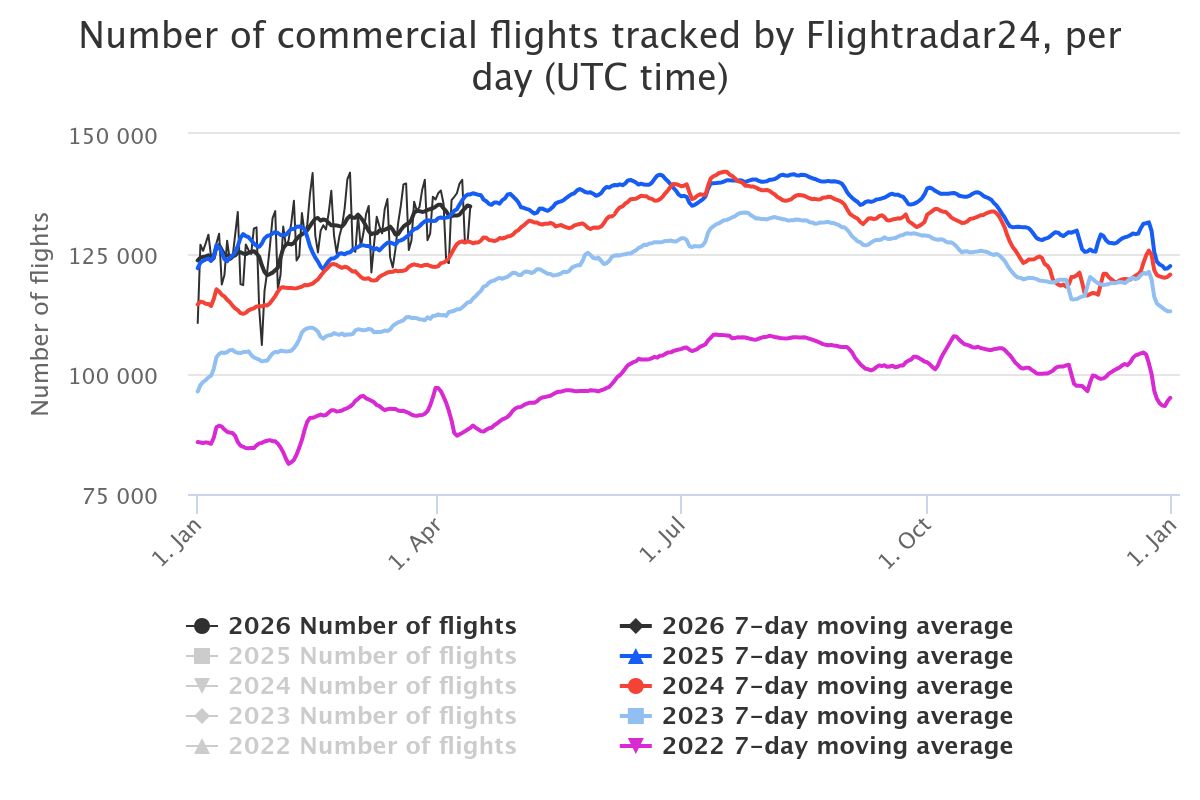
This warning comes as the aviation sector continues to face disruption due to the escalating conflict with Iran. Since the outbreak of war on 28 February, airspace closures and rerouting across the region have forced numerous tour operators to cancel or significantly alter their itineraries, while extended flight times and rising jet fuel costs have compounded the issue.
Although gasoline prices have increased substantially, jet fuel and distillate prices have increased significantly more. pic.twitter.com/FWsbgljvDO
— Hedgeye (@Hedgeye) April 7, 2026
While the most visible impact has been on destinations directly affected in the Middle East, the disruption has extended far beyond the region. Flights between Europe and Asia have been diverted to avoid restricted airspace, which has increased journey times and operational costs. In some cases, routes have become commercially unviable, leading to package holiday cancellations even to destinations not directly involved in the conflict.
Although precise cancellation figures vary by operator, industry data and airline schedules suggest hundreds of disrupted routes and an increasing number of suspended services.
The CAA also reiterated that the Foreign, Commonwealth and Development Office continues to advise against all but essential travel to the Middle East. In such circumstances, consumers have the right to terminate their package holiday without paying a fee under the Package Travel and Linked Travel Arrangements Regulations 2018. Additionally, whether the cancellation is initiated by the organiser or the customer, a full refund must be provided within 14 days.
Crucially, the CAA stressed that, if travel companies offer vouchers instead of cash refunds, travellers must be clearly informed that they have the right to refuse them and opt for a cash reimbursement instead. The CAA also highlighted a key distinction: unlike the holidays they replace, vouchers are not covered by ATOL protection.
Despite ongoing volatility, the CAA confirmed that 1,674 travel businesses have secured an ATOL licence this year, underlining continued demand for protected holidays. The largest licence holders include Jet2holidays, TUI, Loveholidays, easyJet Holidays, and On the Beach.
ATOL remains the UK’s primary financial protection scheme. It safeguards consumers when booking package holidays while providing companies with a recognised mark of trust in an increasingly uncertain global market.