


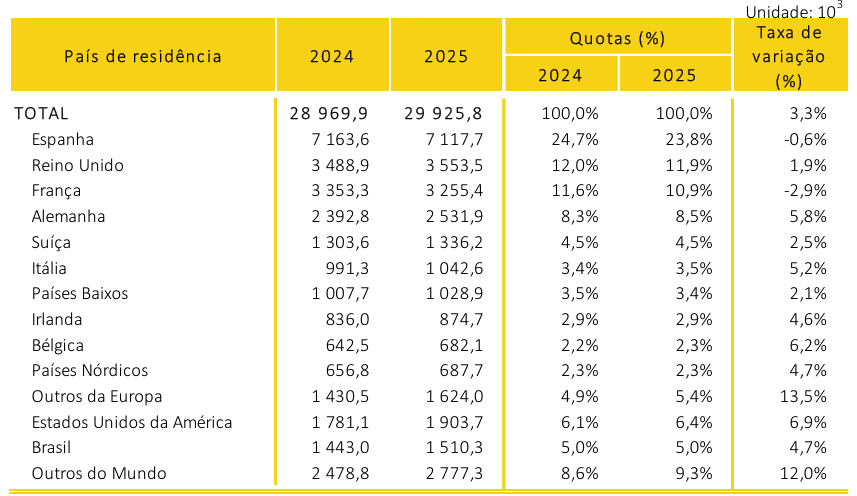
Portugal welcomed 29.9 million international tourists in 2025, representing an increase of 3.3% compared with the previous year, according to new figures from the Portuguese National Statistics Institute (INE).
Although the number of international arrivals continued to rise, growth slowed considerably from the 9.3% increase recorded in 2024, suggesting that the country’s tourism expansion is entering a more moderate phase.
Across all forms of tourist accommodation, Portugal registered 34.8 million guests and 89.7 million overnight stays in 2025, corresponding to year-on-year increases of 2.2% and 1.6%, respectively.
Spain remains Portugal’s largest source market
Spain remained the country’s largest international source market, accounting for 23.8% of foreign tourists, despite arrivals from the neighbouring country declining by 0.6%.
The United Kingdom retained second place, with an 11.9% share of international arrivals. British tourism increased by 1.9%, making the UK the only one of Portugal’s three largest source markets to record growth in 2025.
France ranked third, representing 10.9% of international tourists, although arrivals from the country fell by 2.9%.
Other markets contributed to the continued diversification of Portugal’s international tourism sector. Arrivals from North America increased by 6.9%, while the categories covering other European markets and the rest of the world grew by 13.5% and 12%, respectively.
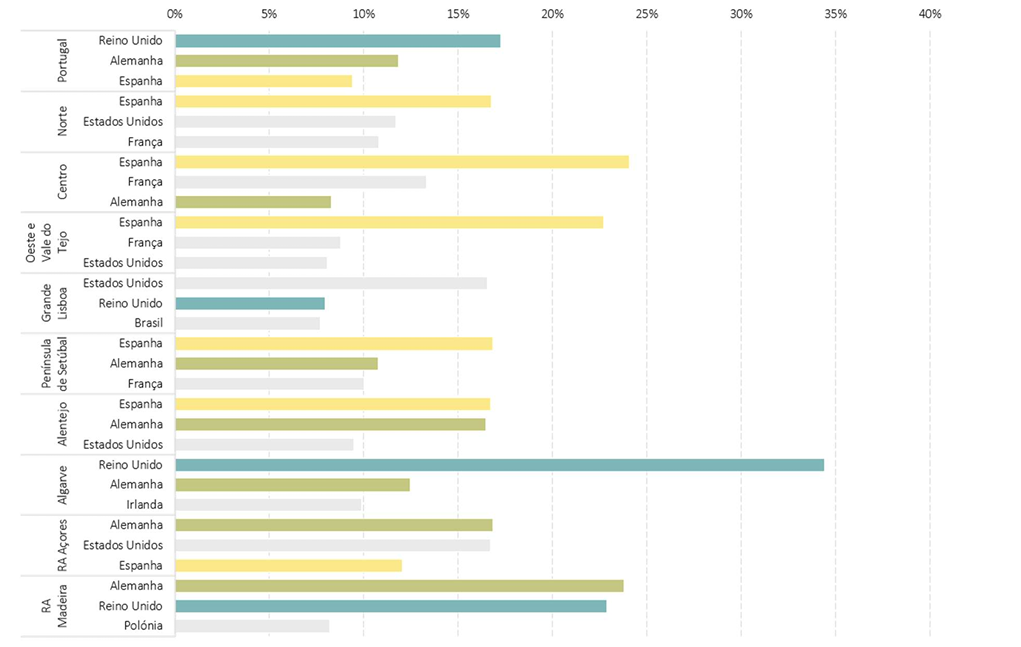
When measured by overnight stays, the UK remained Portugal’s largest international market, accounting for 17.3% of the foreign total despite a decline of 1.7%.
Germany followed with an 11.8% share and growth of 1.3%. Spain represented 9.4% of foreign overnight stays after a 5.1% decline, while the United States strengthened its position with a 9.1% share and an increase of 5.3%.
Poland also stood out, recording an 11.4% rise in overnight stays, while the French market declined by 6.6%.
Domestic tourism grew faster than international demand
International visitors generated 60.2 million overnight stays in 2025, up 0.6% from the previous year and accounting for 67.1% of all nights spent in tourist accommodation.
Although foreign visitors continued to generate more than two-thirds of Portugal’s overnight stays, the country’s dependence on international markets decreased by 0.6 percentage points compared with 2024.
Domestic tourism grew more strongly. Portuguese residents generated 29.5 million overnight stays, representing 32.9% of the total and an annual increase of 3.5%.
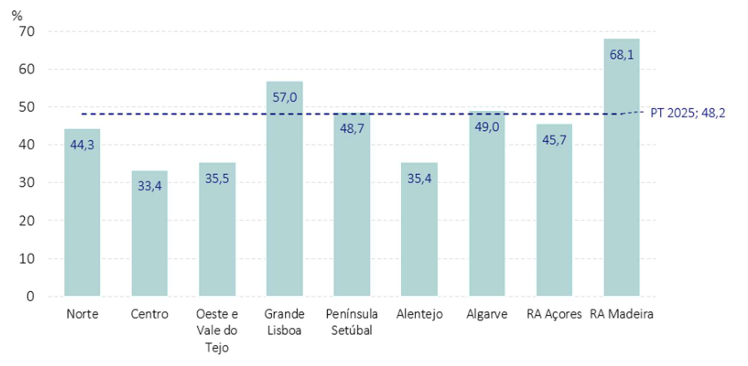
The three largest international source markets accounted for 38.5% of foreign overnight stays, the lowest proportion recorded since 2013. According to the INE, the figures point to a broader and increasingly diversified international visitor base.
In total, 70 Portuguese municipalities recorded more overnight stays from international visitors than from domestic tourists.
Among the 25 municipalities where foreign visitors accounted for more than 75% of overnight stays, 10 were located in Madeira, seven in the Algarve, five in the Azores, two in northern Portugal and one in Greater Lisbon.
Tourism seasonality falls to lowest level since 2013
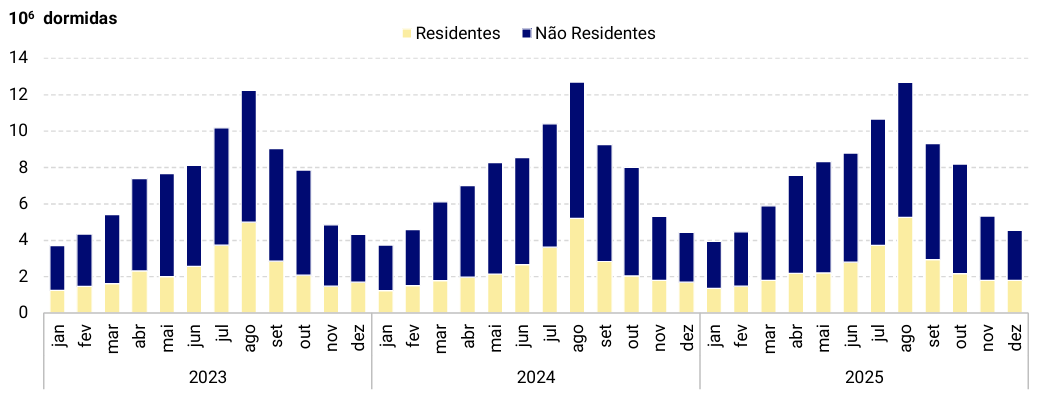
Portugal’s tourism seasonality rate fell to 36.4% in 2025, its lowest level since 2013, indicating that visitor activity was distributed more evenly throughout the year.
Seasonality remained higher among domestic travellers, at 40.4%, than among international visitors, at 34.4%, although the rate declined for both groups.
The reduction supports Portugal’s efforts to promote year-round tourism and attract travellers beyond the traditional summer season. The country has increasingly expanded its tourism offer beyond Lisbon, Porto and the Algarve, promoting cultural, gastronomic, nature and rural tourism across less-visited regions.
Portugal’s reputation for safety, mild climate, historical heritage and established tourism infrastructure has also continued to support demand.
Travel Tomorrow reported in April 2026 that Portugal could benefit from changing international travel patterns as geopolitical instability in the Middle East encouraged some European travellers to favour destinations perceived as safe, politically stable and easily accessible.
A strategic analysis by IPDT – Tourism Intelligence estimated that Portugal could attract around €500 million from the German market alone, potentially bringing approximately 300,000 additional visitors and 2.4 million overnight stays.
The analysis nevertheless warned that further growth would need to be carefully managed, particularly in destinations already facing pressure from overtourism, housing shortages and the expansion of short-term rentals. It recommended directing more visitors towards central Portugal and other less-frequented regions.
Portuguese residents travelled more but spent less per trip
Portuguese residents made 26 million tourism trips in 2025, an increase of 13.7% compared with the previous year. Domestic travel accounted for most of this growth, with trips within Portugal rising by 14% to 22.2 million, while journeys abroad increased by 12.5% to 3.9 million.
Despite travelling more frequently, residents spent less on average during each trip. Average expenditure per traveller fell by 4.2% to €265.10, with spending on domestic trips decreasing by 2.9% to €171.60 and expenditure on trips abroad dropping by 4.8% to €803.20.
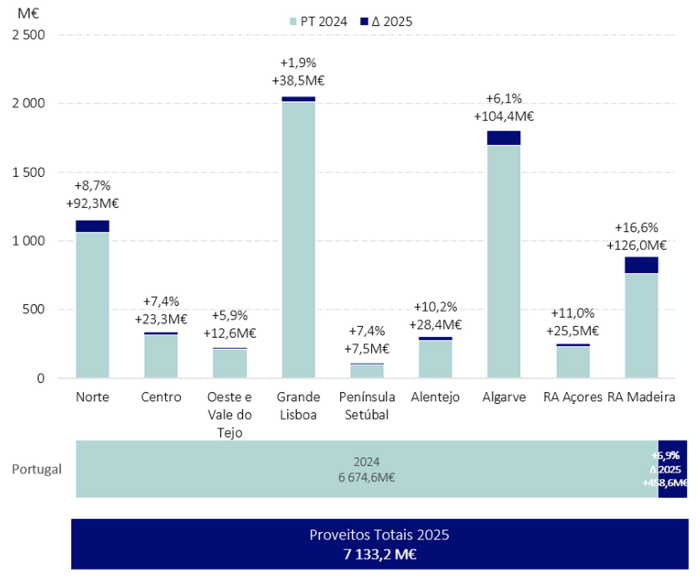
The latest figures indicate that Portugal’s tourism industry continued to expand in 2025, although at a slower pace than in the previous year. At the same time, stronger domestic demand, greater diversification among international markets and the lowest seasonality rate in more than a decade point to a broader and more evenly distributed tourism sector.