


The regional hierarchy has looked settled for years: Thailand owns mass leisure travel, Singapore owns the money, Bali owns the brand. But as the fight for Chinese travellers, India’s rising middle class and Gulf capital intensifies, one name is quietly muscling into the conversation: Malaysia.
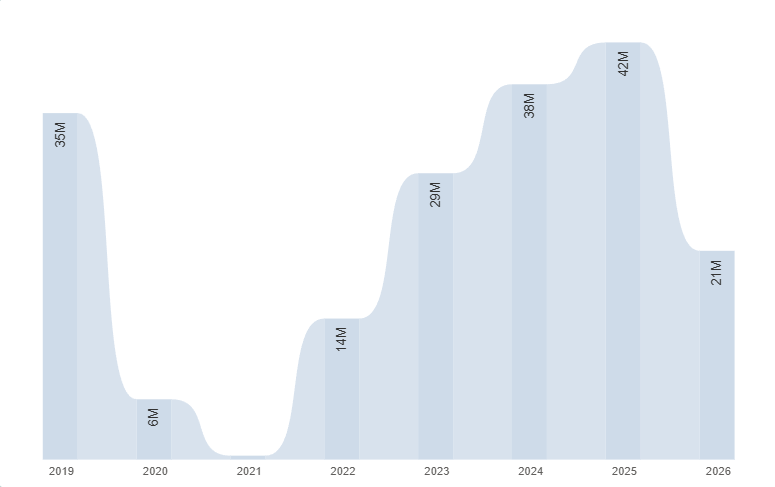
Long overshadowed by its neighbours, the country is now building a tourism machine of its own. The numbers back it up: more than 42 million visitors in 2025, up over 11% year-on-year, with momentum carrying into 2026, including17.5 million arrivals in the first five months alone. The government’s Visit Malaysia 2026 campaign has set its sights higher still, targeting 47 million.
But the real story here isn’t the headline number. Kuala Lumpur is trying to turn tourism into something bigger: a magnet for foreign investment, a soft-power tool, and a strategic bridge linking ASEAN to China, India and the Gulf.
No single star, but a deep bench
Malaysia doesn’t have one marquee destination the way Thailand has its beaches or Bali has its brand, and that may be more of a strength than a weakness. Kuala Lumpur delivers shopping and business travel. Langkawi covers beach resorts. Penang trades on food and heritage. Sabah and Sarawak offer high-value nature and diving tourism. Add medical tourism, Muslim-friendly travel, weddings and golf, and the portfolio looks less like a gap and more like a hedge.
Economies over-reliant on a single market or traveller type are exposed to shocks. Malaysia is spreading its bets.
Beijing comes back online
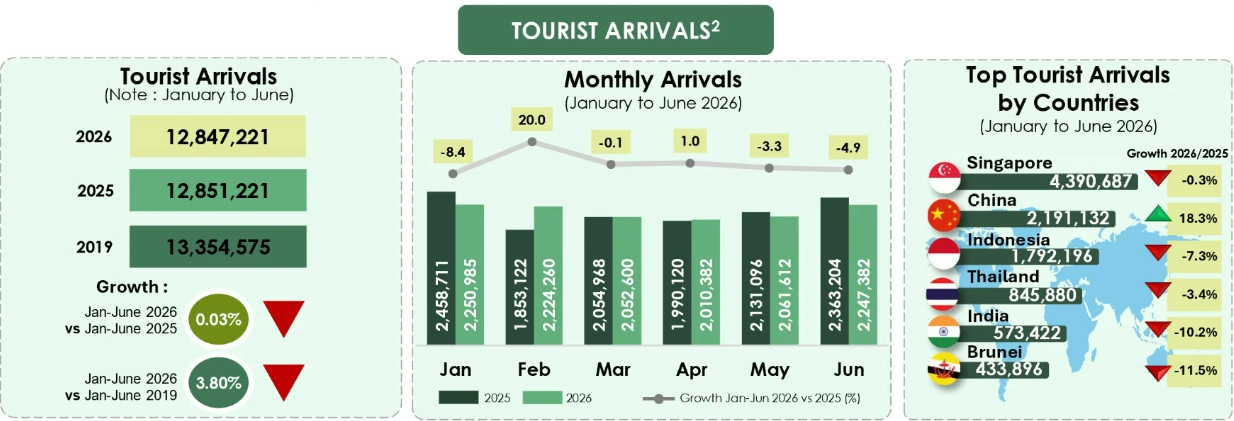
China is driving the first wave of the resurgence. Roughly 4.7 million Chinese tourists visited Malaysia in 2025, a jump of about 25%. That pace held into the first quarter of 2026, with arrivals near 1.4 million.
That’s not an accident. Malaysia has eased visa friction while expanding air links in parallel. As of May 2026, the two countries were connected by roughly 744 weekly flights and nearly 149,000 seats. The logic is simple: visa access generates demand, but demand goes nowhere without airline capacity to match it. Malaysia is building access, connectivity and demand all at once.
India: the long game
If China defined the last decade of Asian outbound travel, India may define the next one. Malaysia drew about 1.5 million Indian visitors in 2025, up 14.6%, with more than 600,000 arriving in the first five months of 2026 alone.
Dubai wants this traveller. So do Thailand, Singapore, Saudi Arabia and much of Europe. Malaysia’s pitch: proximity, competitive pricing, widespread English, familiar food, and infrastructure built for families.
The Singapore effect and the ASEAN hinterland
Geography is the one advantage no marketing budget can replicate. Malaysia logged roughly 21.1 million visitors from Singapore in 2025, up nearly 12%, though much of that reflects same-day “excursionists” rather than overnight tourists, a distinction built into Malaysia’s own visitor methodology. Short-stay traffic still spends on food, shopping and transport, and it matters.
More broadly, ASEAN markets accounted for almost 72% of Malaysia’s inbound traffic in the first five months of 2026. Much like Europe has long leaned on intra-regional travel, Malaysia is cultivating its own version of a captive regional market.
Tourism as an economic backbone
International visitor spending hit roughly RM106.8 billion in 2024, with the sector’s total economic contribution reaching RM291.9 billion, about 15.1% of GDP. Add RM121.3 billion in domestic tourism spending in 2025, and a three-layer demand structure emerges: long-haul international, regional ASEAN, and domestic. That layering makes the sector more resilient to shocks in any single segment.
Have you explored this slice of nature in the heart of the city?
— Malaysia Truly Asia (@TourismMalaysia) February 13, 2025
📍 KL Forest Eco Park, Kuala Lumpur
🕗 8:00 AM – 4:30 PM
💸 Adults: RM10 | Kids & Seniors: RM1#VisitMalaysia2026 #MalaysiaTrulyAsia #CutiCutiMalaysia #SurrealExperiences #KLForestEcoPark #KualaLumpur pic.twitter.com/SCJeaZ2Kq2
The harder challenge now is value per visitor, not visitor count. Medical tourism is the clearest proof point. Roughly 1.85 million health-related visitors in 2025 generated about RM3.35 billion in revenue, turning hospital care into something closer to an export industry. The same economics apply to conferences, luxury travel, weddings and golf.
The capital has the raw ingredients: a major international airport, world-class hotels, strong dining and retail, and connections spanning Asia and the Middle East. What it still lacks is a clear identity. Bangkok became a lifestyle destination. Singapore became a premium urban hub. Dubai turned layovers into an economic model. Kuala Lumpur remains harder to define, a gap that’s also an opportunity if it can convert transit passengers into stopover tourists and win more conferences and premium hospitality business.
The Gulf’s double role
Malaysia is one of Asia’s easiest large destinations for Muslim travellers. Halal food is everywhere, prayer facilities are standard, hotels understand the market, and English is widely spoken. But the bigger prize may not be tourists at all. As Gulf capital moves aggressively into global hospitality and destination development, Malaysia is positioning itself as a target for that investment, not just for Gulf travellers themselves.
The question after 2026
Once the campaign wraps, the real scorecard begins: Did visitors stay longer? Did average spending rise? Did foreign investment follow? Did destinations beyond Kuala Lumpur actually benefit? And did Malaysia manage to shift from competing on affordability to competing on value?
Thailand isn’t going anywhere. Singapore will keep pulling high-spending travellers. Bali will keep its brand. Vietnam is growing fast. But Malaysia has quietly assembled the assets to compete at the top tier: infrastructure, geography, a deep ASEAN catchment, strong access to China and India, cultural fit with the Muslim world, and a sizable domestic base to fall back on.
“Malaysia Truly Asia” was one of global tourism’s most recognisable slogans for years. The next test is harder: converting scale into spending, visitors into investment, and growth into lasting economic leverage. Pull that off, and Malaysia’s rise stops looking like a post-pandemic rebound and starts looking like a redrawn map of Southeast Asian tourism.