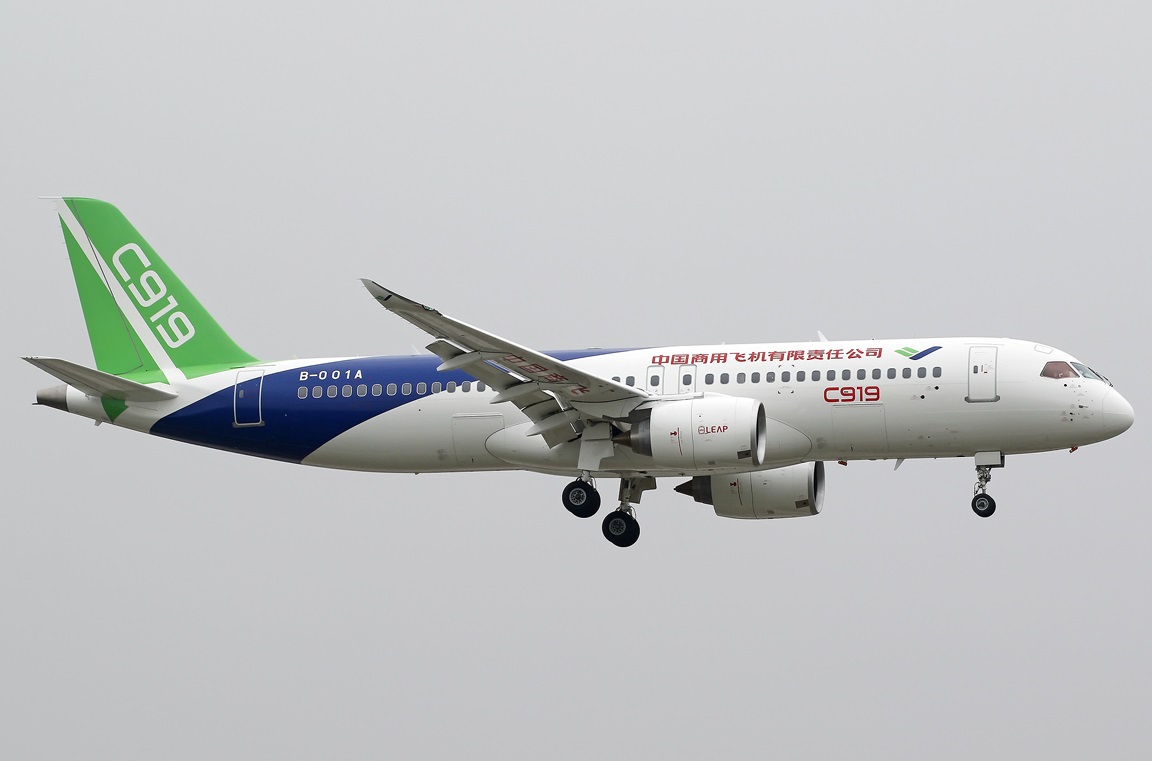



China is looking to reduce its reliance on the European supply chain for its C919, with local suppliers developing alternatives for five components: sealants, rubber, paints, bolts, and cleaning agents.
Zhang Xiaoyan, chief engineer at the Aero Engine Corporation of China (AECC) and the Beijing Institute of Aeronautical Materials, explained that this strategy aims to reduce China’s exposure to foreign supplies at a time when geopolitical tensions and other disruptions have highlighted the vulnerability of companies to shortages and the unreliability of freight transport routes.
Speaking at an aviation forum in Guangzhou, Zhang acknowledged that replacing foreign components and materials would take years. Some Chinese products are already being tested on the C919, while others are still being evaluated by the Commercial Aircraft Corporation of China (COMAC).
The first C919 entered domestic commercial service in May 2023. China aims to use this new aircraft to challenge the Boeing-Airbus duopoly in the commercial aircraft market. By July, COMAC had delivered 42 C919s to Chinese customers.
Another milestone was reached in mid-August when Air China began operating the aircraft between Beijing and Ulaanbaatar in Mongolia, marking the C919’s first scheduled international commercial route. Previously, the aircraft had only operated outside mainland China on services to Hong Kong.
Among the materials of Chinese origin that have already been introduced is HM1176, a polythioether sealant that provides structural sealing and corrosion protection. It has been used in the C919 programme and China’s CJ-1000 engine series since 2025.
The CJ-1000 is still being developed by the AECC and will offer a domestic alternative to the LEAP-1C, which is currently the only engine available for production C919s.
LEAP-1C engines are manufactured by CFM International, a joint venture between US-based GE Aerospace and French company Safran.
At the forum, Zhang also acknowledged that, despite the localisation drive, Western companies continue to supply many of the C919’s advanced components and materials.
“Aeronautical functional materials, including composite materials, can be found throughout the C919. Despite its Chinese identity, most of these advanced materials originate from a handful of well-established US and European producers known for their long-held dominance,” she said.
To accelerate the search for alternatives, China could draw on the technology and manufacturing experience developed for military aviation. According to Zhang, anticorrosive coatings, adhesives, and chemical buffering agents developed for military purposes could be adapted for use in civilian aircraft programmes.
One question this self-sufficiency plan has raised is whether replacing Western components could affect the C919’s bid for certification from the European Union Aviation Safety Agency (EASA), which is considered crucial to the aircraft’s broader international ambitions.
Zhang argued that introducing Chinese alternatives would “not create any adverse impact”, as they would merely provide “an additional safeguard with the option of domestic products”, rather than immediately replacing foreign suppliers.
She mentioned that Chinese-made materials have already gained international recognition, citing Airbus’ approval of Chinese-made protective seals for use on A330 engines operated in China as an example.
Meanwhile, in July, the South China Morning Post reported that European test pilots had carried out an in-flight assessment of the C919 in Shanghai as part of the aircraft’s lengthy European certification process. Flight data and documentation still need to undergo further regulatory examination before certification can be granted.
Zhang sees this as a significant step forward that could have implications far beyond the aircraft itself, and help propel the development of China’s domestic aviation materials industry and supply chain.