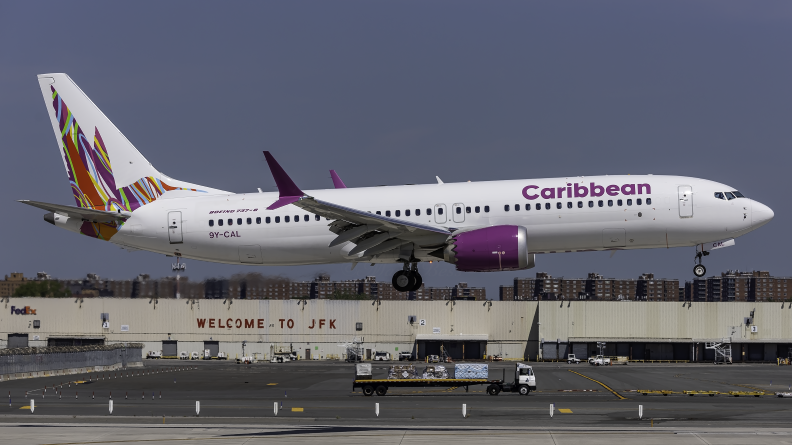



Over the Easter weekend, a pregnant woman went into labour on board an aircraft arriving in New York City, prompting a medical emergency and immediate landing requests from air crew. The baby was born just before the commercial jet touched down, with air stewards and control staff praised for their calm response to a one-in-26-million occurrence.
The incident took place on Caribbean Airlines Flight BW 005 after a four-hour trip from Norman Manley International Airport in Jamaica. The Boeing 747 Max 9 was due to land at John F. Kennedy International (JFK) when the pilot told ground control: “We have a passenger that’s going into labor at this time, and we’d like to continue direct Zetal,” requesting clearance for a navigational fix for low altitude approaches to JFK.
After clarifying what was happening on board, air traffic control asked the flight crew if they would like medical personnel at the gate and confirmed that they had informed the appropriate authorities. Shortly afterwards, a brief but good-humoured exchange took place, indicating that all had gone well and suggesting an airport-inspired name for the newborn.
Air traffic control: Is it out yet?
Pilot: Yes, sir.
Air traffic control: All right. Tell her she’s got to name it Kennedy.
Pilot: Ahh Kennedy. Will do.
Air traffic control: Alright. Have a good day.
@cbsnews A passenger on a Caribbean Airlines flight heading to JFK went into labor on the flight. After securing the situation and calling medical personnel, an air traffic controller told the pilot to suggest naming the baby Kennedy. #atc #jfk #flight #airport ♬ original sound – cbsnews
Many airlines do not allow pregnant women to fly after 36-37 weeks (or 32weeks for twins/multiples) due to the risk of premature labour. A doctor’s letter can be required, and travel is usually restricted when the mother suffers from complications such as high blood pressure or anaemia.
This means that in-flight births are rare. Experts suggest that a baby is born in the air about once for every 26 million passengers, or once a year. Those statistics tie in with the recent birth, just over a year ago in February 2025, of a baby on board a Brussels Airlines flight from Africa to the Belgian capital, but—unusually, just two months later in May— another baby was delivered on a Ryanair flight from Belgium to Spain.
A baby born in the skies typically takes the nationality of its parents under the legal tenet of jus sanguinis, but in cases where statelessness is a risk, a child can take the nationality of the country where the aircraft is registered, or if less than 12 nautical miles from the United States, they could become a US citizen. Cases of citizenship of persons born on planes in airspace above the United States land territory or internal waters may be decided by passport specialists at domestic passport agencies or by consular officers at posts abroad in accordance with relevant laws.