


Global warming driven by carbon emissions has made droughts and wildfire weather at least 20 times more likely in Spain, and doubled the risk in France, according to a new analysis by the World Weather Attribution (WWA) consortium.
Previous WWA studies show that the intense heatwaves experienced across the region in recent years would not have been possible without the greenhouse effect of carbon pollution.
Ironically, the conditions have been worsened by the wet European winters and springs that accompany global warming and promote the growth of vegetation that later dries out during heatwaves to become additional fire fodder.
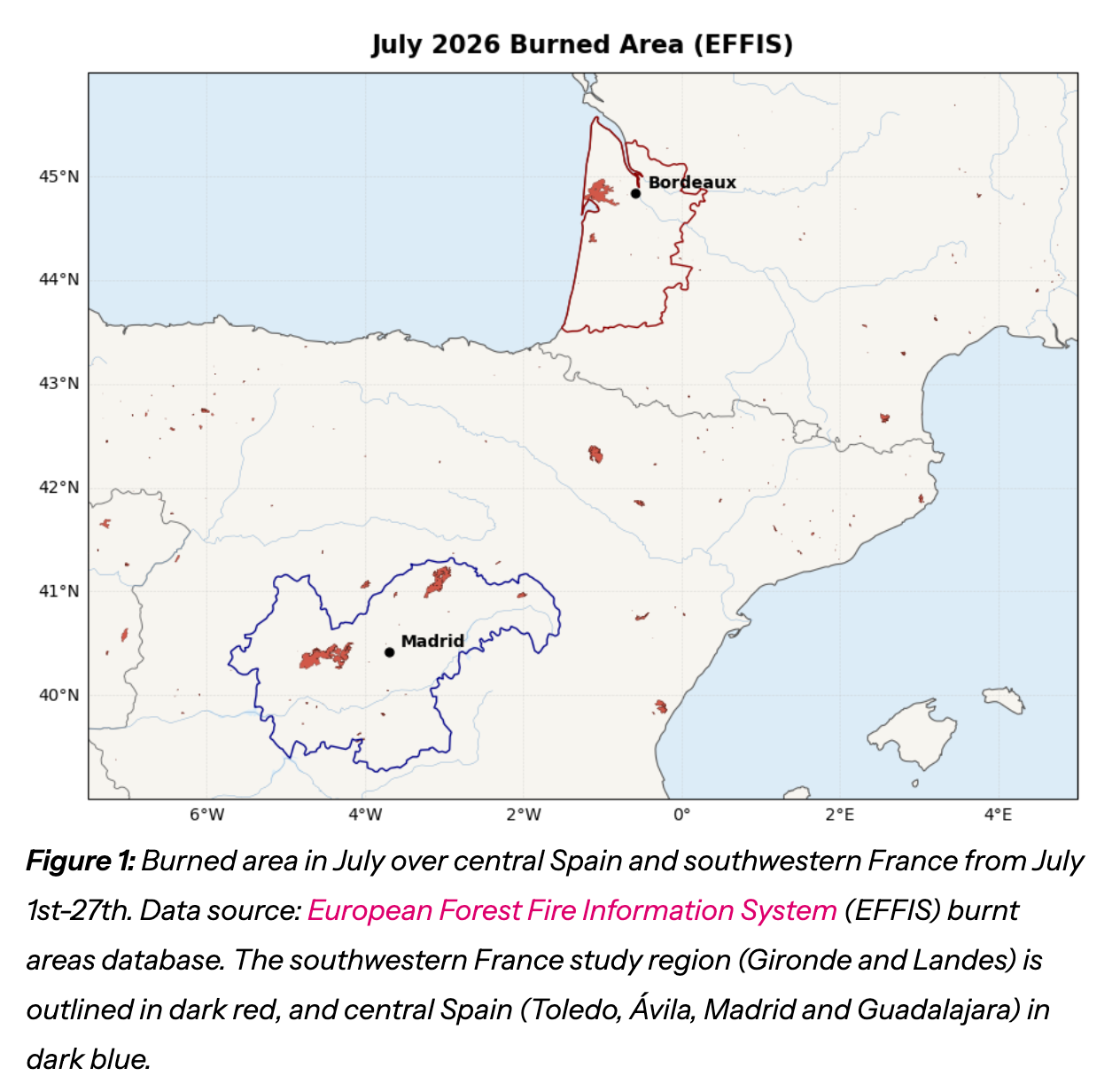
The fire in the Gironde region of France has so far burned approximately 40,000 hectares, the second largest area of land devastated by a single wildfire in France since the Second World War, the WWA points out.
By the end of July, data from the European Commission Joint Research Centre indicated 434, 976 hectares had burnt since the start of the year, far exceeding the record 346,836 hectares burnt in 2025. By 30 July, 1407 fires had been detected, more than double the long-term average of 632 fires.
The situation has driven hundreds of thousands of people from their homes in mass evacuations. Julie Arrighi, programmes director at Red Cross Red Crescent Climate Centre, said: “What we are seeing now in Spain and France goes well beyond what we would expect from past events.”
Dr Clair Barnes, an Imperial College London researcher and WWA team member, said the findings were “extremely scary,” especially with the recent fires taking place “early in the season” with “another heatwave looming.”
As well as the obvious immediate risk of death and injury to populations, the fires have already emitted 17.98 million tonnes (Mt) of CO2 and particulate pollution, further contributing to the climate-driven fire hazard and the health impacts of the phenomenon.
“The smoke increased particulate peak levels up to 20 times above what is considered ‘fair air quality’, and extremely poor air quality was felt up to 400 km away from the fires.” Dr Augustin Colette, at the French National Institute for Industrial Environment and Risks, said.
An estimated 20,000 excess deaths across Europe were caused by the June 2026 heatwave, according to calculations by Assistant Professor Christopher Callahan from the O’Neill School of Public and Environmental Affairs, and about 1.5 million people a year are estimated to have their lives shortened by wildfire smoke.