

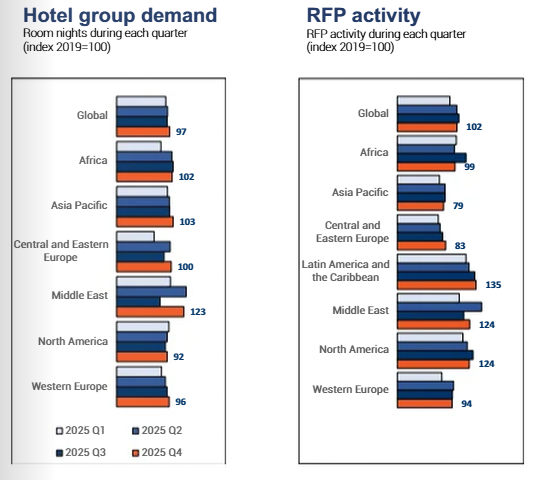
Business travel worldwide is experiencing “steady progress,” according to a new market report from the Events Industry Council. The Global Events Barometer for the last quarter of 2025 notes that demand remains strong in the sector while acknowledging new headwinds in 2026.
Measures included in the barometer are hotel group room nights and event planner requests (RFPs). The room nights index “continues to approach its 2019 level” reaching “97% of 2019 levels and indicating an increase relative to Q3” the report says. The RFP index is also up on 2019 levels, measuring 102%, while global room rates in RFP responses in for the quarter averaged 139% of 2019 levels, which the report interprets as a “recovery in hotel pricing for business events.”
At a country level, Oxford Economics data shows hotel group room nights are well up on 2019 in India (151), the Netherlands (120), and Canada (102), while they remain under the global average and that benchmark in the United States (93), Germany (84), and the United Kingdom (83).
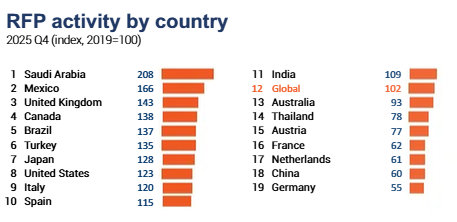
Meanwhile, and bearing in mind the data is for the last quarter in 2025, before the Israeli-US attacks on Iran and the current Middle East oil crisis, planners’ RFP activity was through the roof in Saudi Arabia (208), Mexico (166), UK (143), Canada (138), and Brazil (137). It was also up on 2019 levels in Türkiye, Japan, the US, Italy, Spain, and India. The position of Saudi Arabia and Türkiye could well shift as the latest figures emerge, with one estimate putting travel and tourism losses in the region at €600 million a day.
Regionally, while the US’s dominance in terms of headquartered global businesses gives North America the largest revenue share globally, it looks set to lag the rest of the world for growth in travel spending over the next two years. Central and Eastern Europe is currently doing well, but could be outperformed by Asia Pacific and Latin America by the end of 2027.
Globally, business travel was worth USD $689.7 billion in 2021 and is predicted to hit a value of USD $2.1 trillion by 2031. The Global Business Travel Association (GBTA) has estimated that worldwide spending could reach USD $1.8 trillion by the end of 2026. But the events industry barometer notes that “the operating environment has shifted,” and explains: “Last year closed with solid momentum and sustained interest in in-person gatherings, but the early months of 2026 have introduced new disruptions and heightened uncertainty.”
That means the picture is currently a mixed one. While planners are still looking to book events 12 months away, and business travel spending is predicted to increase 10.5% over the next two years, outgrowing leisure travel, the appetite for nearer-term corporate reservations has dropped. What’s more, “pricing remains elevated, with global room rates well above 2019 levels,” which the report says reflects “both continued demand and ongoing structural cost pressures across the hospitality and travel ecosystem.” In addition, there could be “increased volatility” ahead, “related to the war in Iran and its global impact on fuel supply, travel patterns, and economic confidence.”
Geopolitical tensions, AI/tech downturns, and trade wars are identified by respondents as the top risks in the Q1 2026 Global Risk Survey. Urgent concerns for the sector include an “immediate focus on human safety” in the Middle East, but also awareness of the region’s status as “a major global transit hub, with its airports accounting for around 14% of global international transit activity.” The barometer’s authors also note the likelihood of broader knock-on impacts, on consumer sentiment, energy prices, and the financial markets, pointing out that “turbulence may delay business investment decisions.”