


Connectivity in space is scaling up again, with the announcement of Amazon’s $11.6 billion purchase of satellite operator Globalstar—an acquisition set to make the Jeff Bezos-owned firm a major supplier to Apple in what is being seen as a significant addition to Amazon’s own Leo satellite network.
Offering shareholders $90 per share in cash, or the equivalent value in its stock, Amazon described the Globalstar takeover as part of its “long-term vision for space-based connectivity” and said a “next generation” satellite system could follow by 2028. Despite Bezos’ well-documented ambitions in the space race, his Leo network is seriously behind competitors, with only 200 satellites at present playing catch-up with Elon Musk’s Starlink (which boasts more than 10,000 satellites in low Earth orbit, serving over 10 million customers already).
Amazon is acquiring @Globalstar to support our long-term vision for Amazon Leo.
— Amazon Leo (@Amazonleo) April 14, 2026
The agreement will allow us to build a next-generation direct-to-device constellation that connects to Leo first- and second-generation systems, forming a unified network to connect hundreds of… pic.twitter.com/uzba7V9RSa
Leo already boasts a contract with US airline Delta, a contract recently hailed by Andy Jassy, President and CEO of Amazon, as “a great example of the impact and scale” the company’s technology could achieve, adding: “People increasingly want to stay connected wherever they are in the world, and Leo’s speed and reliability is going to have a big impact for businesses, governments, and consumers. It’s going to make the in-flight experience so much better, and it’s going to change what’s possible while traveling.”
Leo is slated to grow by another 3,200 satellites in Earth’s low orbit by 2029, Amazon has promised, but approximately half of those need to be deployed before July to meet regulatory requirements.
Amazon Leo + @Apple
— Amazon Leo (@Amazonleo) April 14, 2026
In parallel, we have also signed a long-term agreement with Apple for Amazon Leo to power satellite services for supported iPhone and Apple Watch models, allowing users to text emergency services, message friends and family, request roadside assistance, and… pic.twitter.com/UujASAfYgT
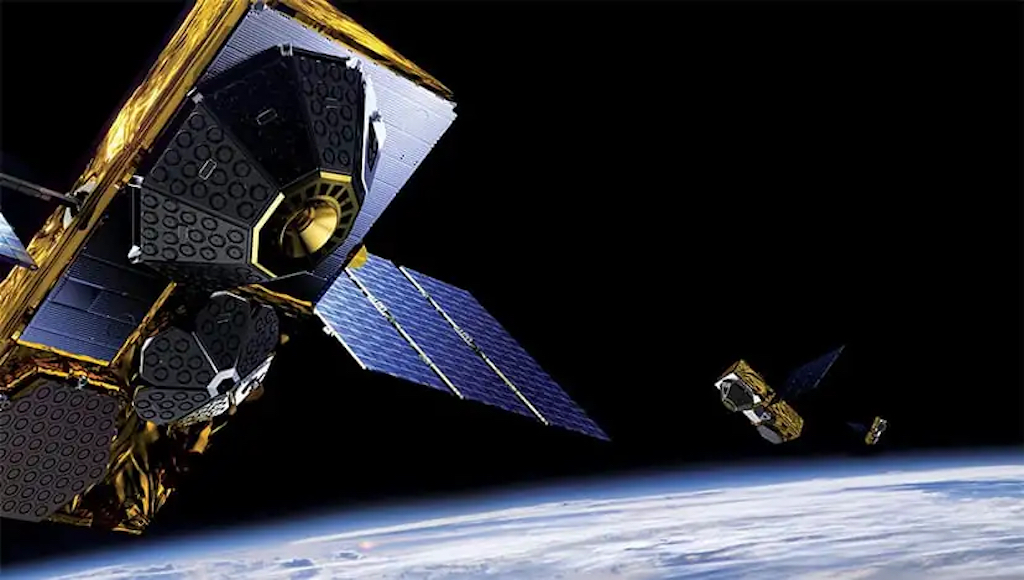
Globalstar will add only around 50 satellites into the mix but its appeal to Amazon lies in worldwide infrastructure, including in California, Georgia, and Louisiana in the United States, as well as in Dublin, Rio de Janeiro, and Toulouse. It also serves Apple Watch and iPhone with emergency SOS call functionality—a role that will continue under the Amazon deal, made possible by Globalstar’s existing low-data Direct-to-Device (D2D) technology that allows devices to connect in limited cellular coverage zones without ground-based cellular towers. Acquiring that D2D capability is being seen as a coup for Amazon by commentators.
Leo is not Bezos’ only satellite venture however. Blue Origin, his rocket company, is aiming to launch 5,400 satellites by 2027, as part of its new TeraWave communications network, designed to capture the business, data centre, and governmental market with download speeds of up to six terabits that put rivals to shame.
Meanwhile, competition regulators such as the US Federal Communications Commission Chair Brendan Carr have signalled an “open-minded” positive stance on the merger, which is being viewed as a boost to innovation in the field of satellite communications. The markets also responded well: Globalstar’s share value rose more than 10%, on top of a 6% gain over the two weeks proceeding the deal. Amazon’s stock also went up, by 3%.