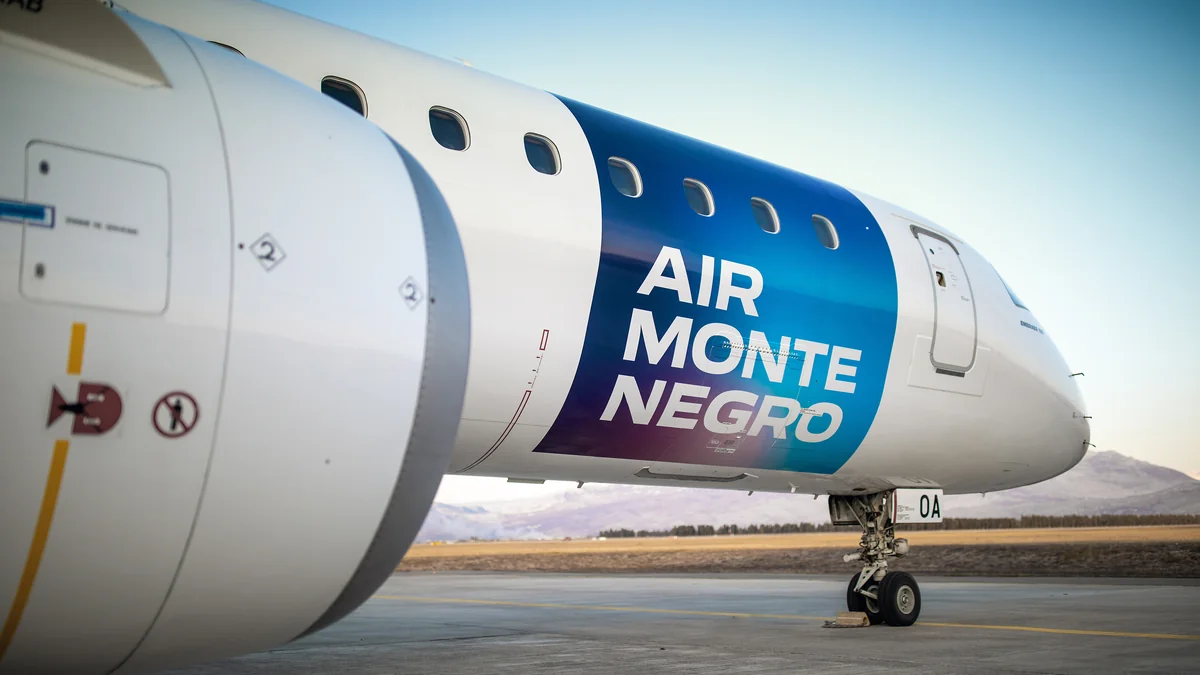



Air Montenegro is launching year-round, thrice-weekly scheduled flights between Podgorica and Brussels Airport from the end of November 2026, in a wider push to improve connectivity between the Balkan nation and its European neighbours, as progress towards Montenegro’s EU membership continues.
From 30 November, the national flag carrier will start operating flights both ways between the two capital cities on Monday and Wednesday mornings, and Friday afternoons, offering at least 110 seats.
The Brussels debut comes hot on the heels of a planned launch of flights to the Croatian capital, Zagreb, on 26 November 2026. What’s more, a connection to Frankfurt, Germany, will follow on 4 December, as well as Paris Charles de Gaulle Airport and Podgorica’s trans-Adriatic neighbour, Bari, in Italy, on 17 December.
Twenty years after declaring its independence from Serbia, putting an end to the ersatz rump state of Yugoslavia, Montenegro (and Albania) are heading towards European Union integration. The connectivity surge represents an important step on Montenegro’s journey. An EU delegation led by Austrian MEP Sophia Kircher visited the two countries from 26 to 28 October, with eyes on mobility and transport infrastructure. Kircher said at the time: “Our mission comes at a pivotal moment,” and described transportation as the “key to bringing the Western Balkans closer to the European Union; better connections and more integrated transport systems are essential to strengthening our partnerships with the region.”
With that in mind, Air Montenegro, which bagged all five contracts at a value of around €4.79 million excluding VAT, is being subsidised under a Montenegrin Public Service Obligation (PSO). The scheme allows airlines to be compensated for running connections that are considered vital to local economic and social development but that may be insufficiently profitable without public financial support.
The question mark over profitability may come as a surprise to some observers, given the growing popularity of Montenegro. As travel trends veer towards smaller, lesser-known destinations, and premium personalised experiences, the country’s 300 km of Adriatic coastline and islands, stunning UNESCO-listed mountain and lake scenery, and association with exclusive luxury, are a major draw. The visitor economy represents around 30% of national GDP, and 50% or more of exports, according to Tourism Minister Simonida Kordić.
🇲🇪 Montenegro welcomed a record 2.73 million international visitors in 2025 and attracted EUR 4.85 billion in FDI over 2021–2025. The Tourism Doing Business guide, investing in Montenegro reflects on where the opportunities are. Discover more: https://t.co/7XPa6AK7bN https://t.co/Yzo3amKYrY
— UN Tourism Academy (@UNWTOAcademy) October 15, 2026
With such a high dependence on tourism, the country’s stakeholders will welcome recent comments to Travel Tomorrow by European Travel Commission (ETC) director, Eduardo Santander. Speaking on the outlet’s podcast and asked to recommend “one European destination that deserves more attention,” Santander highlighted that Baltic economies are “still suffering” and said: “We just came from Montenegro and they will probably be the next EU member, very soon, they speak about 2027/2028, so I recommend people visit Montenegro.”
The upcoming new flight connections to five major European cities will make following that advice even easier to do. Further, as an as-yet non-EU member, Montenegro has not been implementing the EU’s much-criticised new Entry/Exit System (EES), making it potentially less hassle to visit for third-country arrivals than its EU rivals.