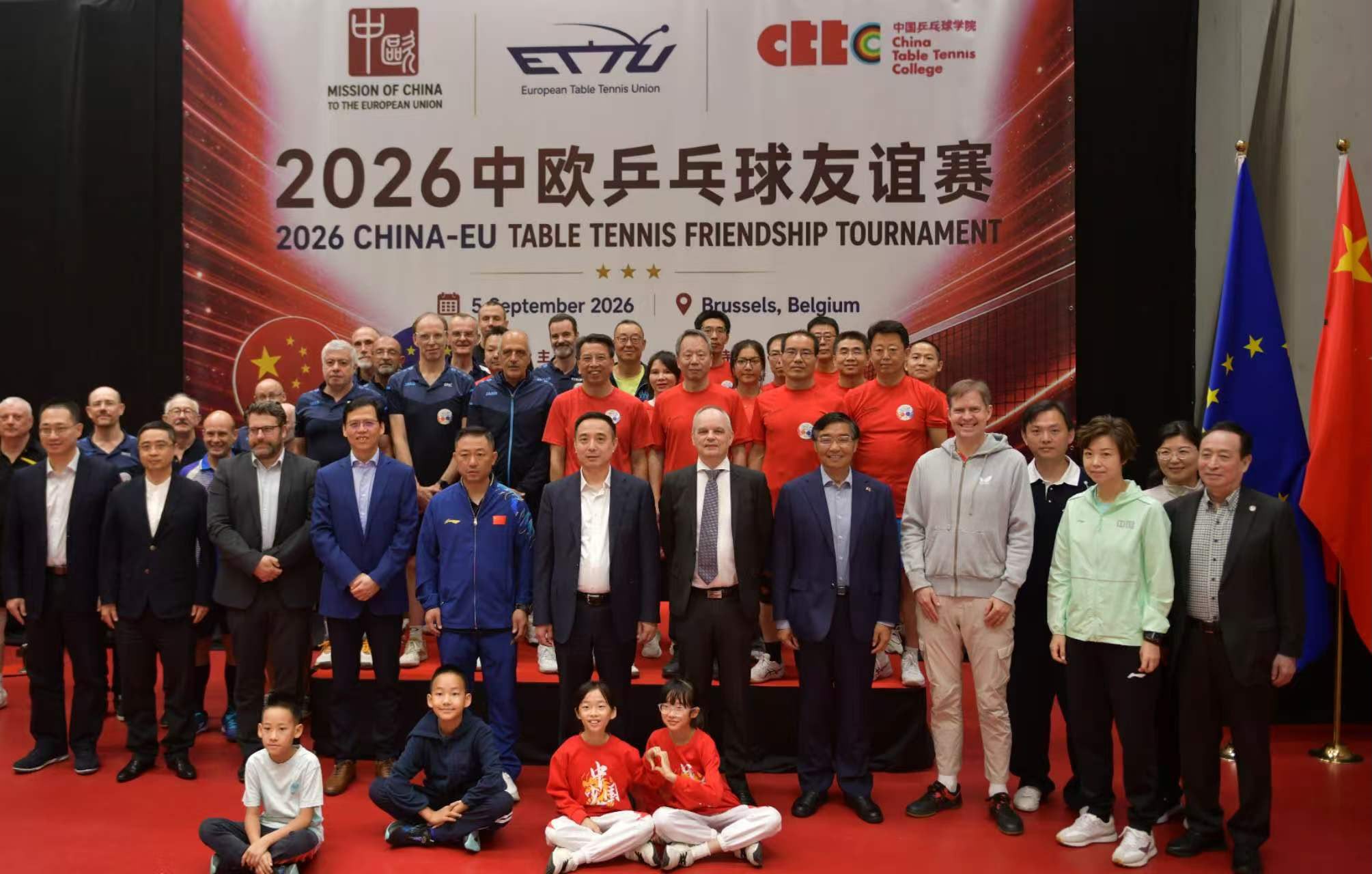


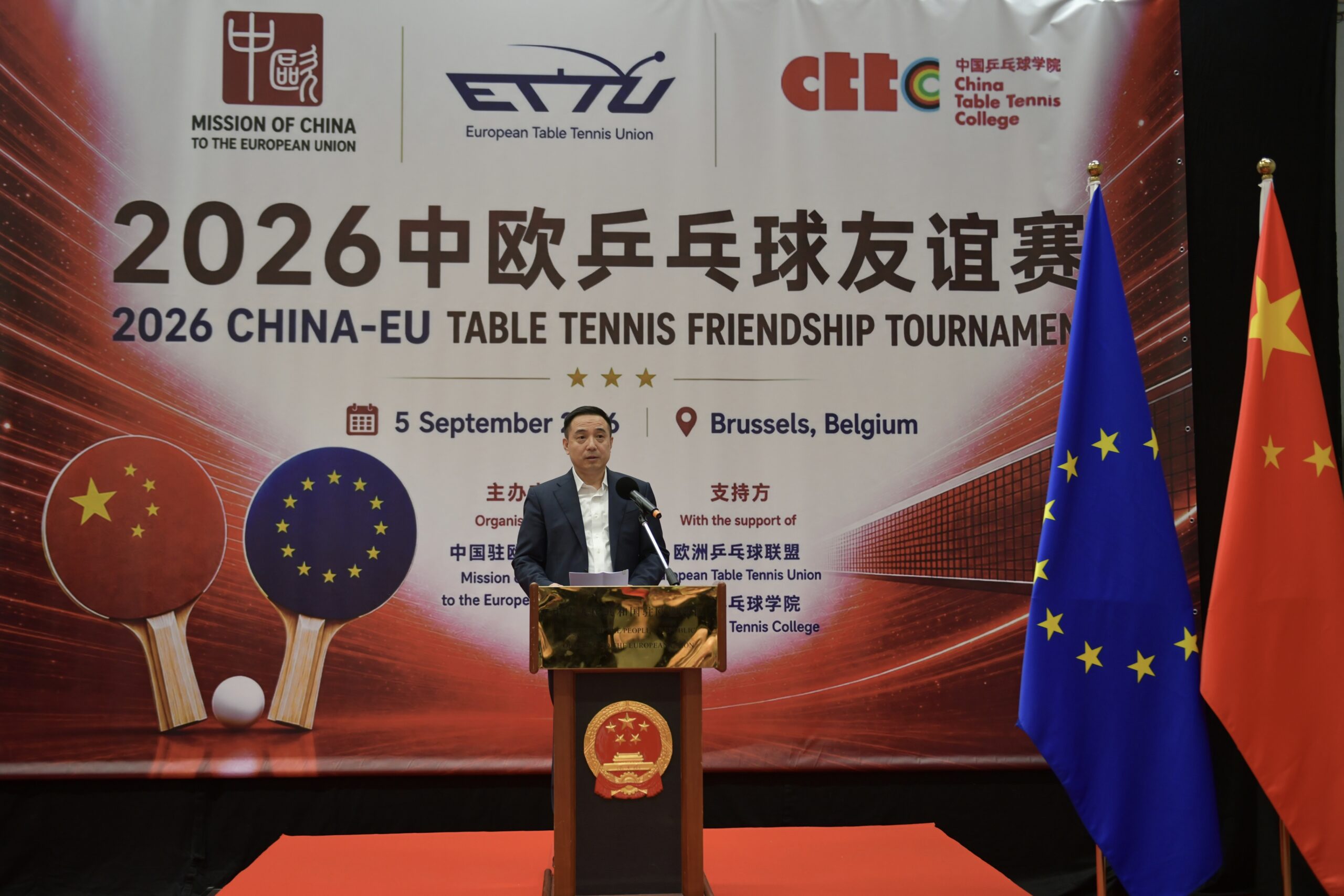
More than 100 participants from China and the European institutions came together in Brussels for the China-EU Table Tennis Friendship Tournament, an initiative aimed at strengthening people-to-people exchanges and relations between China and Europe through sport.
Held on 5 September 2026, the tournament was jointly organised by the Mission of China to the European Union and Euroclub, with support from the European Table Tennis Union (ETTU) and the China Table Tennis College.
Cai Run, Ambassador and Head of the Mission of China to the EU, and Didier Leroy, Vice President of the European Table Tennis Union, attended the opening ceremony, while Fei Shengchao, Chinese Ambassador to Belgium, performed the ceremonial opening serve.
The event also brought two prominent figures from Chinese table tennis to Brussels. Yan Sen, Vice President of the China Table Tennis College and former world champion, and Zhang Yining, former world champion and coach, provided guidance to participants ahead of the competition.
More than 100 table tennis enthusiasts took part, representing China, the European institutions and the European Parliament.
Sport as a bridge
Addressing participants, Ambassador Cai highlighted the role that sporting and cultural exchanges can play in strengthening mutual understanding at a time of geopolitical and economic uncertainty.
He said China-EU relations have increasing strategic and global significance, arguing that the two sides should maintain their partnership, continue cooperation and address economic and trade differences through dialogue and consultation.
According to Cai, stronger exchanges in table tennis can contribute to greater mutual understanding and friendship between China and the EU and support the development of bilateral relations.
Leroy similarly emphasised the potential of so-called “ping-pong diplomacy”, expressing hope that sporting exchanges could help China and Europe move beyond their differences, strengthen dialogue and bring people closer together.
Table tennis has a long association with diplomacy. The term “ping-pong diplomacy” became internationally recognised in the early 1970s, when exchanges between American and Chinese table tennis players helped pave the way for a thaw in relations between China and the United States.
Chinese and European players compete together
Rather than placing Chinese and European participants on opposing sides, the Brussels tournament adopted a team competition format based on mixed Chinese-European teams.
Players competed together in both singles and doubles, with Chinese and European participants sharing teams throughout the tournament.
The format placed cooperation at the centre of the competition, with organisers describing a warm and friendly atmosphere as players competed alongside one another and spectators followed the matches.
The initiative comes as China and the European Union continue to navigate a complex relationship encompassing trade, investment, climate action, international affairs and growing people-to-people exchanges. Against that backdrop, the Brussels tournament sought to use one of China’s most internationally recognised sports as an informal platform for dialogue and connection.