


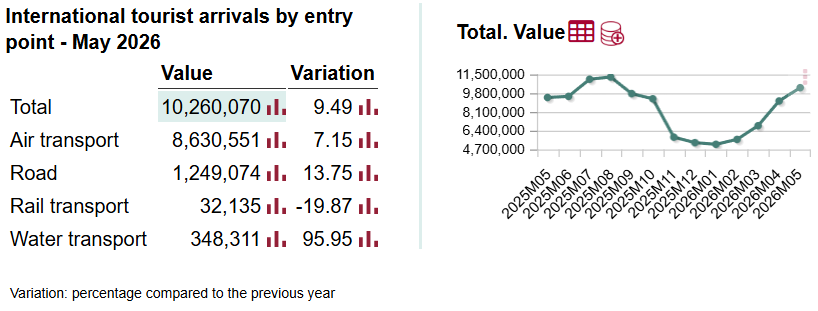
Spain is on track to smash travel and tourism records again in 2026, with 43 million visitors forecast during the summer months alone. The industry is a huge money-earner for the Spanish economy, representing around 13% of GDP, according to the National Statistics Institute, or up to 16% of the economy if World Travel & Tourism figures including indirect revenues are taken into account. This summer’s visitors are predicted to spend €64 billion in just the three months from June to September.
Yet, the National Statistics Institute has also published data showing that, after playing host to so many international holidaymakers, nearly a third of the Spanish population could not afford to take a week’s holiday of their own. The Institute says 32.2% of Spaniards did not take even a week’s vacation in 2025, and 27% have no holiday plans for summer 2026.
While rising fuel costs and air tickets due to Middle East tensions have affected the travel marketplace, the phenomenon taking place in Spain is not new. It’s an issue that Travel Tomorrow has reported before, with problems around the cost of living and housing manifesting themselves across Spanish territories in the form of anti-tourism protests and official crackdowns on short-term rental sites such as Airbnb that are blamed for taking accommodation off the mainstream market.
Speaking to Euronews, Ileana Izverniceanu, Communications Director at the Spanish Organisation of Consumers and Users (OCU), agrees that the cost of travel alone is not the only problem. “The fact that one in three Spaniards cannot go on holiday this summer is not an isolated event, but the reflection of an economic reality that OCU has been observing for years,” she pointed out.
The OCU’s Family Solvency Index remains below pre-COVID times and shows, according to Izverniceanu, that “On paper, the economy is improving, but many families still do not feel that recovery in their day-to-day lives.”
The cost of a family holiday starts at around €665, and that’s for a domestic trip “back home.” Beach holidays are pricier, averaging €1,555, and foreign vacations entail an outlay of €2,327 euros, sums that for many are “simply unaffordable,” the OCU says.
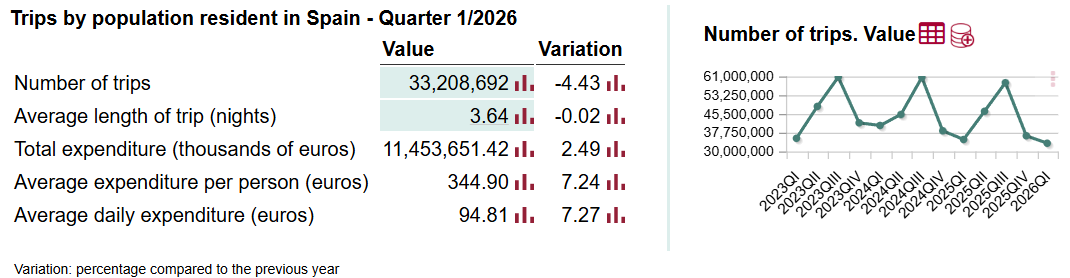
As well as creating tensions between residents and visitors, the issue is affecting how consumers spend on travel, the OCU highlights, with would-be holidaymakers choosing to go away for shorter periods, stay closer to home, and cut back their leisure budget.
With spending by foreign visitors anticipated by the Ministry of Industry and Tourism to go up by 10% compared to 2026, the OCU is calling for measures to ease the cost of living, particularly on energy, food, and housing, for Spanish citizens, so they are not left behind.