Night trains are gaining more attention across Europe as more travellers look for ways to move between countries without flying. A recent survey of 11,000 people commissioned by rail manufacturer Hitachi Rail shows that almost half of respondents want to travel more by train and less by plane in the coming years. This interest is linked to sustainability concerns and the wish for more comfortable travel options across long distances. Night trains are seen as especially attractive because they allow passengers to cover long routes while sleeping and save time during the day.
At the same time, the actual availability of night trains does not always match this growing demand. A new 2026 interactive map created by Back-on-Track.eu shows how the network looks today across Europe. The map includes around 205 regular sleeper train connections and is designed as a clear overview of all existing routes. It also includes practical information and booking tips through an accompanying database. This makes it one of the most complete tools for understanding how night trains currently operate in Europe.
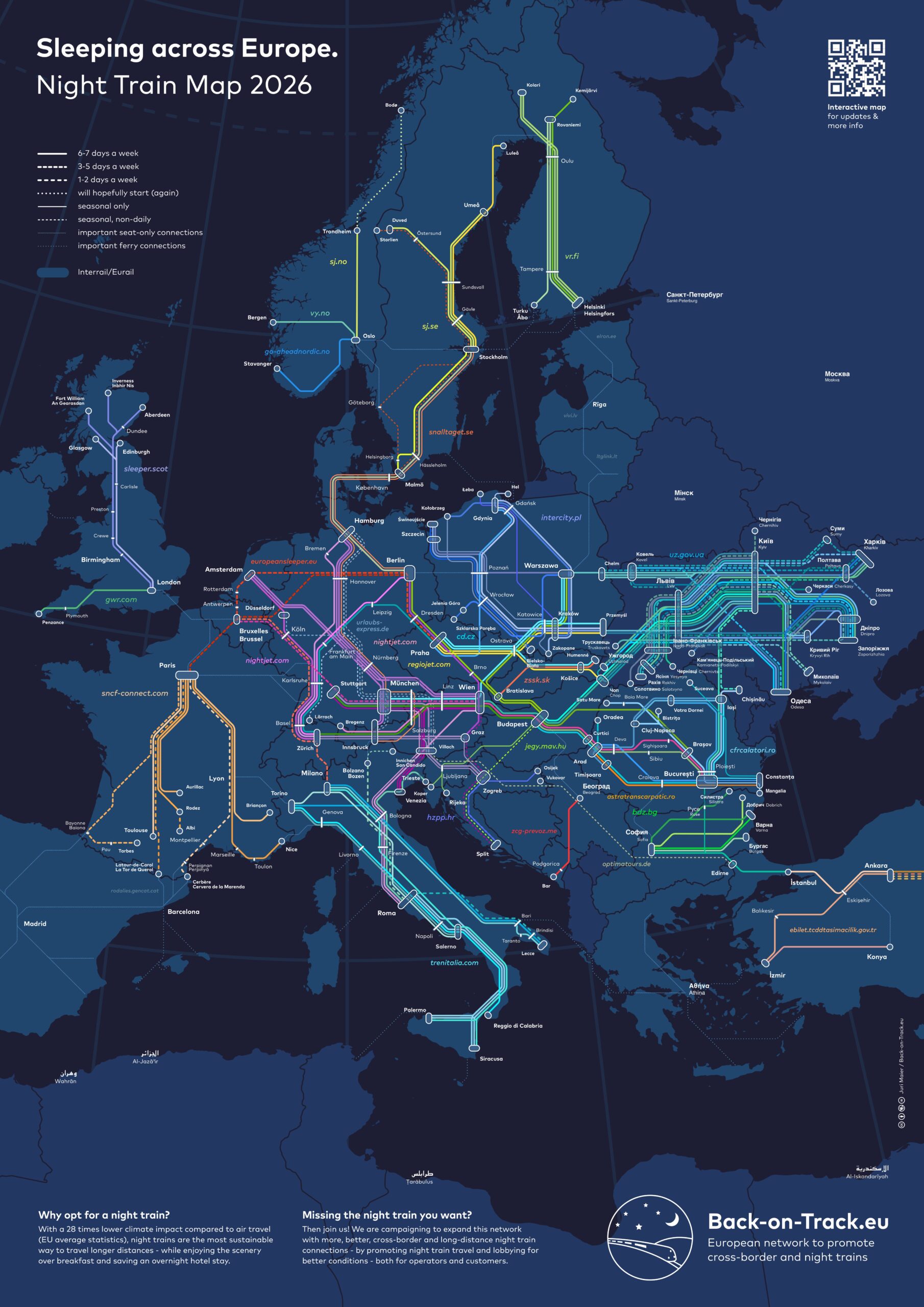
The 2026 edition of the map highlights some important changes compared to previous years. Five new connections have been added to the network. These include the European Sleeper service between Paris and Berlin and a planned Brussels to Milan connection. New routes operated by PKP also link Poland with Prague and Munich, adding more central European options. In the Nordic region, Helsinki to Kolari is also included among the updated services. These additions show that some parts of Europe are still expanding their night train offering.
However, the map also shows that not all changes are positive for passengers. Around ten lines have disappeared from the network, including several ÖBB Nightjet services. One of the most notable losses is the long Stockholm to Narvik connection, which was one of the longest night train routes in Europe at 1,456 kilometres. Other routes in countries such as Bulgaria, Romania, and Croatia have also been removed or reduced. In some cases, services have been shortened, such as the Bratislava to Split route, which now starts in Vienna.
This mix of new routes and disappearing connections reflects a wider problem in European rail travel. Demand for night trains is clearly increasing, but the system is not always able to support it. At the same time, short-haul flights continue to grow in frequency, even as many travellers say they would prefer rail alternatives. This creates a gap between what passengers want and what transport systems are currently able to provide. Night trains often become the clearest example of this imbalance, where interest is high but services are limited.
One of the main reasons for these challenges is the lack of investment in rolling stock and rail infrastructure. According to Juri Maier from Back-on-Track, who helped design the map, this shortage is one of the biggest obstacles for expanding night trains in Europe. He explains that demand is present and that air travel is no longer as dominant on some routes. He also notes that modern sleeper train designs could carry up to 750 passengers, which would make many routes more economically viable. However, without significant investment, these ideas cannot be fully developed. Track maintenance works across Europe also create disruptions that make scheduling more difficult for long-distance overnight services.
Despite these challenges, there are expectations that night trains could become more connected in the future. Some infrastructure improvements are planned for the next decade, with potential benefits for cross-border rail travel by around 2032. One example is the planned Brussels to Milan route, which could fill an important gap in the current network. However, experts also point out that this route may face operational challenges, especially as it passes through Switzerland. Even so, there is interest in seeing how such services develop and whether they can be successfully introduced. The 2026 map, therefore, reflects a system in transition, where expansion and reduction happen at the same time across different parts of Europe.