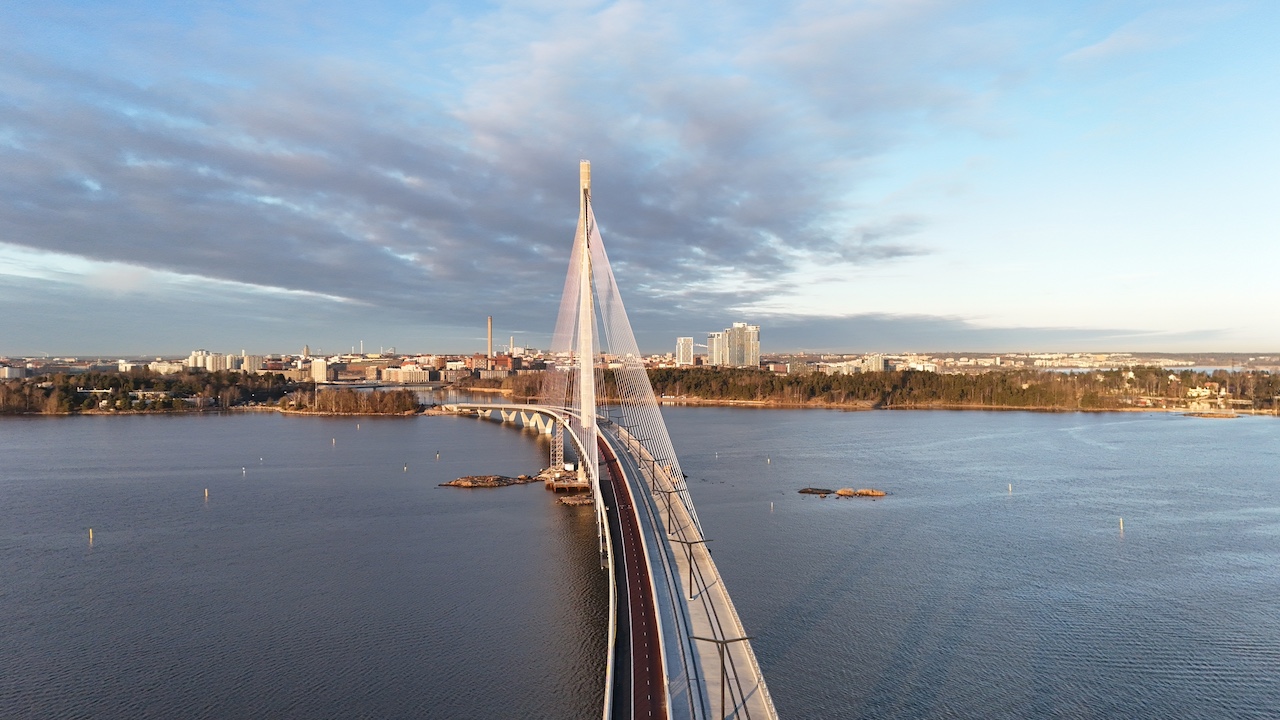



One of the longest pedestrian bridges in the world has opened in Finland, welcoming 50,000 visitors over its inaugural weekend and establishing what Helsinki Partners have called “a distinctive new identity” for the Finnish capital’s skyline.
The Kruunuvuorensilta bridge not only stands as Finland’s longest at 1,191 metres across, but also marks a new record for the country’s tallest at 135 metres, beating the highest residential building by one metre. It connects the waterfront residential neighbourhood with the island of Korkeasaari, the district of Laajasalo, and central Helsinki.
City mayor Daniel Sazonov said: “Kruunuvuorensilta bridge is the new, unique and exciting landmark for Helsinki. A sight that will draw visitors from near and far. The new bridge reshapes how we look at Helsinki. It attaches the areas of Kruunuvuorenranta and Laajasalo in a completely new way to the larger central city area. The bridge reflects our commitment to sustainable solutions and embraces Helsinki’s unique maritime setting.”
Started in 2021 and coming in at a cost of around €326 million, according to official figures, the bridge now cuts the distance between neighbouring city districts by nearly six kilometres, and by 2030, it is predicted to be serving around 23,000 tram trips and 3,750 cycling trips per day. Work on a light rail system is ongoing.
@markhactar #helsinki #finland #suomi #kruunusilta #urban ♬ Eshgam (Love) – Khrystalist
Helsinki is implementing a long-term vision to prioritise public transport, walking and cycling in urban mobility. The majority of journeys in Helsinki are made using sustainable modes: around 41% on foot, 25% by public transport and 11% by bike, while only about 20% are made by car.
With a design life of 200 years, Kruunuvuorensilta aims to boost tram and active mobility for future generations. The bridge’s sustainability credentials can also be seen in a carbon footprint of approximately 129,000 tCO₂e, of which 76% originates from construction and 24% from operation and maintenance over a 50-year period. Emissions have been reduced through the use of low-emission materials and renewable energy sources.
The structure also features weather-proofing approaches suited to Helsinki’s cold, coastal location, with stay cables that the wind keeps in constant, slight motion, preventing ice formation. Combined with a special coating, it means the bridges can shiver away flakes of ice as they form. Like the best of Finnish design, in a country known for the happiness of its citizens, it combines practicality with a sense of fun and joy, with different colours of LED lighting up at different times of day.
For fans of Finnish architecture, one of the oldest indoor swimming pools in the Nordics re-opened in the capital earlier this year, combining Classicism and Art Deco and offering not just a place to do laps, but a heritage taste of Finland’s sauna culture.