


Qantas’s Project Sunrise has reached a major milestone with a 19-hour, non-stop test flight from Toulouse, France, to Melbourne, Australia, aboard a specially designed aircraft for ultra-long-haul travel.
The aircraft flew from Airbus’s manufacturing facility in Toulouse to Melbourne in just under 20 hours and is the first of 12 Airbus A350-1000ULRs that Qantas has ordered for the programme. Although this factory test and delivery flight took place between France and Australia, the first commercial service under Project Sunrise will connect Sydney and London in October 2027, followed by New York.
The flight attracted enormous interest from aviation enthusiasts, with more than 67,000 people tracking it live on Flightradar24. By the time the aircraft landed, this figure had increased to approximately 75,000 people, making it the second most-followed flight on the platform after the flight carrying Queen Elizabeth II’s coffin from Edinburgh to London in 2022.
The aircraft left Toulouse at 7:33 a.m. local time on Thursday and touched down in Melbourne at 10:46 a.m. local time. Qantas said four Airbus test pilots and five flight-test engineers were on board, while two Qantas pilots will join the crew for Monday’s return flight to Toulouse, expected to take around 23 hours.
Chief technical pilot Alex Passerini said the return journey would enable the crew to test a range of systems, from fuel management to air conditioning, under operational conditions. Scheduled rest periods have also been built into the flight. “Everyone is going to get tired,” he told Channel Seven.
Our Project Sunrise Airbus A350-1000ULR has touched down in Australia for the first time.
— Qantas (@Qantas) July 24, 2026
This journey is part of its two-month flight testing campaign, with the aircraft flying directly from Toulouse to Melbourne in 19 hours and 12 minutes. pic.twitter.com/B8lvCmZER8
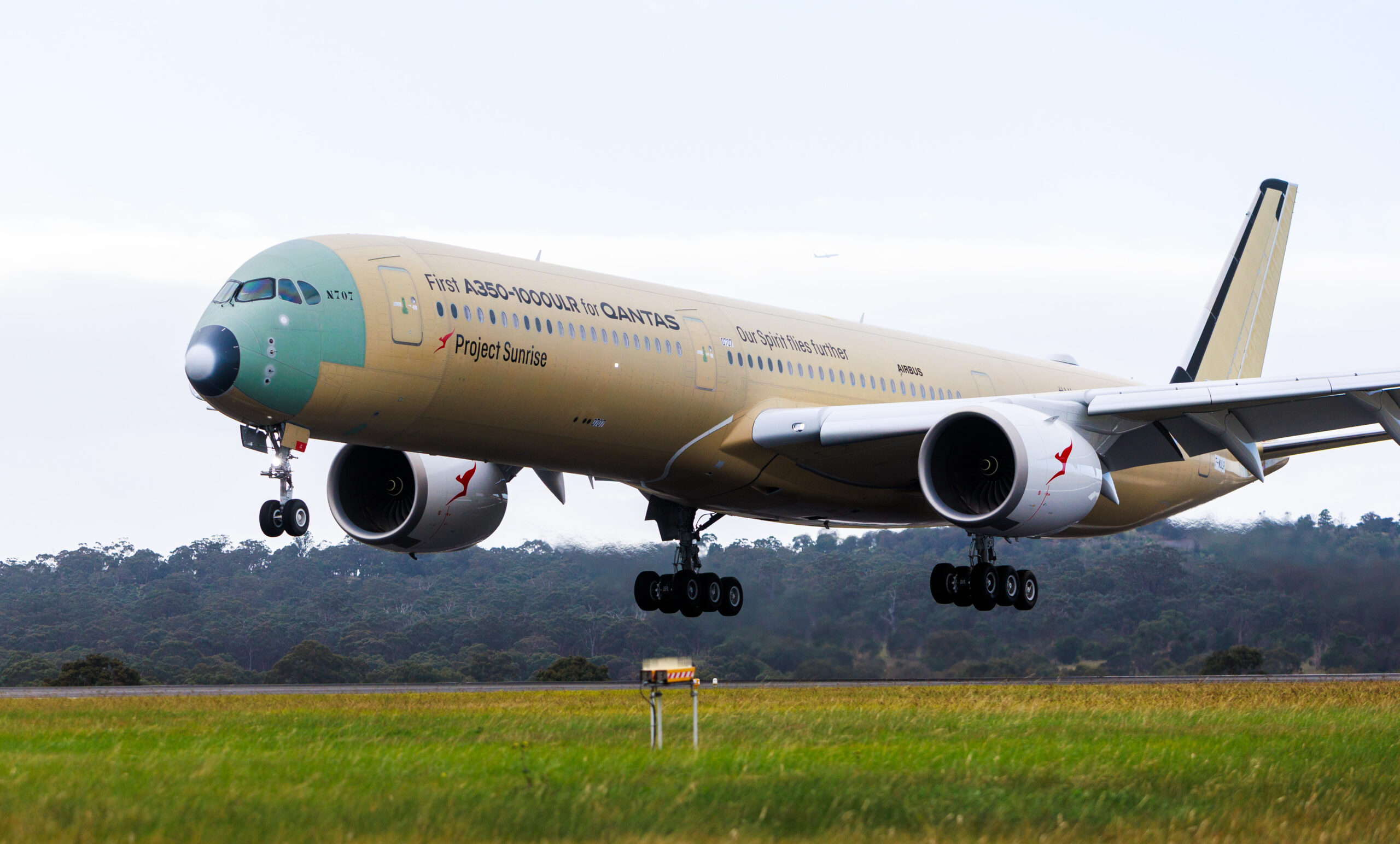
For now, the aircraft isn’t wearing Qantas’s distinctive red livery. Instead, it has a plain tan colour scheme which gives it a faintly military feel, with only Qantas logos on the wingtips. This test flight follows a shorter one in early June: a three-hour, 43-minute journey over France and the French Atlantic coast.
The key modification that makes Project Sunrise possible is an additional 20,000-litre fuel tank, which enables the A350-1000ULR to operate flights lasting up to 22 hours.
Qantas has ordered twelve of these 238-seat aircraft, which are currently on the production line. They are expected to start arriving in April 2027 following several programme delays.
Arriving in 21:33h: @Airbus Project Sunrise A350-1000ULR has just departed Melbourne on an epic nonstop journey to Toulouse. Track it: https://t.co/lEeXgZZ61N @Qantas pic.twitter.com/tRaVMJ4M4o
— Flightradar24 (@flightradar24) July 27, 2026
Chief executive Vanessa Hudson has confirmed that tickets for the inaugural Sydney–London service will go on sale in February 2027, ahead of the service’s launch in October. Sydney–New York flights are expected to follow. Flights from Melbourne have yet to be confirmed.
“We will be able to announce the routes progressively as the new aircraft arrive over the next two and a half years,” Hudson said. “Demand can change, and we’re going to be responsive to that.”
Passerini also revealed that the London–Sydney flight path will go over the North Pole. While this may seem counterintuitive given the extra distance, favourable winds along this route can make it the faster option depending on the season.
From summer to winter in a single hop!
— Airbus (@Airbus) July 23, 2026
As part of our flight test campaign, our test crew is taking the #A350-1000ULR from Toulouse to Melbourne NON STOP for the first time.
Follow this major milestone live on @FlightRadar24! https://t.co/J5nObjN1n3
Next stop: Australia!… pic.twitter.com/QrAvgBMos4
Passengers on flights to London will spend around 12 hours in darkness and cross seven to nine time zones, while those travelling to New York will cross up to 16.
Peter Cistulli, a sleep medicine professor who advised Qantas on Project Sunrise, says crossing up to 16 time zones is “a major biological challenge”. As light is “the strongest environmental cue for the body clock”, the airline has focused on cabin lighting, meal timing, and protected sleep periods to help passengers adjust more quickly to their destination.
A wellness zone, developed with the Charles Perkins Centre and open to all passengers, will be located between the premium economy and economy cabins and will offer guided in-flight exercises.