


On 28 September 2026, the Prix Versailles revealed its World’s Most Beautiful Stations List 2026. Featuring spots from around the globe, the list is a celebration of local heritage combined with creativity and innovation.
Since 2015, the Prix Versailles has celebrated architecture, design, and sustainability in a series of different competitions announced at the UNESCO headquarters in Paris. Different lists feature a yearly selection of airports, university campuses, passenger stations, sports venues, museums, shops, hotels, and restaurants.
The laureates of the World’s Most Beautiful Stations List 2026 have been announced on 28 September. The list features stations from across the globe, including Italy and Saudi Arabia.
“In the realm of transport stations, the stakes are high when it comes to creating cultural expressions that are simultaneously beautiful, fashionable and sustainable, that reinforce passenger mobility whilst revitalising local neighbourhoods and that support modernisation whilst showing respect for existing architecture. These strategies, with their ability to stimulate exchanges and assert a project’s local roots, remain all too rare on today’s global scene,” said Jérôme Gouadain, Prix Versailles Secretary General.
The World’s Most Beautiful Stations of 2026
Town Hall Station – Melbourne, Australia
“Town Hall Station enjoys a fantastic location in the heart of Melbourne’s historic centre. Designed by Hassell, RSHP and WW+P, it stands out for the sheer size of its underground volumes. Its concourse, built under City Square, is punctuated by eight imposing columns like trees whose branches hold up the canopy above and endow the whole hallway with a cathedral-like feel. Coppery vaulted ceilings tower 10 metres above the particularly wide platforms, accentuating the impression of openness and space,” Prix Versailles writes.
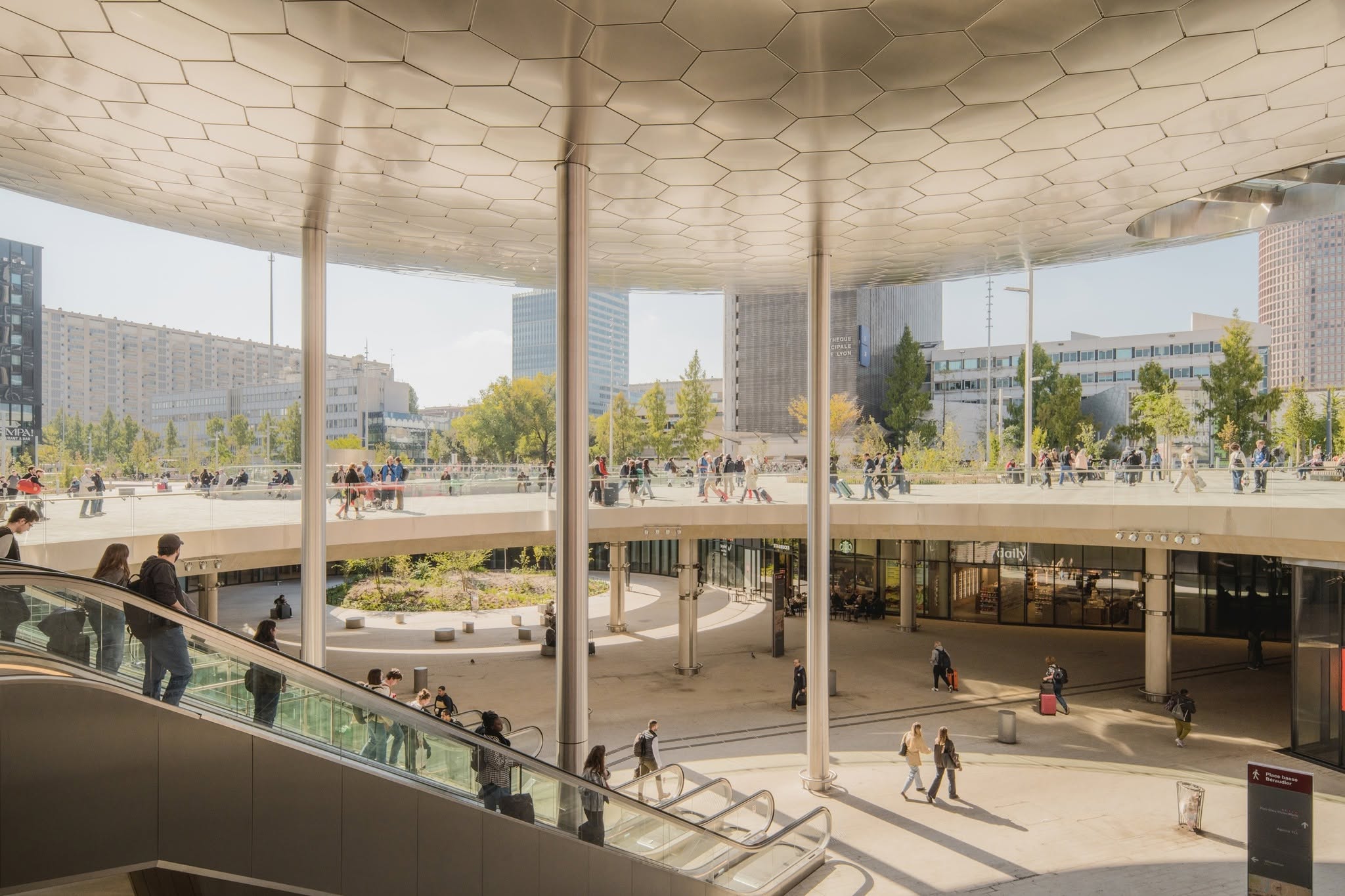
Lyon Part-Dieu Station – Lyon, France
“In Lyon, walking through a building to get from one street to another is a way of life and, although it wasn’t originally designed that way, Part-Dieu Station had become a shortcut between different neighbourhoods. This regional, national, and international train station, one of Europe’s top stations in terms of the number of connecting passengers transiting through it, has doubled in size thanks to the architectural teams at AREP and L’AUC, with additional access points and pass-throughs to boot. Inspired by the hidden passageways (traboules) of the Vieux-Lyon and Croix-Rousse districts, Lyon Part-Dieu has devised its own, eminently contemporary, railway version.”
Colosseo – Fori Imperiali Station – Rome, Italy
“For the chic Rome Metro, digging is always a trip back in time. And now, the Colosseo–Fori Imperiali Station has transformed this hurdle into an incredible contemporary project. Spanning four levels at a maximum depth of more than 30 metres, it has created a vast underground cavity where archaeological finds unearthed during construction now accompany passengers in transit. Ancient wells are the common thread running through the architecture, which plays with shadow and light to reveal the different strata that form the bedrock of Rome.”
Monte Sant’Angelo Station – Naples, Italy
“Designed by artist Anish Kapoor, working with the architectural firms Future Systems and AL_A, Monte Sant’Angelo Station – a project that began more than twenty years ago – has turned crossing the threshold to the underground world into its own complete experience. Two monumental openings made of corten steel and aluminium provide access to a whole subterranean world that at once calls to mind Mount Vesuvius, a cave and the legend of the Cumaean Sibyl. The station itself is a sculpture that the public can enter all the way down to the bowels of the earth. A mythological, contemporary projection that brings past, present and future together.”
National Museum Station – Riyadh, Saudi Arabia
“This Metro station was designed to be the gateway for visitors to the National Museum and the city’s historic centre. Created by the teams at Arup architecture practice, it stands out for its lattice façade, an impressive concrete shell modelled after the topography of Tuwaiq Mountain, with Najdi-inspired triangular openings through which the radiant blue of the interior can be seen. The site delivers an experience that is as surprising as it is precious: the sense of stepping inside the crystal of a geode… a real treat for the eyes!”
Western Station – Riyadh, Saudi Arabia
“Located on the site of an old open-air marketplace, Western Station was designed by Omrania to transform the spot without taking away from its public utility. Like a little slice of the city, a local ecosystem is evolving, with shops and a mosque, as well as many pedestrian areas that are great for a stroll or a get-together, set up all around the station’s tracks. Its silhouette is made up of two long spaces topped with undulating roofs. Inspired by desert dunes, their curved lines provide shady thresholds where light and air flow through the buildings freely. The structures are connected by a passageway like the seasonal riverbed of a wadi.”
LAX/Metro Transit Center – Los Angeles, United States
“In the heart of a Californian metropolis that has historically been heavily car-centric, the new station is radically reinventing airport transit, for a more ecological, more equitable experience. The multimodal platform, created by Grimshaw Architects in collaboration with Gruen Associates, connects Metro’s C and K Lines, 16 bus lines, a regional bike hub, and forthcoming automated people movers. Capped with sweeping sculptural canopies and glass ceilings, this infrastructure is unobtrusive, placing the focus instead on a smooth journey for travellers. Designed with the local climate in mind, the site uses limited air conditioning thanks to its natural ventilation and awnings. Solar panels cover about half of the building’s interior energy demand.”
According to Jérôme Gouadain, by overcoming the many challenges they are faced with in terms of design, architecture, and sustainability, the winning buildings are proof that 21st-century passenger stations can be bridges to a more desirable future.
On 10 December, three of the passenger stations from the 2026 list will receive further distinction in the form of a World Title. The Prix Versailles, Interior, and Exterior titles will be awarded at UNESCO Headquarters.