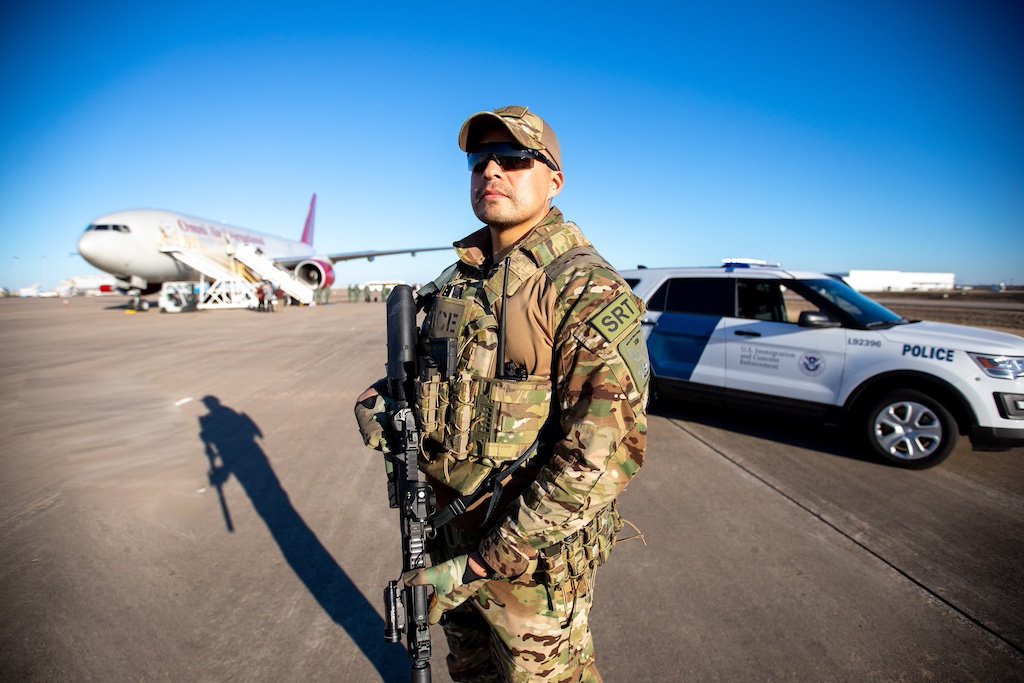



Airports in the United States are being staffed by Immigration and Customs Enforcement (ICE) agents amid personnel shortages created by the ongoing partial shutdown of government services.
President Donald Trump announced the move on Truth Social on 21 March, since when at least 13 major airports have seen teams of ICE officers deployed. Those airports are:
- Chicago O’Hare International Airport (ORD)
- Cleveland Hopkins International Airport (CLE)
- Hartsfield-Jackson Atlanta International Airport (ATL)
- Houston’s William P. Hobby Airport (HOU)
- Louis Armstrong New Orleans International Airport (MSY)
- Luis Muñoz Marin International Airport in Puerto Rico (SJU)
- Newark Liberty International Airport (EWR)
- New York’s John F. Kennedy International Airport (JFK)
- New York’s LaGuardia Airport (LGA)
- Philadelphia International Airport (PHL)
- Phoenix Sky Harbor International Airport (PHX)
- Pittsburgh International Airport (PIT)
- Southwest Florida International Airport (RSW)
Unmasked ICE ERO officers deployed to Houston's George Bush Intercontinental Airport were seen handing out bottled water to travelers waiting in TSA lines that stretched as long as four hours on Wednesday. The scene marked the third straight day immigration agents have been sent… pic.twitter.com/LBXfSwVswG
— CBS News (@CBSNews) March 25, 2026
The aim is to support Transportation Security Administration (TSA) agents, who are expected to continue to work without pay during government shutdowns, but whose numbers are depleted by absences and around 500 walkouts. However, commentators are pointing out that ICE agents cannot perform the full range of tasks for which TSA staff are trained, such as passenger screening and patdowns, operating X-ray machines, detecting explosives, or inspecting bags.
What the ICE agents can do is maintain public order by boosting crowd control and guarding airport entrances and exit points. They can also undertake some back-office roles. Both these functions are claimed to free up more TSA staff to undertake vital screening and keep queues fluid.
Addressing the ICE role, DHS spokesperson Lauren Bis said in a statement: “The more support we have available, the more efficiently TSA can focus on their highly specialized screening roles to efficiently get airport security lines moving faster,” she said.
Still, some experts question the impact ICE can have. Ex TSA agent Angelo Kevin Brown, an Assistant Professor of Criminology at Arkansas State University, told CNN: “Even if it works as planned and frees up a few TSA agents from smaller tasks, the main issue with time in the security line is dependent on the number of lanes open, so there is still the issue of not enough TSA agents to run the technical side of the lane.”
🚨 Media caught off guard: ICE agents step in at airports to support TSA, and even liberals admit “the lines are low, it’s working” as staffing shortages ease.pic.twitter.com/han808V6Za
— Derrick Evans (@DerrickEvans4WV) March 25, 2026
With those potential delays in mind, passengers are advised to ensure they have all the right, up-to-date documentation for their travel and arrive at least four hours early for flights, checking their departure status frequently with airlines and airports. It’s worth being aware that the TSA’s own app is not being fully updated in real time as a result of the crisis.
In terms of what to expect at airports, as well as long queues, Miami-based immigration attorney Juan Carlos Rivera cited the White House border czar Tom Holman, telling The Independent ICE would be “taking over supportive and perimeter duties.” That implies that passengers might see ICE present but do not necessarily need to engage with them. ICE agents have also been spotted handing out water bottles and helping with bags.
Whether that will be enough to reassure the public remains to be seen. One TSA agent who spoke to CNN confirmed that TSA officers are, in fact, training up ICE agents, and some passengers are reportedly already cancelling journeys out of fear of encountering ICE.