


Passenger traffic across Europe’s airports continued to grow during the first half of 2026, demonstrating the resilience of demand for air travel despite geopolitical tensions, higher fuel prices and disruption linked to the European Union’s Entry/Exit System (EES).
According to the latest air traffic report from Airports Council International (ACI) Europe, passenger numbers across the European airport network increased by 2.6% compared with the first half of 2025. While growth slowed during the second quarter as the conflict in the Middle East affected aviation markets, Europeans continued to prioritise travel, and North Americans visited the continent in record numbers this summer.
Geopolitics reshape growth
Passenger traffic growth eased from 4.3% in the first quarter to 1.3% between April and June, reflecting reduced traffic to the Middle East and capacity cuts by some airlines as higher jet fuel prices increased operating costs. As a result, domestic traffic (+3%) outperformed international traffic (+2.5%) for the first time since the aviation industry’s recovery from the COVID-19 pandemic.
“There is no escaping the fact that geopolitics have increasingly been shaping traffic performance this year,” said Olivier Jankovec, Director General of ACI Europe. While acknowledging that growth has lost momentum, he argued this reflects supply-side pressures rather than weaker demand.
“Europeans continue to prioritise air travel while North Americans continue to visit our continent in record numbers this summer,” he said, adding that the evolution of the conflict in the Middle East will largely determine how European aviation performs during the remainder of the year.

EES remains a major concern
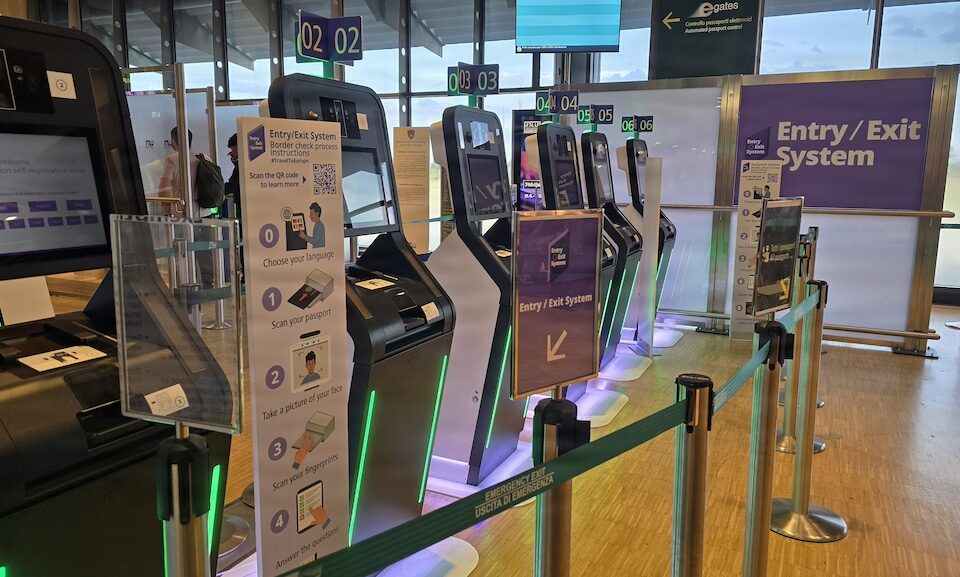
Alongside geopolitical uncertainty, ACI Europe warned that the EU’s Entry/Exit System is becoming an increasing obstacle to smooth travel.
“Looking ahead, fixing the Schengen Entry/Exit System must be Europe’s immediate priority,” Jankovec said, warning that “long, unpredictable and unacceptable waiting times” at border controls are beginning to deter travellers.
The comments add to growing pressure on the European Commission. As Travel Tomorrow recently reported, nine European countries have asked Brussels to extend emergency flexibility measures allowing biometric checks to be temporarily suspended during periods of exceptional demand. The Commission has acknowledged that there is “still a lot to do” to improve the system, while continuing to defend the EES as a key element of the EU’s border management strategy.
Italy and Spain outperform Europe’s biggest markets
Passenger traffic varied widely across Europe. Within the EU+, Slovakia (+101.3%), Malta (+15.6%) and Slovenia (+14.7%) recorded the strongest growth, while Iceland (-7.1%), Cyprus (-4.4%) and Austria (-2.6%) saw the sharpest declines.
Among the continent’s largest aviation markets, Italy (+4.2%) and Spain (+3.7%) led growth. France (+0.6%) and the United Kingdom (+0.4%) posted only modest gains, while Germany (-1.2%) remained the weakest major market.
Outside the EU+, North Macedonia (+27.9%), Moldova (+21%), Albania (+17.2%), Uzbekistan (+15.7%), Armenia (+11%) and Montenegro (+10.4%) all recorded strong growth. In contrast, Israel (-19.2%), Azerbaijan (-3%), Georgia (-2.5%) and Kosovo (-1.5%) experienced declines, highlighting the uneven impact of regional geopolitical developments.
Heathrow keeps the lead
London Heathrow remained Europe’s busiest airport during the first half of the year, welcoming a record 40 million passengers (+0.2%), narrowly ahead of Istanbul Airport with 39.84 million (+1.6%).
Among Europe’s largest hubs, Istanbul Sabiha Gökçen (+6.4%), Barcelona (+4.4%) and Madrid (+4.2%) posted the strongest growth. London Gatwick (-5.2%), Munich (-4.2%) and Frankfurt (-0.8%) all recorded declines, while Amsterdam Schiphol, Paris Charles de Gaulle and Rome Fiumicino remained broadly unchanged.
Overall, airports handling more than 40 million passengers grew by just 0.8%, making them the slowest-growing airport category during the first half of the year.
Smaller airports continue to outperform
The strongest growth came from smaller airports, with those handling fewer than one million passengers recording an 8.6% increase, driven by low-cost carrier expansion and resilient leisure travel. They nevertheless remain the only airport category yet to recover to pre-pandemic passenger levels.
Among larger regional airports, Tirana, Tashkent, Malta, Kraków and Milan Linate all achieved double-digit growth, while Bratislava led medium-sized airports with a remarkable 122.7% increase in passenger traffic.
Freight traffic remained broadly stable, increasing by 0.7% compared with the first half of 2025 and remaining 11.2% above pre-pandemic levels. Aircraft movements also rose by 1%, although they are still slightly below 2019 volumes.