

The new EU Passenger Package (EUPP) is a well-intentioned but discombobulated move that might still not do enough to adequately protect passengers choosing rail over air travel.
The problem arises when travellers need to combine several operators on the same journey, ending up with insufficient protection of their rights and at risk of missing connections and losing tickets without proper compensation, with little choice but to buy a new ticket at the highest last-minute fare.
Though the EUPP is a huge leap forward, applauded by the Youth on Track coalition of NGOs, its shortcomings, laid out in the coalition’s open letter, remain largely unresolved weeks later.
Under the new rules, travellers buying a single-transaction journey get full rights, even across operators and borders. If delayed or cancelled, operators must largely re-route them at no extra cost, provide food, refreshments and accommodation free of charge, plus compensation worth 25% of the ticket price for delays of 60-119 minutes, rising to 50% for two hours or more.
However, EU countries can exempt a wide range of services, urban, suburban, regional, long-distance domestic, historical and touristic trains, which in practice covers most of them. They can also exempt international trains to non-EU states… and warn passengers to check the rules before booking.
With such wide loopholes, disputes are bound to follow.
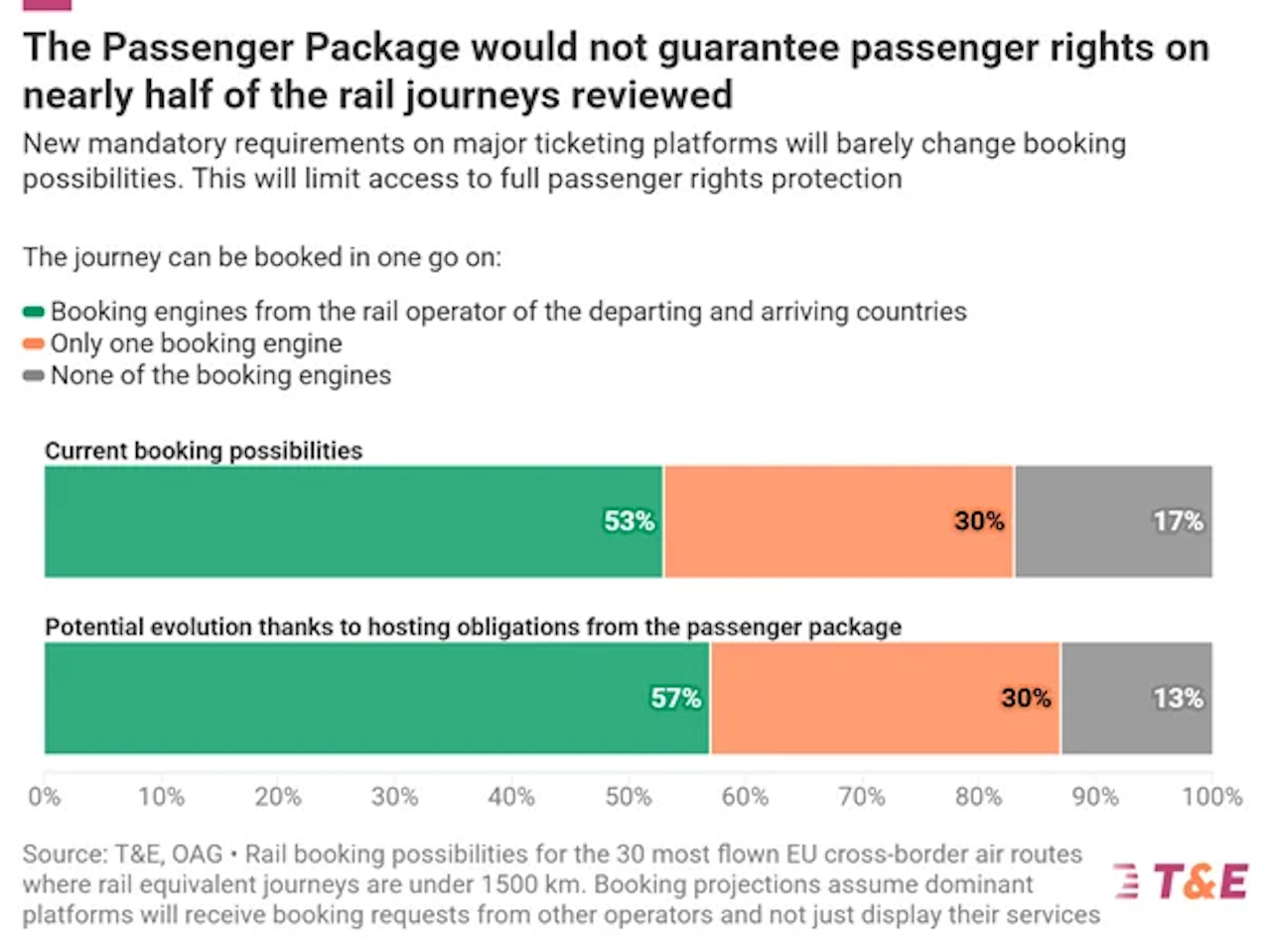
To make matters worse, booking a single-transaction ticket, the only way to unlock full rights, is often impossible: T&E found 13 of the EU’s 30 busiest cross-border flight routes (43%) will still be hard or impossible to book as one rail ticket.
Until now, passenger rights on international rail journeys have depended largely on voluntary agreements between operators. The EUPP obliges operators to share ticket data on request but stops short of requiring dominant platforms to sell competitors’ tickets on major routes. As a result, popular journeys like Paris-Rome or Barcelona-Milan may still be impossible to buy as a single ticket, depriving passengers of their full protections.
This matters because national platforms can account for up to 90% of rail ticket sales. Campaigners argue that obliging them to offer single-ticket bookings on Europe’s busiest corridors is essential if rail is to rival flying.
Until that’s resolved, passengers booking outside major operators’ platforms may still be unable to board the next train free of charge or claim compensation for a missed connection.
This will keep pushing travellers towards faster, cheaper, less risky alternatives, such as the road or the plane. As Europeans increasingly favour shorter breaks, reliability and compensation become non-negotiable, especially for families swapping a plane for a train on a long weekend where every hour counts.
Georgia Whitaker, Rail Campaigns Manager at T&E, welcomed the EUPP’s spirit but warned it will “barely make an improvement for those taking long international rail journeys”, adding that the EU Council and Parliament must ensure it delivers the sustainable mobility promised.
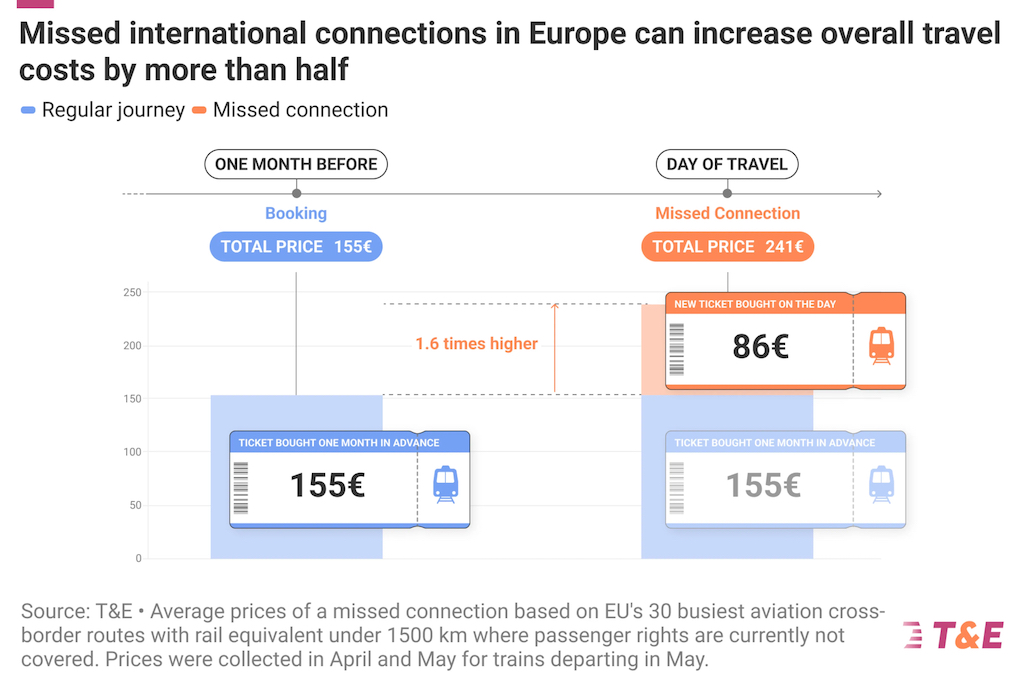
According to T&E, passengers who miss a connection on unprotected routes face an average €86 penalty, 1.6 times the price paid a month ahead. On some routes, last-minute fares soar to 2.6 times the original price, and on around half of these journeys, travellers must also pay for overnight accommodation while they wait for the next connection.
And missing connections are far from rare. According to a Que Choisir and T&E survey, 44% of passengers on multi-operator journeys have missed a connection at least once. So while the EUPP is definitely a step in the right direction, the age of seamless train travel is still in need of some great improvements.