


Players at the men’s FIFA World Cup 2026 could find their performance affected by extreme temperatures associated with global warming, and fans might notice match strategy changing in response to the climate, a new study has found.
Research suggests that temperatures above 28°C (82.4°F) can affect soccer players’ performance — especially how fast, far, or frequently they run during a match. This can influence a team’s overall match strategy and style of play.
Ultimately, it could be harder for players to reach their peak performance during a match because of hotter temperatures. And teams with styles of play that rely on speed and repeated sprinting could face a disadvantage.
The analysis from Climate Central shows that climate change is making it more likely there will be temperatures high enough during most matches (97 out of 104) to negatively affect athlete performance. Nearly half of the matches (49) have at least a 50% likelihood of taking place during performance-impairing heat, the research found. In 26 of those matches, climate change increases the likelihood by at least 10 percentage points.
Among all matches, conditions for the match on 26 June in Guadalajara between Uruguay and Spain are most affected, with the 70% chance of performance-impairing heat 37 percentage points higher due to climate change.
And when it comes to the final, scheduled for 19 July at MetLife Stadium in New Jersey (known as New York New Jersey Stadium by FIFA), whichever teams are lucky enough to go that far will face a 47% likelihood of performance-impairing heat — odds that are about 17 percentage points higher because of climate change.
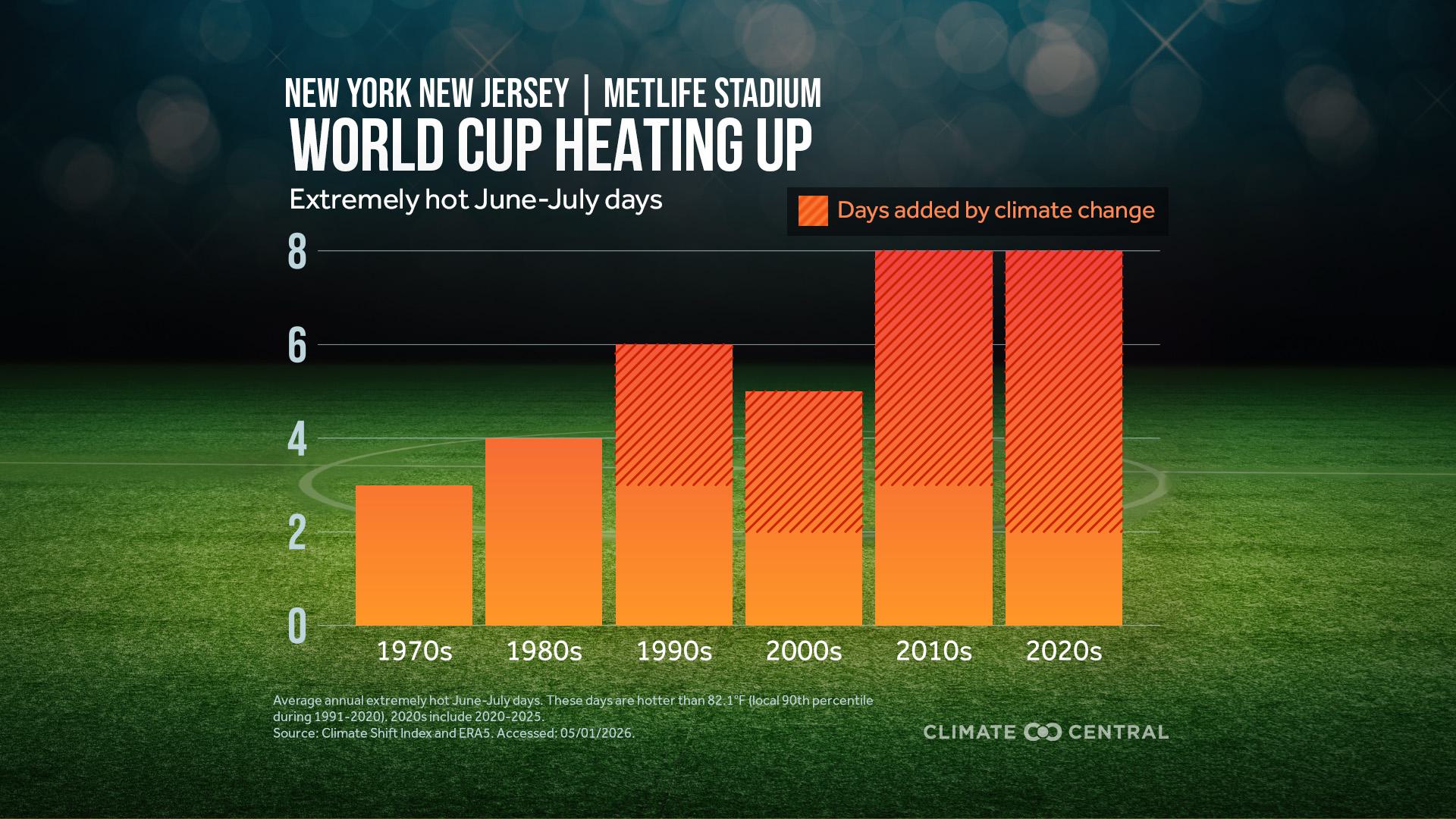
As well as affecting match strategy and how hard and fast players approach the game, extreme heat can pose a serious health risk, the Climate Central researchers point out, especially when combined with high humidity.
To keep players, fans, and staff safe, World Cup organisers are adapting to the rising heat risks by scheduling more evening matches in hotter cities as well as imposing mandatory hydration breaks at all 104 matches. Matches may be postponed if the web-bulb globe temperature (a measurement of humid heat) hits 32°C (89.6°F) to minimise risks of heat stress.
Another factor to be taken into account is that most stadiums are open-air, leaving players and millions of fans exposed to peak summer heat. Only three stadiums are fully climate-controlled (Atlanta, Dallas, and Houston). Fans as well as players then, should take sensible precautions to guard against heat stroke and sunburn, including drinking plenty of water, using suitably protective suncream and hats, and limiting exertion during the hottest parts of the day.