


Depending on where you are in the world, the days may be getting worryingly hot, or the nights colder and longer and more depressing, and sometimes the news might feel like World War 3 is upon us, but at least one Doomsday scenario is now known to be wrong: Friday 13 November 2026 has passed—and we are all still here and have not been crushed to death.
Published by physicists in 1960, the so-called “Doomsday study” predicted that on Friday 13 November 2026, Earth’s human population would outgrow the available room on the planet. “At this date human population will approach infinity if it grows as it has grown in the last two millennia,” the researchers, led by Heinz von Foerster, said. “Our great-great-grandchildren will not starve. They will be squeezed to death.”
Von Foerster used a mathematical formula to bypass the “ups and downs” of fertility, disease, food availability, environmental disasters, and other mass mortality events. Instead, looking at how the world population had increased over the previous two millennia, he created a hyperbolic growth curve model. He noted that humanity’s numbers were doubling faster and faster. The maths suggested Friday 13 November 2026 would be the date when the human population became “infinite” –something the planet, of course, could not sustain.
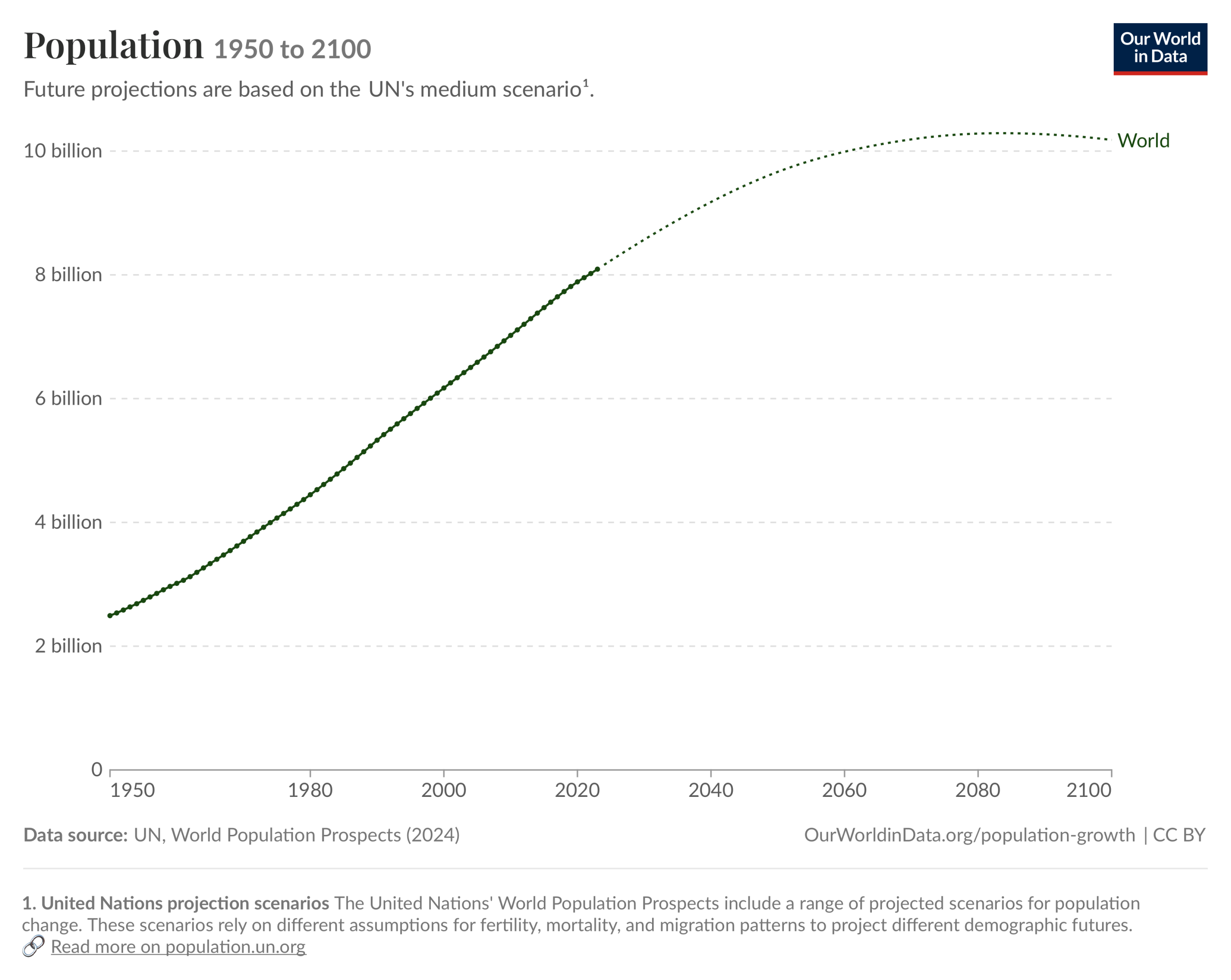
In reality, birth rates in developed nations have fallen away since the post-war baby boom and mid 1960s, and the United Nations says Earth’s human population will start stabilising or dropping from around 2085, peaking at around 10.3 billion. In fact, these days many developed nations are more concerned about demographic decline and an ageing population that is not being replenished (and looked after) by younger generations, than they are about overpopulation.
Other fears also remain. As we approach COP31, scientists, world leaders, and civil groups continue to seek ways to avoid the point of no return for global warming and climate change. We have already had one global pandemic within recent living memory. Nuclear proliferation has not been prevented. Artificial intelligence continues to “escape the sandbox” and perform rogue operations in the real world. Wars, conflicts, and insurgencies are ongoing in Afghanistan, Haiti, India, the Middle East, Myanmar, Pakistan, the Sahel, Sudan, Ukraine, and Yemen (the list is not exhaustive).
Indeed, the real-world Doomsday Clock, a symbolic monitor of how close humanity is to global destruction, maintained since 1947 by the Bulletin of the Atomic Scientists, is currently set to 85 seconds to midnight (as of January 27, 2026). That’s closer to disaster than it’s ever been before. But at least we can be grateful that von Foerster was wrong. Right?