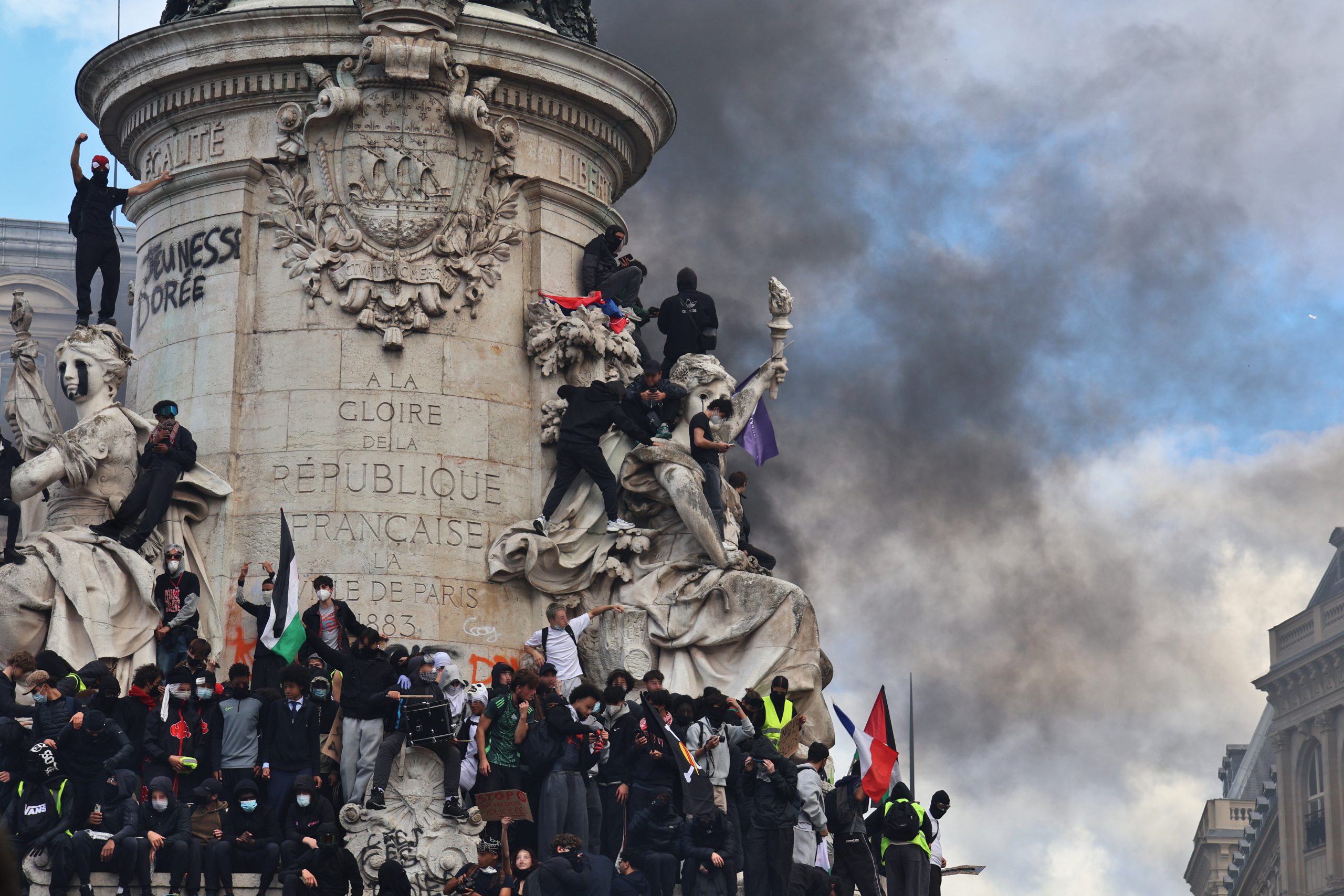



Violent protests have rocked France, with buildings ransacked and burnt out, widespread looting, damage to street infrastructure and vehicles, and arson even causing Limoges’s 19th century city hall to collapse. The French government is assessing what emergency moves might be required to quell the unrest, while officials around the world too have been forced to respond to their citizens’ security in what remains the world’s most visited nation.
A situation that started a few weeks ago with student demonstrations against educational inequalities has quickly ignited into a wider nationwide movement against low living standards and a declining welfare state—spreading beyond French borders into Belgium too. While President Macron has appealed for calm, French ministers and local powers are scrambling to respond with, at the time of writing, overnight curfews in parts of Lille, Marseille, Nice, and Paris.
French authorities have imposed a partial ban on protests as 3000 stores were destroyed and looted on Saturday night alone. https://t.co/dBU0GPA948
— Daily Loud (@DailyLoud) October 19, 2026
Travellers should be aware that French riot police, or the Compagnies Républicaines de Sécurité (CRS) are not known for their restraint, having been criticised many times in the past, including during the so-called gilets jaunes anti-poverty protests in 2018, for heavy-handed use of weaponry and riot gear, such as point-blank firing of rubber bullets and tear gas canisters that blinded and mutilated dozens of citizens.
Now, once again, images emerging from the weekend of 17 October 2026 have shocked global viewers, with perhaps the most striking being the destruction and fall of the central clock tower and belfry of Limoges town hall, an attractive 19th-century neo-Renaissance heritage building which had survived two world wars. Footage of the belfry’s hulk silhouetted against burning flames and collapsing have reawakened the trauma felt by some when fire ravaged Notre Dame de Paris cathedral in 2019.
France: The bell tower of Limoges City Hall has collapsed after a massive fire engulfed the historic building during protests. The landmark, inaugurated in 1883, was more than 140 years old. https://t.co/7F4OO6tIiD
— Clash Report (@clashreport) October 17, 2026
At the time of writing, flights and Eurostar trains are still operating normally, though delays may occur on the roads due to impromptu closures or curfews. But, is it safe to visit France and its capital when emotions and public anger are running so high, and police responses risk being even more severe than usual?
At the time of writing, the United States has not changed guidance dating to 28 May 2025, which puts the risk level for France at “Level 2 – Exercise increased caution.” However, France’s close neighbour, the United Kingdom, updated its travel guidance for France on 19 October, following the weekend of violent protest.
The Foreign and Commonwealth Development Office (FCDO) noted: “In response to recent events, the French government has announced that local curfews may be introduced at short notice. To find out if you are in an affected area check local media. Follow the instructions of local authorities.” Still, there is no specific UK “Do Not Travel” warning, meaning UK citizens will have to check the terms of their own bookings and travel insurance to see if they are covered, should they choose to cancel their trip.
See #FCDO #FranceTravelAdvice about the risk of local curfews being introduced. Check local media to find out if you are in an affected area. https://t.co/zD0VI4EBJU https://t.co/lhVsR97OQD
— FCDO Travel Advice (@FCDOtravelGovUK) October 19, 2026
Elsewhere, similar advisories are in place. China’s Foreign Ministry encouraged Chinese to remain alert and exercise caution, avoiding demonstration zones. Czechia has said citizens should not attend public gatherings amid the “deteriorating” situation. Dutch authorities also told citizens to avoid the protests.
Germany has warned that more riots could be coming, and told citizens to comply with authorities, saying fines could be applied if they failed to do so. Italy has urged citizens to stay away from large crowds and remain cautious. It also invited those already on the ground in France to register with an app that can help locate them in case of emergency.
Malaysia meanwhile has perhaps gone the furthest, advising its nationals to reconsider non-essential trips until the situation improves.
🔴 🇲🇾 MALAISIE / 🇫🇷 FRANCE Les autorités malaisiennes conseillent officiellement à leurs ressortissants de reporter tout voyage non essentiel en France en raison des manifestations et des tensions actuelles. À mon avis, d’autres pays vont rapidement suivre. Àsuivre. #17octobre #24octobre
— Geocrises FR (@geocrises) October 19, 2026
Overall, the message is clear: exercise caution, do not join protests, and avoid their vicinity. Stay informed of local conditions and shelter in place if there is a curfew. Comply with officials and police to avoid arrest or financial penalties. Remember, outside its major conurbations, France is a large country with widespread rural areas where life will be continuing as normal and there may continue to be little sign of trouble.