

Global airports handled a record 9.8 billion passengers in 2025, but growth has slowed sharply in 2026 amid geopolitical tensions, airspace disruption and rising costs, according to new figures from Airports Council International (ACI) World.
Published on 23 September, ACI World’s 2026 Annual World Airport Traffic Report draws on data from 2,817 commercial airports across more than 185 countries and territories. The organisation’s largest dataset to date covers an estimated 97% of scheduled global passenger traffic.
International travel was the main driver of growth in 2025, with passenger traffic increasing by 6.1%, compared with growth of 1.7% for domestic traffic.
The results build on figures previously covered by Travel Tomorrow in its report on the world’s busiest airports in 2025. Hartsfield-Jackson Atlanta International Airport remained the world’s busiest, handling 106.3 million passengers, followed by Dubai International Airport with 95.2 million and Tokyo Haneda Airport with 91.7 million.
✈️ Big data drop: the Annual World Airport Traffic Dataset 2026 just landed.
— ACI World (@ACIWorld) July 15, 2026
A comprehensive global view of airport traffic based on 2025 data from 2,800+ airports across 185+ countries and territories.
What you'll find inside:
📊 Passengers – domestic and international… pic.twitter.com/pnAsFkXDjp
Passenger growth was recorded across almost every region in 2025. Africa led with an increase of 9.0%, followed by the Middle East at 6.5%, Asia-Pacific at 5.1%, Latin America and the Caribbean at 4.5% and Europe at 4.2%. North America was the exception, with traffic declining by 0.7% amid weaker domestic demand.
Records were also reached beyond passenger traffic. Global air cargo volumes increased by 3.3% to an all-time high of 131.2 million tonnes, while aircraft movements rose by 2.0% to 103.1 million.
“The 2025 results confirm what this industry has shown year after year: long-term demand for air travel remains strong, and more capacity will be needed,” said Justin Erbacci, ACI World’s Director General.
“Meeting that demand means expanding capacity while getting far more out of the infrastructure we already have. It also means advocating for regulation that enables investment rather than blocking it and never losing sight of the fact that airports are strategic assets for their communities.”
Middle East passenger traffic drops 21%
The picture has changed considerably in 2026. Global passenger traffic reached approximately 4.7 billion during the first six months of the year, representing growth of just 0.6% compared with the same period in 2025.
Growth continued across Africa, Europe, Latin America and the Caribbean, and Asia-Pacific, while North American traffic remained broadly flat. The Middle East recorded the sharpest decline, with passenger traffic falling by 21% amid escalating conflict and airspace disruption.
The downturn reflects disruption already documented by Travel Tomorrow, including the impact of the Middle East conflict on major aviation hubs and international routes.
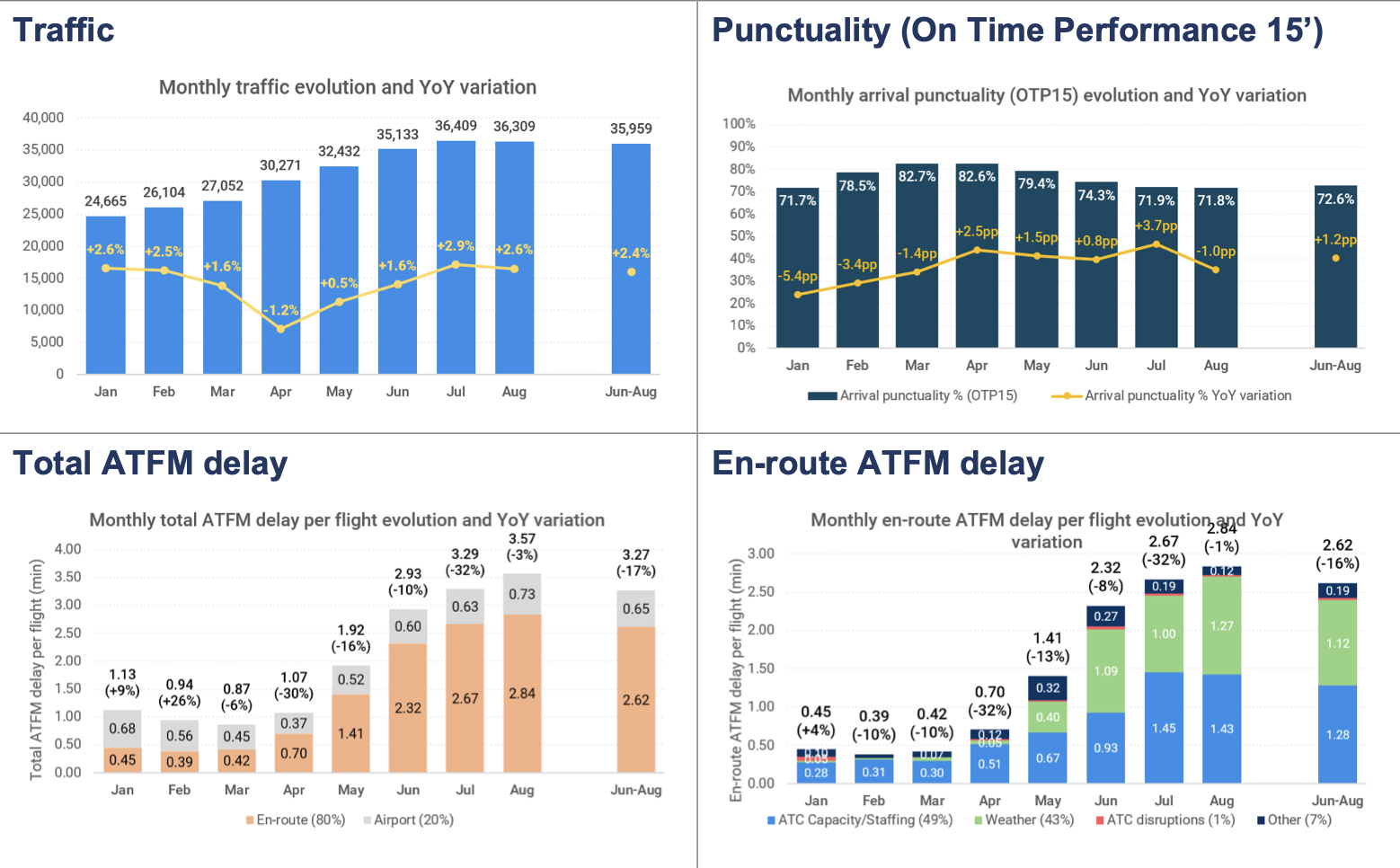
Europe, meanwhile, has shown greater resilience. More recently, Travel Tomorrow reported that the continent recorded its busiest-ever summer for air traffic in 2026 despite disruption linked to the Middle East conflict. Between 1 June and 31 August, the European aviation network handled an average of 35,959 flights per day, up 2.4% compared with summer 2025.
The global slowdown also comes as airports face the longer-term challenge of accommodating continued growth in demand. ACI World argues that expanding airport capacity and making better use of existing infrastructure will be necessary to keep pace with future passenger numbers.
Despite the volatility seen in 2026, the organisation maintains that the underlying drivers of aviation demand remain strong, including population growth, rising incomes, expanding connectivity and continued demand for mobility.
The latest figures therefore point to a contrast between record-breaking global airport activity in 2025 and a considerably more uncertain operating environment in 2026, with geopolitical tensions, airspace disruption and rising costs weighing on short-term growth.