


Spain welcomed a record 58.1 million international tourists during the first seven months of 2026, putting the country increasingly within reach of the symbolic threshold of 100 million visitors this year.
Between January and July, international arrivals increased by 4.6% compared with the same period in 2025, according to the latest Frontur figures published by Spain’s National Statistics Institute (INE).
Tourism revenues grew even faster. International visitors spent €82.05 billion in Spain during the seven-month period, an increase of 7.8% year-on-year and another record for the country.
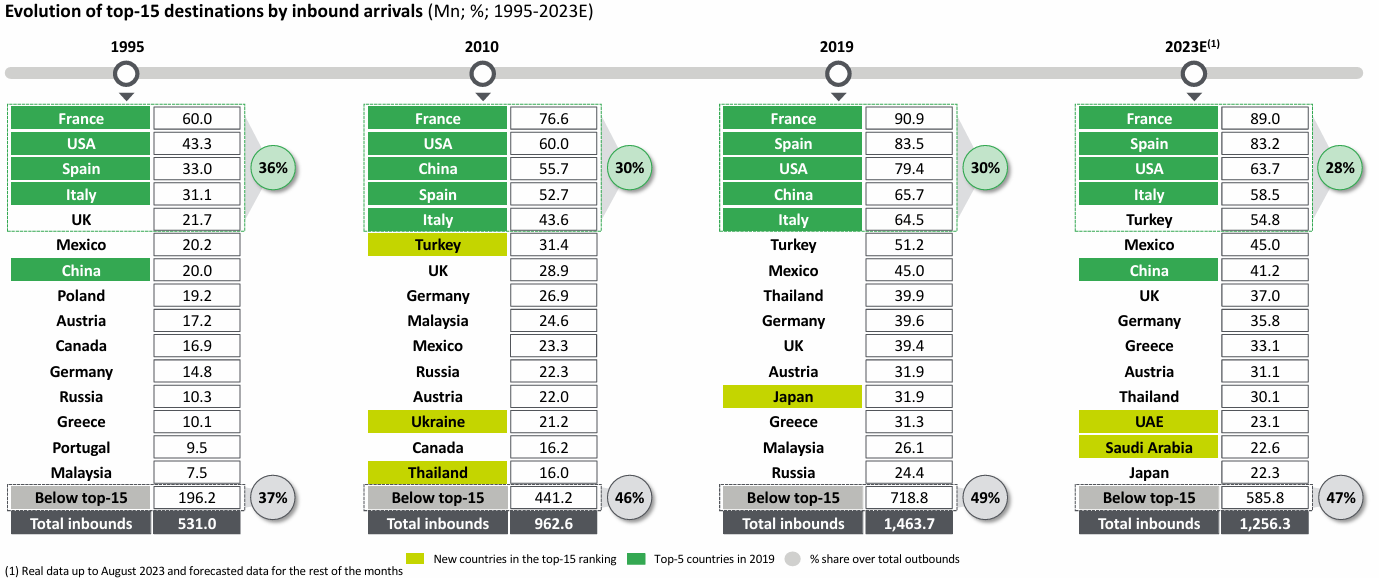
The figures reinforce Spain’s position as one of the fastest-growing major tourism destinations in Europe. In 2025, the country welcomed a record 96.8 million international tourists, meaning even relatively modest growth this year would be enough to take Spain beyond 100 million annual arrivals for the first time.
Furthermore, a recent study by Deloitte and Google predicts Spain could eventually overtake France as the world’s most visited country, reaching around 110 million international tourists annually by 2040.
Visitor spending grows faster than arrivals
The record-breaking trend continued during the peak summer season. Spain received 11.5 million international tourists in July alone, 4.6% more than during the same month last year.
Their spending increased considerably faster, rising by 10.9% to €18.22 billion.
The figures continue a trend increasingly emphasised by Spanish tourism authorities: tourism revenues are growing faster than visitor numbers.
Accommodation accounted for the largest share of international visitor expenditure in July, representing 19.8% of the total. Package holidays accounted for 19.3%, followed closely by international transport at 19.2%.
The most common length of stay was between four and seven nights, accounting for 5.7 million visitors, an increase of 8.7% year-on-year.
Independent travel also continued to dominate. Almost 8.5 million international tourists visited Spain without a package holiday in July, compared with around 3.1 million who travelled as part of one.
@wanderwithdeleah POV: You go to Barcelona in July… and the streets are FULL. The heat, the crowds, the vibes — people are definitely peopling 🇪🇸☀️ Would you still visit in peak season? #Barcelona #spain #barcelonaspain #traveltok #flightattendant ♬ Jet2 Advert – ✈️A7-BBH | MAN 🇬🇧
UK remains Spain’s largest tourism market
The United Kingdom remained by far Spain’s largest source market between January and July, accounting for 11.5 million visitors, 4.6% more than during the same period last year.
France ranked second with more than 7.2 million tourists, an increase of 1.2%, while approximately 6.9 million visitors arrived from Germany, down 0.5%.
Italy recorded the strongest percentage growth among Spain’s major source markets. Around 3.5 million Italian tourists travelled to the country during the first seven months of the year, 10.3% more than in 2025.
Growth was even stronger among visitors grouped by INE under other source countries, with arrivals increasing by 16.9% to 717,000 and spending rising by 24.5%.
British travellers also dominated the July figures. Around 2.2 million visitors arrived from the UK during the month, an increase of 5.6% year-on-year, while their expenditure reached €3.04 billion, up 4.8%.
Madrid and Valencia record strong growth
Catalonia remained Spain’s most visited autonomous community during the first seven months of 2026, receiving 11.94 million international tourists, 2.9% more than during the same period last year.
The Balearic Islands followed with 9.16 million visitors, an increase of 1.8%. The Canary Islands received 9.02 million tourists, 0.6% fewer than a year earlier.
Andalusia also attracted around 9.02 million international visitors, but recorded much stronger growth, with arrivals increasing by 8.2%.
Among Spain’s major destinations, Madrid and the Valencian Community posted the strongest increases during the January-to-July period, at 9.6% and 8.9% respectively.
The trend accelerated in July. The Valencian Community received 1.63 million international tourists during the month, 9.5% more than a year earlier, while Madrid welcomed around 800,000, an increase of 11%.
Spain moves closer to 100 million tourists
The latest figures add weight to expectations that Spain could cross the 100-million-tourist mark in 2026. After welcoming 96.8 million international visitors in 2025, Spain would need growth of only around 3.3% this year to reach 100 million. Arrivals during the first seven months are currently running above that pace, at 4.6%.
Maintaining the current growth rate throughout the year would put Spain at roughly 101 million international visitors in 2026.
Such a result would also further narrow the gap with France, which welcomed 102 million international visitors in 2025 and remains the world’s most visited country.
The comparison is particularly striking when tourism expenditure is taken into account. Spain generated €134.7 billion in international tourism spending in 2025, considerably more than France’s €77.5 billion, despite receiving fewer international visitors.
Spain’s challenge is therefore increasingly shifting from attracting more tourists towards managing the economic, social and environmental consequences of its extraordinary popularity.
Tourism Minister Jordi Hereu has advocated a model of “calm growth”, with greater emphasis on increasing tourism’s economic value, spreading visitors across different regions and seasons, and promoting inland, cultural, gastronomic and nature tourism.
With 58.1 million international visitors already recorded by the end of July, Spain’s latest tourism record suggests that managing that growth could become an even more pressing issue if the country passes 100 million arrivals this year.