


The extent of Cuba’s tourism crisis amid United States sanctions has been revealed in comments by Prime Minister Manuel Marrero, who said on 29 July that the sector was suffering “almost total paralysis.”
Three quarters (73%) of the island’s hotels have closed and seven international chains, (who between them operate around half of Cuba’s hotels), have now left, Marrero said, pointing to the scale of the risk.
Although Cuban tourism had suffered setbacks from US travel restrictions and COVID-19 since its heyday in 2017 (when it welcomed 4.2 million international visitors), the sector employed 300,000 people and was the island’s second largest source of foreign currency earnings until 2025— a year when instability and infrastructure problems, such as rolling power cuts and electricity blackouts, began to eat away at core source markets. Cuba only welcomed 1.8 million international visitors across 2025, which was described as “the worst figure since 2002.”
With the avowed goal of regime change, the United States has been exerting pressure on the Cuban economy through sanctions and since January 2026, that includes the imposition of new tariffs on fuel suppliers to Cuba and penalties for those who do business with the military-run “GEASA” sectors of the island’s economy, such as tourism.
Cuban aviation fuel supplies began running out as early as February, and with global fuel supplies affected by the Middle East blockade, airlines began rationalising flights. Canadian, European, and Russian carriers all suspended routes to Cuba.
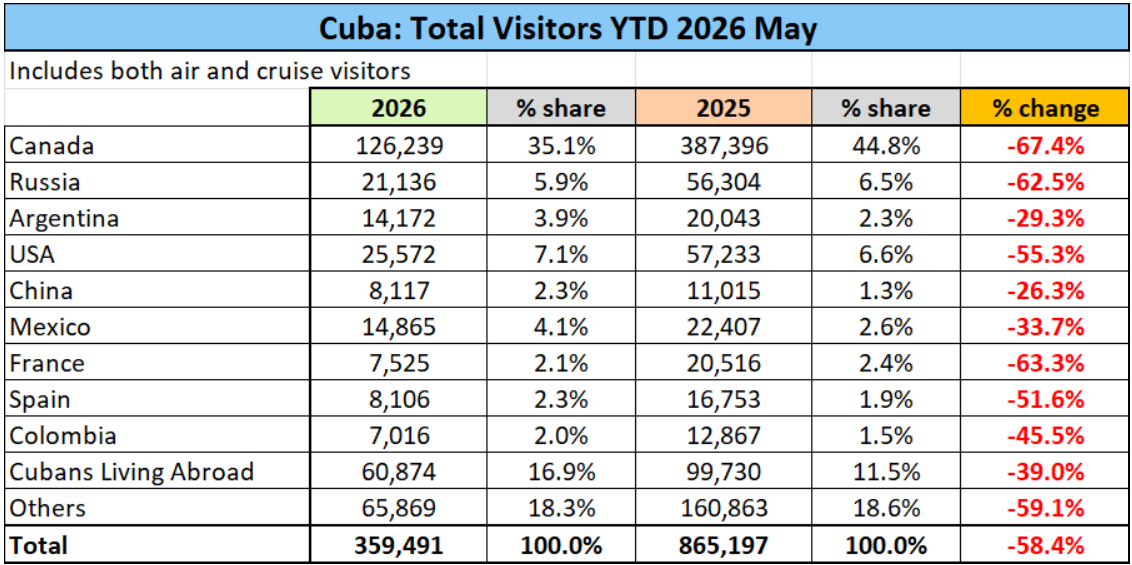
The effect on international arrivals was immediate, according to official data showing tourist numbers dropped 58% in the first six months of 2026, compared with the same period the year before.
That drop in connectivity and demand, and the disincentive of renewed US sanctions in July, has prompted further international hotel group closures, and the crisis only seems to be deepening.
With occupation rates as low as 34.1%, Spanish hospitality chain Melia slashed the Portuguese-run Ilha Bela Gestao E Turismo operations at 15 of its 34 hotels in June, only to announce a complete withdrawal from the island a month later, blaming economic, legal, and operational struggles. Other chains such as Iberostar and Barceló join them, as well as Canada’s Blue Diamond Resorts, and key players in other industries, such as Canadian mining firm Sherritt.
Having welcomed just 360,000 international visitors between January and June 2026, Cuban tourism—described by Fidel Castro in 1994 as the only thing that could save the nation— now faces around 25,000 job losses, Marrero said.