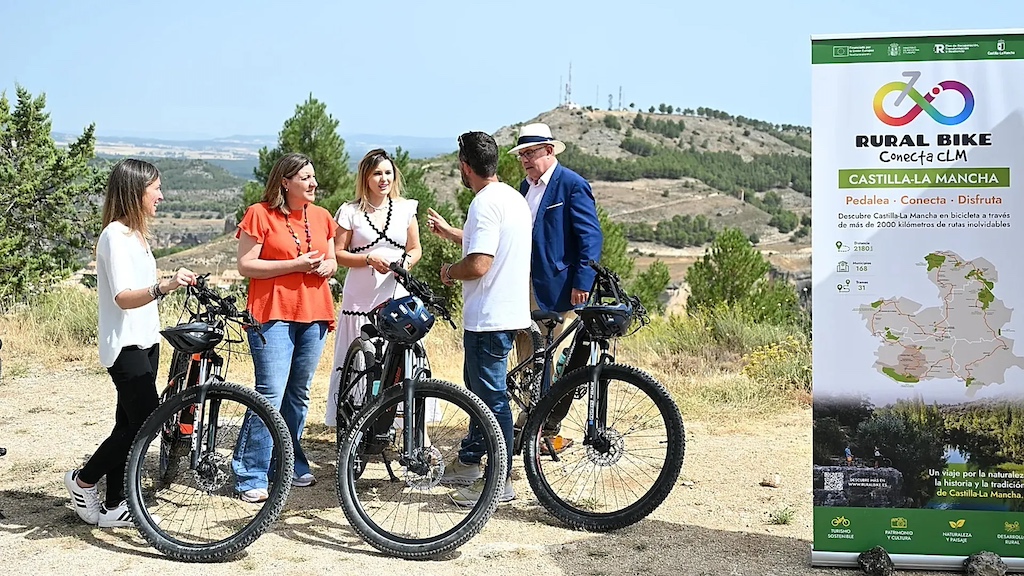



Castilla-La Mancha is offering visitors a slower, more Don Quixote-esque way to discover the region, albeit on two wheels rather than horseback. The new Rural Bike Conecta CLM route invites cyclists to explore 168 municipalities from the saddle, taking in the windmills that inspired Cervantes’ immortal knight, UNESCO-listed cities, and some of Spain’s richest natural landscapes.
The €2.4 million network was developed with funding from the EU’s Next Generation programme and implemented by the regional government as part of its sustainable tourism strategy.
Castilla-La Mancha is home to one of Europe’s highest concentrations of protected natural areas and now offers cyclists a route linking two national parks, seven natural parks and two UNESCO Global Geoparks, passing through provincial capitals and remote rural communities along the way.
The path weaves together historical trails, disused railway lines and existing paths. More than 3,200 signposts have been installed to help cyclists stay safe and on course, and the surface of 168 kilometres of the route has been upgraded.
Sights to slow down for include Tablas de Daimiel National Park, where cyclists can dismount and explore on foot along one of three self-guided walking routes, including one leading to a viewpoint described by Spain’s tourism board as offering one of the finest sunsets. Other highlights include Cabañeros National Park, which has 16 marked walks through lush greenery, diverse birdlife and wildlife, framed by vast Mediterranean plains and rugged mountains.
Beyond nature, the route passes through Toledo, a UNESCO World Heritage city renowned for its Jewish and Moorish heritage, before descending into the canyons of Cuenca and passing the windmills of Ciudad Real, the very same La Mancha windmills that were made famous in Don Quixote.
The project was spearheaded by the region’s Ministry of Economy, Business and Employment. Its head, Patricia Franco, described the new network as an “invitation to enjoy nature and active tourism”, adding that it also serves as “a starting point and a route throughout our region”.
Franco said the project would help “strengthen and consolidate” the region’s tourism prospects, which she described as “very positive so far this year”.
According to the latest Exceltur Barometer, Castilla-La Mancha recorded the strongest growth in Spain’s tourism sector in the second quarter of the year, with revenues rising by 11.9%.
This is a positive sign, given that Spain is still dealing with the issue of overtourism in popular destinations such as Barcelona, Mallorca and the Canary Islands, and is trying to divert some of this pressure towards its less popular regions.
This off-main-attraction-track initiative, with its eco-charming outlook likely to appeal to younger generations, could be a turning point and have a huge impact. Rather than depositing coachloads of tourists in villages unprepared for such numbers, it has the potential to inject fresh income into rural communities one bicycle at a time.
The network has been designed for cyclists of all abilities, with routes ranging from gentle, paved sections suitable for families and occasional riders, to gravel tracks and mountain bike trails for more experienced cyclists.
Plans are also in place to eventually connect Rural Bike Conecta CLM to EuroVelo, a network of 17 long-distance cycle routes spanning the continent. These routes run from London to Amsterdam, Brussels to Luxembourg and as far as Zagreb, Bucharest and Athens.