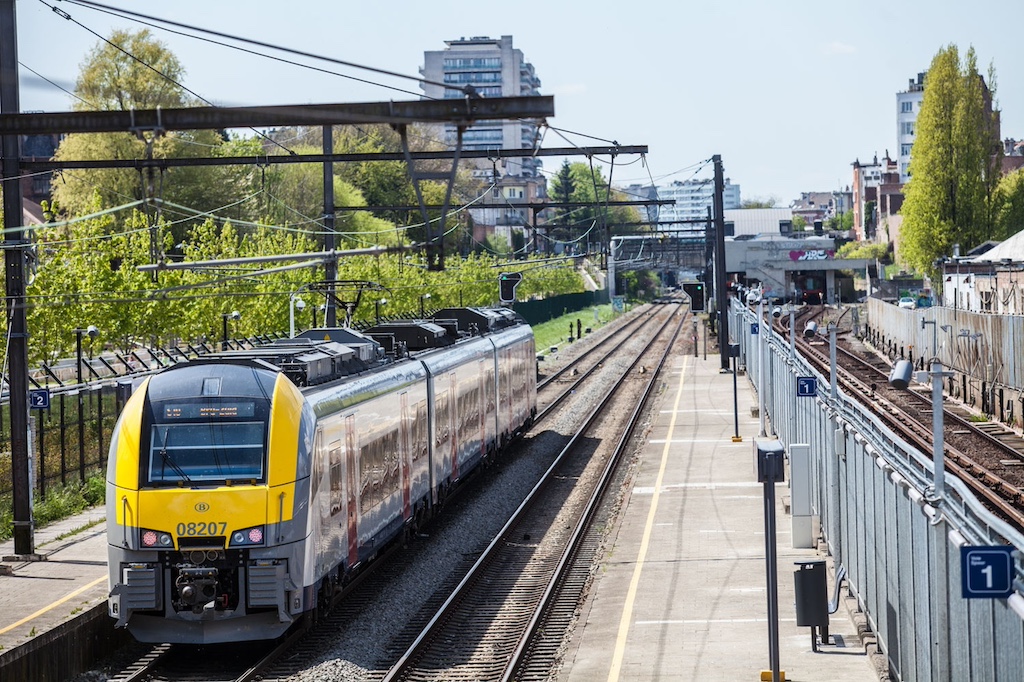



International train travel is becoming more popular among Belgian travellers, according to new figures released by operator NMBS/SNCB that show a six percent increase in cross-border peak season journeys year-on-year.
The summer of 2025 saw 1.6 million international fares purchased in Belgium, up from 1.5 million in the same period of 2024, an increase that commentators are attributing in part to expanding connectivity reaching a wider range of destinations. From the Belgian capital, it is now possible to take the train to 6000 destinations across fifteen European countries, with 1000 of them six hours or fewer away.
Sustainability is also a key factor driving rail uptake, which has seen a more than 50% increase since 2019. A recent Monitoring Sentiment for Intra-European Travel survey by the European Travel Commission found that over three-quarters (76%) of Europeans say climate-related factors influence their travel behaviour. Tying in with that data, NMBS/SNCB pointed out how few carbon emissions per kilometre are generated by train compared to commercial aviation. Travelling by train emits about 80% to 90% less carbon dioxide per passenger-kilometre than flying. The same is true for trains versus cars (depending on occupancy and car-pooling rates), and, what’s more, trains cause less stress and provide more comfort than planes or cars for travelling city to city, the operator claims.
France is the preferred destination for Belgians, who can easily reach northern French cities such as Paris and Lille, as well as those further afield and in the south, such as Lyon, Avignon, and Montpellier. Cross-channel journeys to the UK capital, London, are also a frequent choice, alongside Amsterdam and Rotterdam in the Netherlands, and Cologne and Berlin in Germany. More far-flung destinations like Austria, Czechia, Italy, and Spain are also becoming more and more sought-after.
International passengers will find the offer from Belgium expanding further in the coming years, thanks to NMBS/SNCB plans to connect to 8,000 international train destinations by 2030, a “continuously growing range” which the operator says, “confirms the role of Brussels South Station as an important international hub in Europe, with nearly 300,000 travelers weekly.”
An important element of that expansion activity is the Belgian operator’s deepening relationship with foreign train companies. With French operator SNCF, it will be growing the OUIGO service, and a collaboration with Switzerland’s SBB will extend the Brussels-Strasbourg route (TGV INOUI service) to link to Basel in Switzerland. In addition, since 2024, Belgium has been cooperating with Dutch NS to run Eurocity Direct, a service offering direct trains from Brussels to Amsterdam South or Rotterdam.