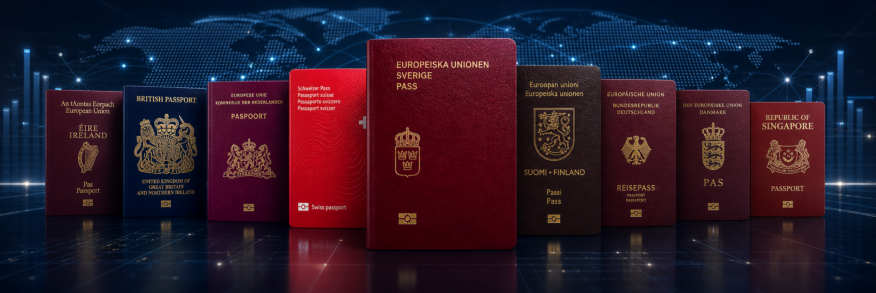



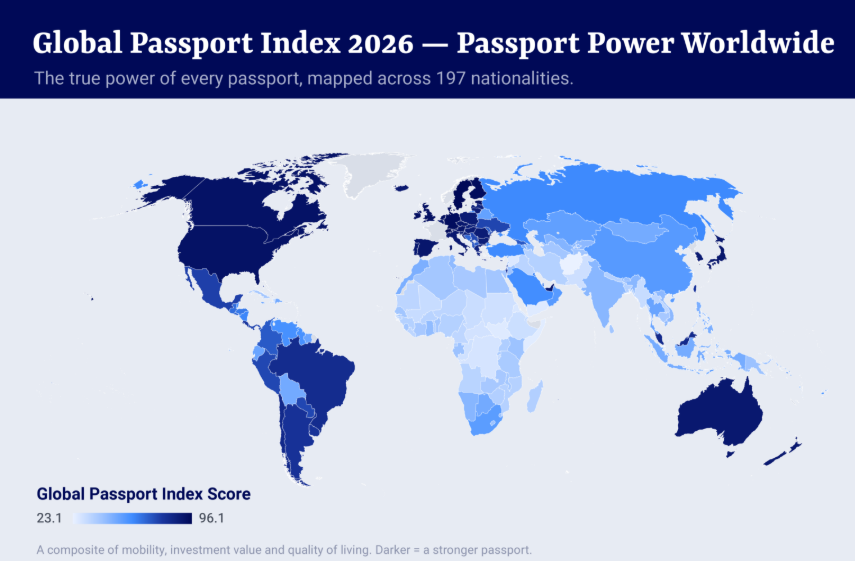
The fifth edition of the Global Passport Index has been published and, once again, the top ten of most powerful passports is being dominated by Europe. The ranking takes into account factors such as Enhanced Mobility, Investment, and Quality of Living.
Passport rankings aren’t new. Every year, a few organisations publish their overview of the world’s strongest passports. Among them, the Henley Passport Index is probably the most well-known and is based on the number of visa-free destinations per passport. In its 2026 top 10 of countries with the most powerful passports, the Henley Passport Index mentions Singapore, Denmark, and Soutch Korea as the global winners.
On 1 July 2026, however, investment migration firm Global Citizen Solutions launched the fifth edition of its Global Passport Index (GPI). Contrary to most other rankings, which mainly take into account the number of visa-free destinations, the GPI synthesises fourteen indicators overall across three weighted pillars: Enhanced Mobility, Investment, and Quality of Living – including factors such as economic competitiveness, healthcare, tax environment, climate, safety, and social infrastructure. This led to a Europe-driven top ten, with the exception of Singapore.
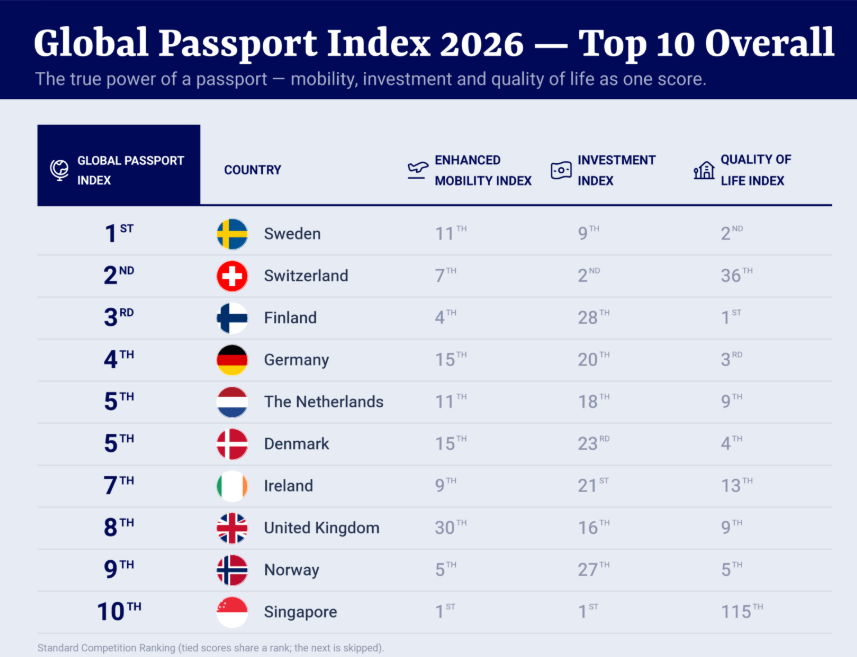
“Europe’s dominance of the Global Passport Index is total at the top, and it is built on balance, not on any single strength. The nine most powerful passports in the world in 2026 are all European, led by Sweden, Switzerland, and Finland. What is striking is how they win. On pure travel freedom Singapore beats every one of them, and on raw investment pull several Gulf and Asian states rival them. Europe’s edge lies elsewhere: it is the only region that pairs near-maximum global access with the world’s highest quality of life, the one dimension no government can create through treaties or tax incentives,” said Patricia Casaburi, CEO at Global Citizen Solutions.
According to Global Citizen Solutions, three macro-developments were defining in 2026.
The mobility divide continued to harden: Sweden (96.05) now sits 72.95 points above Afghanistan (23.10), and the gap between the strongest and weakest passports has widened in every edition since 2021, the top of the ranking gaining incrementally while the bottom loses ground in absolute terms.
The bilateral analysis underlying the 2026 index reveals: reciprocity is not the rule on bilateral mobility agreements, and that the world’s most privileged passports are concentrated in the wealthy Anglosphere and Gulf sates.
The two halves of the global system moved in opposite directions: the Global North converged on digital pre-screening (the UK Electronic Travel Authorisation, the EU Entry/Exit System and forthcoming ETIAS, and the long-standing US ESTA), adding friction even to destinations the index scores as highly open. Meanwhile Asia, led by China’s visa-free expansion to roughly fifty countries with the United States pointedly excluded, moved the other way, a system liberalising and tightening at once, along lines that track wealth and geopolitics rather than any global trend.
The Global Passport Index invites people to look beyond the sheer number of visa-free destinations, while also underlining the fact that it is becoming harder than ever for holders of a restricted passport to gain global access.