

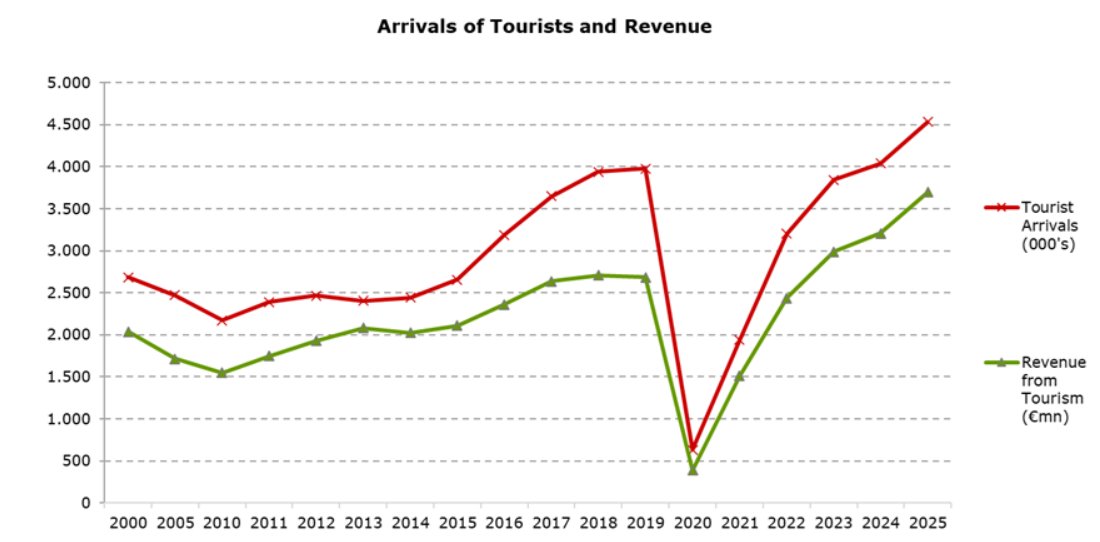
Tourism revenues in Cyprus fell by over a third in April 2026 compared to the same month in 2025, revealing the impact of the Middle East conflict prompted by Israeli and US attacks on Iran in February.
The latest figures from the Cypriot Statistical Service indicate a 35.1% drop in revenues year-on-year, with the Travellers Survey clocking up revenue of €197.5 million, compared with the month of April 2025 when revenue was €304.2 million.
Over the winter to spring period between January and April, the downturn was less severe, at a drop of 23.9%, since nearly two of those months fell before the war with Iran broke out and actually recorded year-on-year growth in visitor arrivals and income of around seven per cent.
But those arrivals fell away after the conflict began, and a drone strike on the British Sovereign Base Area in early March led the US State Department to urge would-be tourists to “reconsider travel” to Cyprus, raising its travel advisory for the territory to level three. A number of European nations followed suit.
Unsurprisingly, across March, arrivals then plummeted 30.7%, and revenues fell 33.8%. The recent data shows that the situation for Cypriot tourism stakeholders continued to worsen into April.
Overall, per capita, visitors spent €651.77 each in April 2026, compared with €726.42 in April 2025, a 10.3% drop. Breaking it down by market, UK visitors (Cyprus’ biggest source market) represented 39.2% of arrivals in April 2026, spending €86.43 per day on average. Polish visitors were the second-largest source market for April, accounting for 8.4%) and spending €81.89 per day. German tourists came a close third in terms of numbers, composing 8% of the total, and spent more than the Poles, but less than the Brits (€85.99).
Commenting on the figures, Deputy Minister of Tourism Kostas Koumis said it was “well known” that the sector “was significantly affected by the conflict in the Middle East and its aftermath. The 35.1% decrease in revenues in April 2026 compared with April 2025 was unfortunately expected.”
Koumis blamed April’s data on the ‘Jet Fuel Crisis’ and subsequent “tremors in the pan-European tourism economy, bringing additional uncertainty and a slowdown in booking rates across Europe.”
Koumis also described a suite of measures taken by the state to support the travel sector, including bringing “dozens of foreign journalists” to Cyprus “to convey the true picture of the destination, which is characterised solely by safety.” Promotional activities abroad were “stepped up,” he said, and strategic partnerships “strengthened.” He went on to argue that: “The improvement in tourism performance in the months that followed proves that the measures taken had a positive impact, but above all we are pleased to see the tourism sector back on a stable course.”
As the closest European Union territory to Israel, Cyprus usually benefits not only from European Union visitors keen on its Mediterranean climate, but also from significant numbers of visitors from Israel (13%). With flight schedules in and out of Tel Aviv gradually normalising, Cypriot stakeholders will be hoping that the record growth seen in 2025 will pick up again during the last two quarters of 2026.