

Some Gulf airlines are operating almost at pre-Iran-War levels, recent flight data shows, meaning that aviation appears to be recovering from the conflict, which saw mass disruption caused by the grounding of some of the world’s largest carriers.
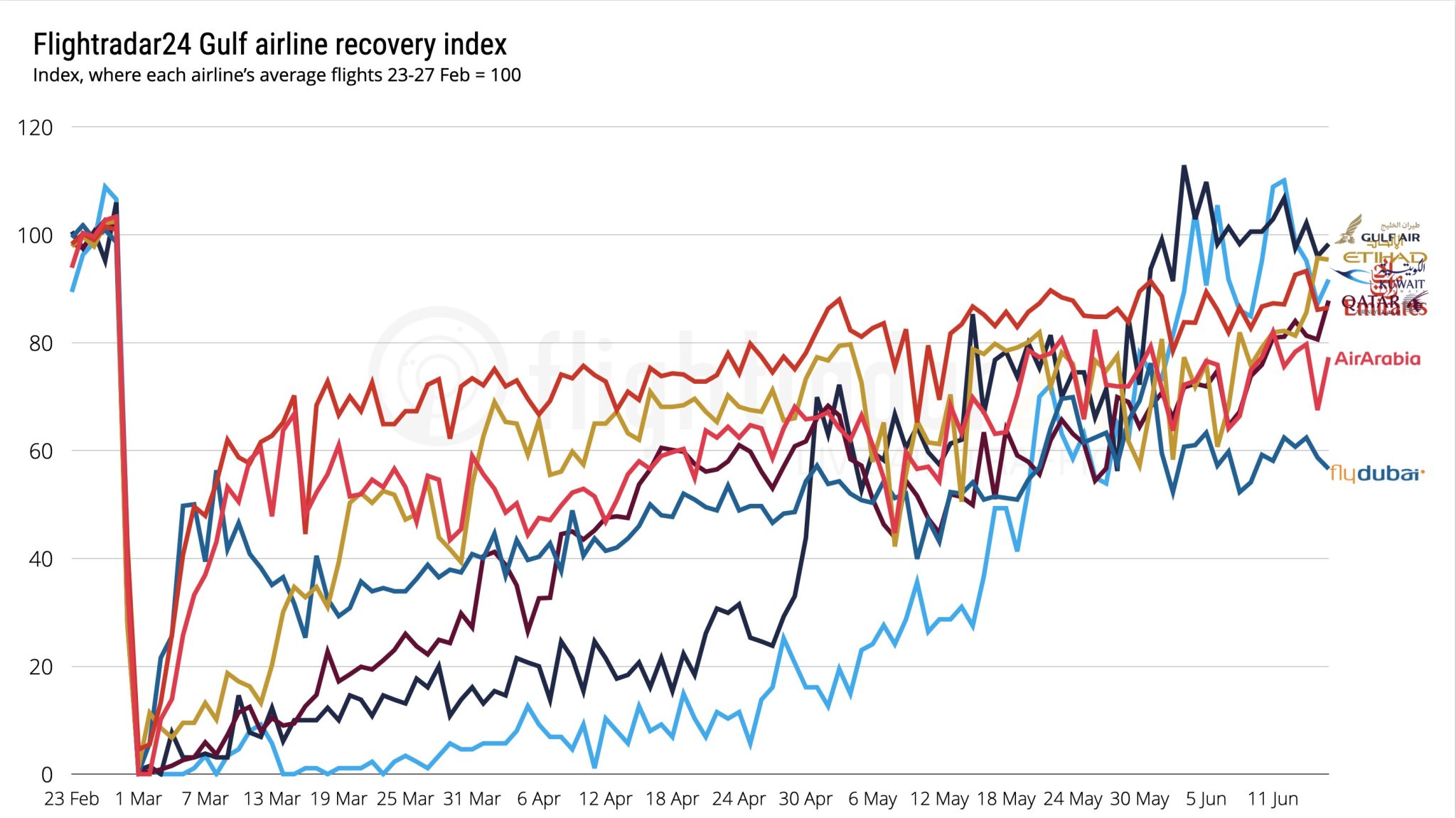
Emirates, Qatar Airlines, and Etihad (the three largest Middle East airlines) have returned to flying at or above 90% of their pre-conflict flight numbers, according to Flightradar24 data. Meanwhile, Gulf Air (usually ranked five for size) and Kuwait Airways (outside the top 10) have now exceeded the flight numbers they were handling before the war began in late February 2026.
The geopolitical tensions led to drone attacks and missiles on Gulf infrastructure that effectively closed down aviation in the region and led to the stranding and emergency repatriation of thousands of visitors, amid worldwide travel warnings.
Four months later and with a ceasefire package signed, stakeholders and analysts are hopeful that Gulf airspace and airports, which include some of the world’s busiest international hubs, will see a quick return to business as usual. James Halstead, managing partner at Aviation Strategy, reported by Kuwait Times said: “If it gets back to normal, I just see them acting as normal, coming back in full force.”
In a session on the Middle East with regional partners.
— Ursula von der Leyen (@vonderleyen) June 16, 2026
First, we need to ensure the full restoration of freedom of navigation in the Strait of Hormuz, without restrictions.
Second, the events in the Strait have highlighted vulnerabilities that we need to adress.
We should… pic.twitter.com/rWMP5xvhV2
Australia recently lifted its alerts for a number of Middle Eastern nations, so that should mean an uptick in traffic. Turkish Airlines resumed flights to Amman, Beirut, and Damascus on 1 May, to Doha on 8 June, and to Dubai on 9 June. And Abu Dhabi is set to hit Turkish schedules again on 1 July.
Air France is set to resume flights to and from Beirut and Dubai on 24 June, when the European Union Aviation Safety Agency (EASA)’s “exercise caution” warning for flights to Bahrain, Kuwait, Israel, Jordan, Qatar, Oman, UAE and Saudi Arabia, may be eased. SunExpress has suspended Dubai flights until 30 June, and Bahrain, Beirut, and Erbil flights until 14 July.
Similarly, airBaltic is due to resume flights between Riga and Tel Aviv from 1 July, and KLM will recommence Dubai, Riyadh, and Damman operations on 10 August. August is also the month when British Airways will fly again to Doha and Riyadh.
While all that is good news for a region heavily invested in developing its tourism sector as it pivots away from fossil fuel exploitation, Mateusz Klimek, an airline network planning expert, told Euronews Travel: “Many airlines that were flying to the Gulf region have used those planes to add extra capacity to other destinations in Asia as people choose to fly nonstop. Once you add that capacity, you don’t want to change it back because of the disruptions to passengers and the costs.”
Accordingly, British Airways is not due to return to Amman, Bahrain, Dubai, or Tel Aviv, until 25 October, and will not be resuming flights to Jeddah at all. Likewise, many carriers, including the Austrian Airlines, airBaltic, Finnair, suspended operations to a range of Middle East destinations until the autumn, and Norwegian has announced an indefinite suspension of its Beirut and Tel Aviv routes.
To tempt travellers back, though, Etihad has a special offer for free Abu Dhabi complimentary medical insurance from July until December. It’s a strategy in line with Emirates approach, whose CEO Tim Clark has told Reuters promoting the region’s reputation for safety and reliability is the way to get consumers to return. If it works, the region’s economies could do better than expected, but only last week the International Air Transport Association slashed its 2026 forecast for the aviation sector in half, anticipating net profits of $23 billion – a drop of $22 billion since 2025.