


According to a new analysis commissioned by the World Travel & Tourism Council (WTTC), hefty EES border delays could cause a blow to the European travel industry. The WTTC warns that 41 million visitor arrivals and $45.4 billion in visitor spending would be at risk.
The new European Entry/Exit System (EES), the rollout of which debuted in October 2025, officially launched on 10 April 2026. The system eliminates the need for manual passport stamping at borders, instead gathering biometric data from non-European, third-country arrivals to any of the 29 nations that are part of the Schengen Zone. It is free to use and applicable to those without a residence permit or long-stay visa for stays of up to 90 days within any 180-day period.
While on paper and in the long term, EES should improve the border crossing process, the introduction of the system is not going as smoothly as some players had hoped. Due to long queues at airports across Europe, even before the start of the busy summer season, travellers are already missing their flights and budget airline Wizz Air recently urged people to arrive at the airport at least three hours in advance.
Now, research commissioned by the World Travel & Tourism Council (WTTC) and based on interviews with 2,500 travellers from the United States, Canada, the UK, and Australia shows that the complicated rollout of EES might have a serious impact on the European travel industry.
“The introduction of EES is an important step forward in modernising Europe’s borders and strengthening security. Our research clearly shows that travellers support digital and biometric border systems and understand the long-term benefits they can deliver,” said Gloria Guevara, President & CEO of WTTC.
The analysis found that if travellers were to face regular border waits of three to four hours when entering the Schengen Area, around one-third would become much less likely to travel to Schengen or would choose not to visit at all. UK travellers would be most likely to change their plans in such a scenario (39%), followed by 33% of travellers from both the United States and Canada, and 27% from Australia.
When applying these findings to 2026 visitor forecasts, this would imply that EES border delays exceeding three hours could put 41 million visitor arrivals and $45.4 billion in visitor spending at risk.
“As with any major transformation, there will inevitably be teething problems. The challenge now is not whether EES should proceed, but how governments, border authorities and the Travel & Tourism sector work together to ensure implementation is as smooth as possible. The good news is that solutions already exist. By making greater use of digital pre-registration tools, improving traveller communications and ensuring operational readiness at border crossing points, Europe can reduce friction and deliver the seamless experience travellers expect,” Guevara continued.
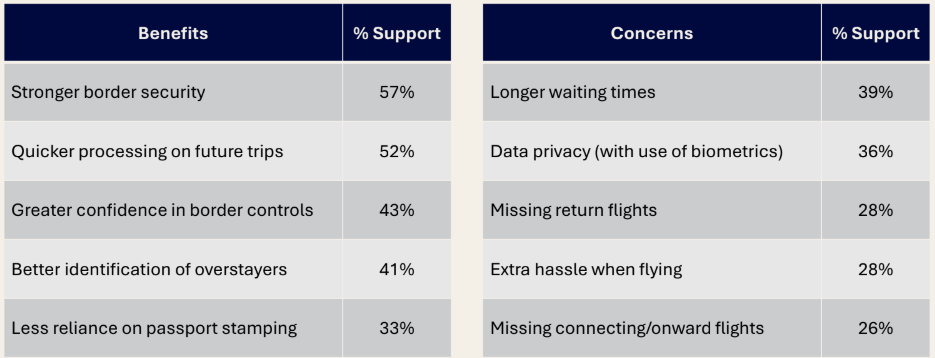
Although the numbers might be cause for concern, the WTTC points towards a positive: interviewees showed a strong underlying support for EES. 65% supported the system after learning about it, while only 6% are very negative towards the use of biometric border controls. Factors including stronger border security (57%), quicker processing on future trips (52%), and greater confidence in border controls (43%) were regarded as the system’s most important benefits. However, more than half of travellers (55%) had heard little or nothing about EES, while 49% did not know what would be required of them when entering or exiting the Schengen Area.
To support a successful rollout, the WTTC is calling for three priority actions:
- Member States should accelerate the adoption of the Travel to Europe app for digital pre-registration.
- A coordinated communication campaign is needed across key source markets, particularly the UK, US, Australia, and Canada. Clear step-by-step guidance should be provided to airlines, airports, travel agents, tour operators, and destination partners so that travellers understand exactly what is required before they travel.
- Member States must ensure operational readiness across all border crossing points. This includes fully functioning equipment, sufficient staffing levels and measures to streamline processing wherever possible, including for travellers who have already provided biometric data through visa procedures.