

The most controversial hotel on Poland’s Baltic coast is about to open its doors. This five-star behemoth was built on a former military site and cost nearly 1,500 trees. It is already making Germany nervous.
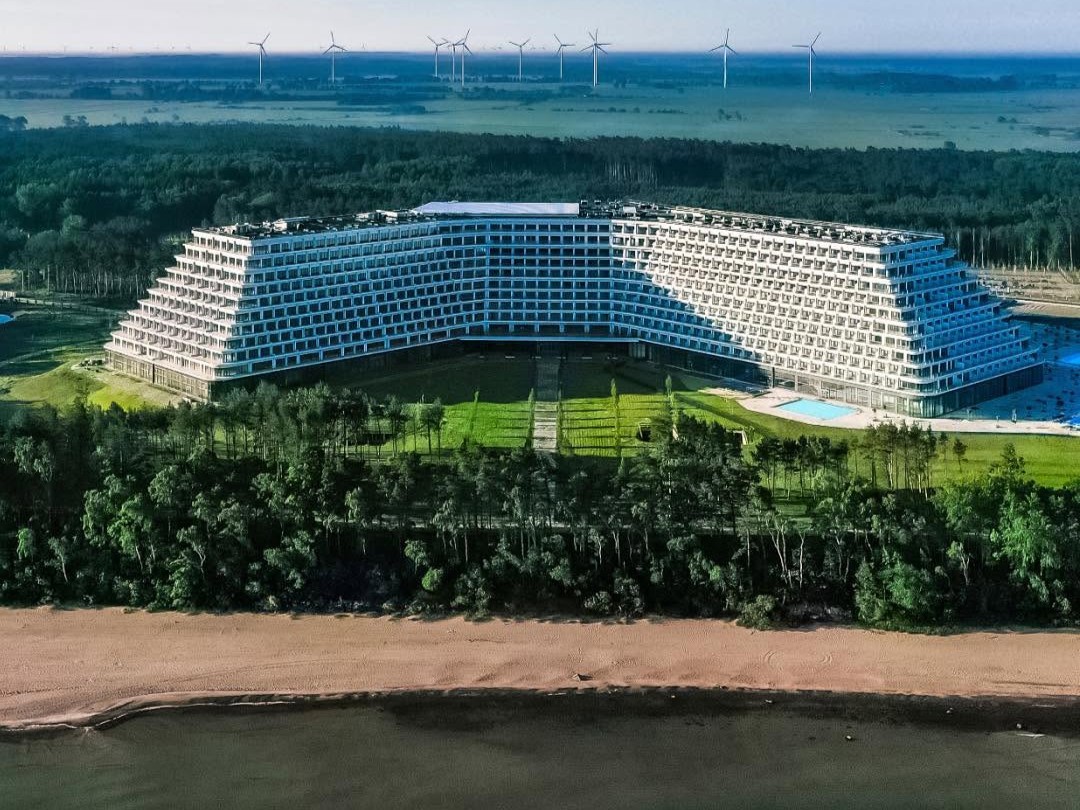
Located in Pobierowo, a small seaside resort with a population of around 1,000 on Poland’s north-west coast near the German border, the 13-floor, 1,240-room hotel is the fifth and most ambitious project of the luxury Gołębiewski chain.
The chain’s founder, Tadeusz Gołębiewski, started his career selling wafer rolls before entering the hotel business in 1991. He laid the foundation stone in 2018 on land that the Rewal municipality had sold the previous year for 50.5 million zloty (around €11.8 million).
Construction took eight years, with the opening delayed several times due to permit issues, the pandemic, and construction disputes.
Gołębiewski died in June 2022, before seeing his flagship project completed.
Spanning 180,000 square metres and located just 150 metres from the beach on the Baltic Sea, the outdoor pool is an impressive 104 metres long by 60 metres wide. The Tropikana water park, indoor pools and whirlpools cater for families, while adults can enjoy a spa with 11 treatment rooms, a salt cave and an ice cave.
The hotel also features a cinema, a bowling alley, a nightclub, a supermarket, volleyball courts, and entertainment for children. As guests wander from one activity to the next, they can enjoy the sounds of a live pianist in the lobby.
Demand has been staggering, with over 2,000 bookings within the first 24 hours of reservations opening. In fact, demand has been so high that the hotel has brought forward its opening date from 26 June to 10 June, two weeks ahead of schedule and before all the rooms and attractions are ready.
For now, only around 500 of the 1,240 rooms are expected to be available. The rooms, suites and apartments measure around 50 square metres each and many have balconies with sea views. Prices start at around €350 per night, with suites reaching up to €900.
Summer in Pobierowo is pleasant, if not scorching, with temperatures reaching around 22°C and sea temperatures reaching 18–20°C. The region is renowned for its iodine-rich sea air, pine forests, and expansive sandy beaches.
The German press was quick to nickname the project ‘Little Dubai’, describing it as absurd and megalomaniacal. However, hotel director Barbara Garczyńska chose to embrace the comparison rather than deflect it. “I understand the scale evokes associations,” she told Gazeta Wrocławska, “but if we are to be like Dubai, a place full of amenities and luxury, then so be it. If guests choose to relax on the Polish Baltic instead of travelling to the other end of the world, that will be our greatest satisfaction”.
@jas.stas_lifetrip Znamy dokładną datę otwarcia Hotelu Gołębiewski w Pobierowie. Pierwszy sezon nad morzem sieć rozpoczyna 26 czerwca. W połowie maja zostanie udostępniona możliwość rezerwacji. Do dyspozycji gości park wodny Tropikana, baseny oraz restauracje.
♬ Into The Light – Brand X Music
Berlin is a three-hour drive away, and the German holiday island of Usedom is just half an hour away. Garczyńska makes no secret of expecting a steady flow of guests from Germany and the Czech Republic as well as Poland.
Not everyone shares her enthusiasm. The Sueddeutsche Zeitung called it “the largest and perhaps the ugliest hotel on the Baltic coast,” comparing it to a cruise ship run aground and drawing a parallel with Prora, the vast Nazi-era complex built on the German Baltic coast for 20,000 workers, which never opened as a resort. “Prora is historical megalomania,” the paper wrote. “Pobierowo is a slightly smaller but contemporary folly.”
For many Poles, the concrete colossus rising where a forest once stood recalls the brutalist apartment blocks of the communist era.
Nevertheless, tourism operators in Mecklenburg-Vorpommern are watching closely. Their largest Baltic hotels have fewer than 500 rooms each, and some fear that travellers, spending, and hospitality workers will cross the border in favour of newer, cheaper infrastructure. Located just 60 kilometres from the German border, the Gołębiewski could transform the landscape of Baltic tourism.