
It’s lined up to join the EU in less than three years, but what does Albania’s capital city have to offer tourists?
A brief history
Tirana grew from a small trading settlement into Albania’s capital by 1920 due to its central location. The city transformed from an Ottoman town into a capital with Italian-influenced architecture, but later endured a harsh communist dictatorship from 1944 to 1992.
Stalinist dictator Enver Hoxha led a harsh, isolationist regime that built bunkers, transformed cityscapes with socialist style housing, and tore down religious buildings.
Today, though, this delightful capital has evolved into a vibrant, colourful European city.
Communist past
No visit to Tirana is complete without dipping into a period of time that, one imagines, many Albanians may now prefer to consign to history: the communist era.
Having said that, relics from that period are scattered around the city and are now “must see” tourist spots.
These very much include Bunk’art, a communist era nuclear protection bunker which you could easily miss were it not for several large notice boards pointing you in its direction.
This really is a fascinating place to visit. You descend a few steps below ground to encounter several tunnels and rooms, now converted into a museum, art space and learning experience.
@damianos_gkinis Creepy, silent, underground. Bunk’Art📍 #BunkArt #Tirana #VisitAlbania #CreepyPlaces #traveltiktok ♬ Creepy and simple horror background music(1070744) – howlingindicator
These contain sometimes rather harrowing photos and information about the country’s gruesome and recent past.
Located just a few steps from Skanderbeg Square, the city’s main public square, it is arguably at its best when telling the personal stories of those who experienced the worst extremes of communist doctrine.
Another must see attraction is the House of Leaves, a building just outside the city centre that was originally a humble maternity hospital.
It later became an interrogation centre and torture chamber under previous regimes and, again, retells the stories of ordinary Albanians who were sometimes cruelly treated by the feared secret police, known as the “Sigurimi”.
Woe betide anyone considered a “traitor” to the state.
The site also contains an impressive collection showing some of the intriguing ways the political leaders of the time spied on their own people, as well as foreigners.
It seems hardly any conversation escaped recording or monitoring, with listening devices inserted into all manner of objects, including broomsticks, ties and pipes.
Skanderbeg Square
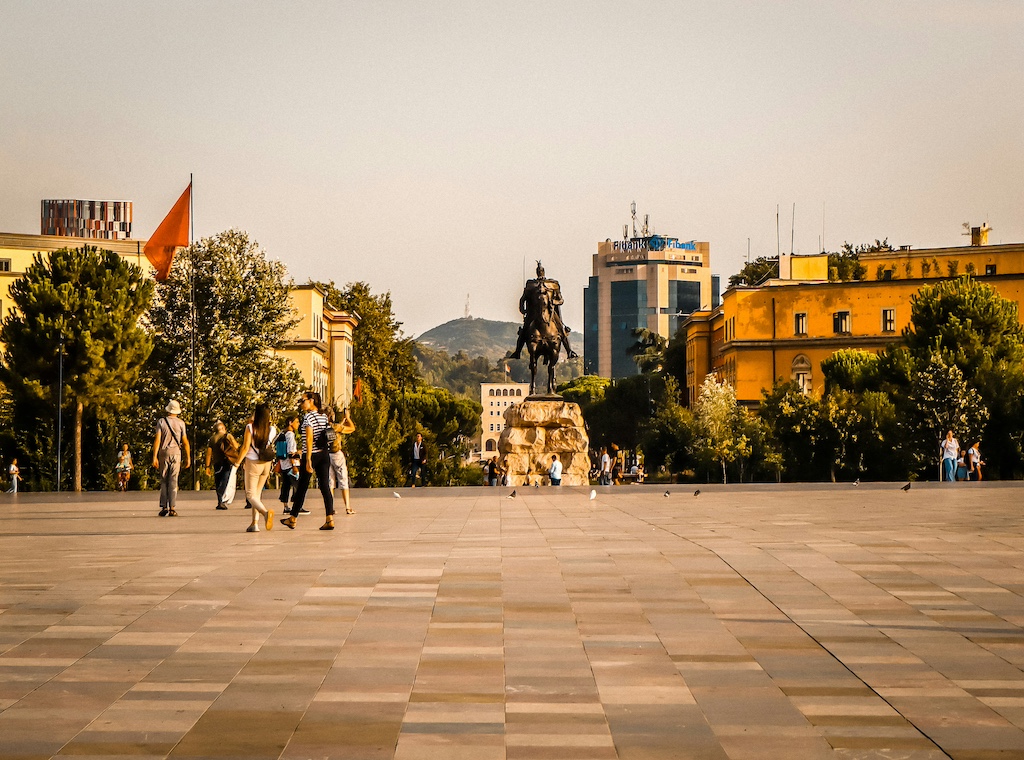
Think Brussels’ Grand Place but about six times the size and you get some idea of the scale of this huge public space in the centre of Tirana.
It was built by the Austrians in 1917 and is named after Skanderbeg, the 15th century Albanian military leader and national hero. He is also honoured with statues in other cities around the world, including Brussels. Skanderbeg died from malaria in 1468.
The square is surrounded by what can only be described as a highly eclectic mix of architecture, some dating from the communist era, and is a great starting point for any visit to the city.
Coffee and George W. Bush
Don’t scoff. This city really is in love with both.
Walking around with a cup of coffee has become de rigueur in many places, but here it is deeply ingrained in the local culture as a vital social ritual and not just a caffeine boost.
Tirana is known for having one of the highest numbers of coffee shops per capita in the world. They really do seem to be on every corner. Cafés in Tirana serve as essential hubs for connection, business meetings and leisure.
With the fall of communism in the 1990s, cafés exploded as public social spaces, and you will see people sitting for long periods of time, putting the world to rights over a very often tiny cup of coffee.
This must also be one of the few places with its own dedicated coffee museum.
It is called Komiteti Kafe Museum and, again, is easily missed, not least because it also doubles as a café, albeit one of the most colourfully decorated you are likely to come across.
@eli_radu30 ☕️ If you’re visiting Tirana, don’t miss Komiteti — Kafe Muzeum, a cafe that feels like stepping into Albania’s story. Every corner is filled with history, vintage decor, and the coziest atmosphere — perfect for a slow coffee moment or an evening drink. 🇦🇱✨ 📍 Komiteti Kafe Muzeum, Rruga Fatmir Haxhiu, Tirana #tirana #albania #komiteti #travelalbania #cafehopping ♬ original sound – 𝓙ᝰ.ᐟ
It is retro inspired and full of vintage memorabilia, which is worth seeing in itself. But, of course, you should also sample one of its many varieties of coffee and discover more about the country’s coffee culture.
Coffee we understand, but George W. Bush?
While perhaps not quite sharing the same level of obsession, the sometimes ridiculed former US president remains highly popular in Tirana.
This is primarily because he was the first sitting US president to visit the country, doing so in 2007, and for his active support of Albanian interests, particularly Kosovo’s independence and Albania’s NATO membership.
President Bush received a “rock star” welcome in Tirana and the town of Fushë Krujë, where crowds chanted “Boosh-y”.
There is a major road named after Bush, along with a library just outside the city centre.
More broadly, Albania has long held a deep appreciation for the US, dating back to President Woodrow Wilson’s support for Albanian independence in 1919.
An unexpected link with Belgium
Aside from both sharing an affinity with the EU, you would not necessarily expect to find much connecting this Western Balkans state with Belgium.
But pay a visit to the city’s Catholic cathedral and you may meet one of its priests, who hails from Bruges.
Father Koen Van Kershauer is a Flemish born clergyman who has been in Tirana for some 30 years.
He told this site what brought him to the city, saying: “I was in Germany at the time but I heard about how the former communist regime persecuted and even killed priests and burned down churches.
“It was just after the fall of communism in the early 1990s and I decided I wanted to come here to help. I did not realise I might stay this long but I am happy here.
“I am also happy to say that today all religions, whatever they are, co exist happily together in Albania. I guess that is the best one can do,” said the 83 year old.
“I have witnessed major improvements in how religion is perceived here and how all denominations are treated.”
The stained glass window to the left of the cathedral’s front door features Pope John Paul II and Mother Teresa, who was of Albanian origin.
A statue of Mother Teresa can be found at the entrance of the cathedral, along with a very impressive huge montage made from seashells.
It is a modern looking building that does not resemble a traditional church, but it is well worth a visit.
So, what else is there to see?
Another religious attraction is the Et’hem Bey Mosque in the city centre, built between 1791 and 1794 by Molla Bey. During the totalitarian rule of the Socialist People’s Republic of Albania, the mosque was closed.
It was later declared a historical monument and underwent restoration in the late 1960s and 1970s.
On 18 January 1991, despite opposition from the communist authorities, some 10,000 people entered the mosque carrying flags. The event became a milestone in the rebirth of religious freedom in Albania.
The mosque’s frescoes depict trees, waterfalls and bridges.
Other attractions include the Pyramid of Tirana, originally the Enver Hoxha Museum named after the long time communist leader but now transformed into an art space, and the Grand Park of Tirana, ideal for a stroll around its lovely artificial lake.
Albania and the EU
Earlier this month, the EU celebrated Schuman Day, regarded as the beginning of what would later become the European Union.
While the occasion may have gone largely unnoticed even in some founding member states, there was considerable fanfare in Tirana.
This includes a specially dedicated area in the city centre displaying the flags of all current EU member states alongside the dates they joined the Union.
Albania, of course, is considered one of the leading frontrunners among Western Balkans countries to join the EU and is aiming to do so by 2030.
Unlike in some current member states, support for the EU is booming here, with public backing for membership said to exceed 90%.
A desire to raise living standards is among the reasons why many Albanians appear eager for their country to become the EU’s next member.
It is also worth noting that prices here remain very favourable, certainly when compared with countries such as Belgium, with a good meal and drink often costing up to 50% less.