


As the summer season begins, so do reports of poor behaviour in the world’s tourist destinations. The latest rage-bait example has occurred in Florence, Italy, where a 450-year-old fountain has reportedly been damaged by a visitor carrying out a bachelorette dare.
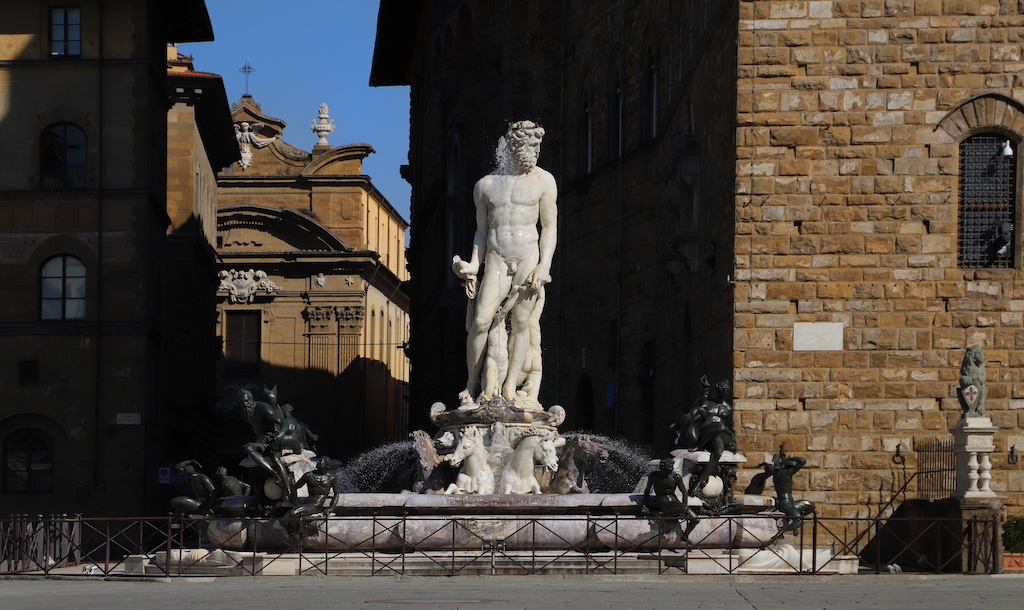
Designed by Baccio Bandinelli and portraying mythological figures, the Fountain of Neptune (also known as “Biancone” or “great white,” thanks to its luminous marble) stands in Piazza della Signoria. It was commissioned by the last Duke of Florence, Cosimo I de’ Medici, in 1559 and was meant to celebrate his gift of clean water to the city. It also featured in the marriage of his son and heir to Grand Duchess Joanna of Austria. Now, it has been a part of some wedding nuptials once again, much to the displeasure of authorities.
Only restored in 2019 at a cost of €1.5 million, the fountain was damaged again on 18 April 2026, allegedly by a woman who, police said, climbed over railings, stood on its edge, and made her way onto one of the horse’s legs. Officers removed her from the masterpiece immediately. She told them she had been trying to “touch the statue’s private parts as part of a sort of pre-wedding challenge.”
Experts from the Palazzo Vecchio Workshop have assessed the harm to the monument as “minor but significant,” with impacts on the horses’ hooves and a frieze that the woman held on to in an attempt to avoid falling into the water. The fountain now faces repairs estimated at a cost of €5,000 euros, according to the police statement, while the woman is now due to face judicial authorities, accused of defacing the country’s artistic and architectural heritage.
Long an object of curiosity and public antics, the fountain has previously suffered a broken hand after another 2005 incident where a tourist scaled its heights. Again, in 2023, a 22-year-old German tourist damaged it as he posed for photographs with the Roman sea-god. In the 16th century, city-dwellers used it to wash themselves in, spoiling its railings. And in 1848, during political unrest in Florence over Italy’s unification, it was struck by cannonballs. Balls of a different description appear to have been part of the most recent problem.
Italy, perhaps thanks to its dolce vita reputation, regularly features in reports about irresponsible tourism. In 2023, Rome’s iconic Trevi Fountain was breached by a visitor wanting to fill a water bottle. It now costs €2 to even approach the monument. A gondola in Venice capsized in the same year, when its passengers refused to stop taking selfies. Even natural assets cannot escape: in 2024, in a self-defeating protest about the negative effects of overtourism, an ancient rock in the Dolomites was graffitied with an anti-tourism slogan: “Tourists Go Home.” It remains to be seen whether visitors will prove they can behave themselves in 2026.