


Padel continues its trajectory of worldwide domination, both as a sport and a driver of travel, according to a report by the International Padel Federation (FIP) that calls the game “a global language, a cultural phenomenon, and, increasingly, a model of how growth can be guided by unity and shared purpose.”
The Federation highlights the racquet sport’s popularity, counting 35 million players around the world, and court capacity growth of more than 15% in a single year to reach 77,000 globally across 24,627 clubs and facilities. Many of those courts are appearing at hotels, apartment complexes, and resorts, which are using padel’s immense cachet to attract clientele.
Europe leads the way, with over 51,000 courts, followed by the Americas (18,500), where Mexico and Florida are seeing strong growth, and Asia (over 4,500), with Saudi Arabia the leader.
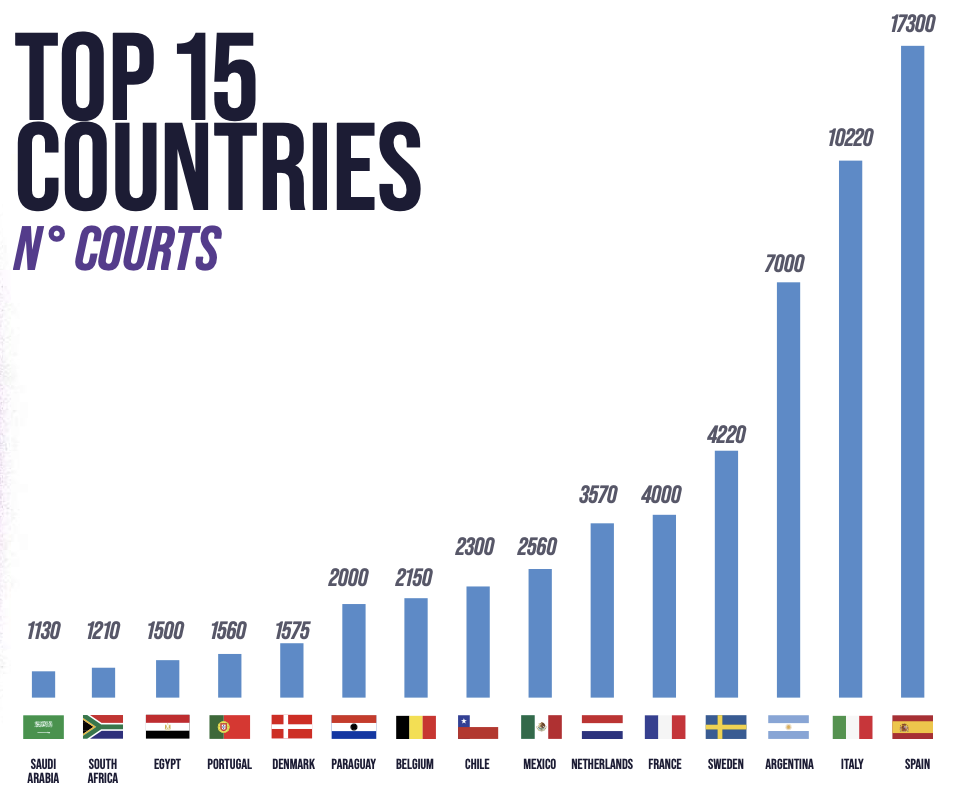
Within Europe, Spain and Italy are described as countries where the market is “consolidated,” while Eastern Europe is “in start-up phase” and “smaller countries” such as Switzerland (+400 courts ), Greece and Austria (+300 courts), Lithuania (+200 courts), Cyprus (+200) and Ireland (+100), are “ones to keep an eye on,” the Federation says. This interest in smaller nations ties in with one of padel’s main advantages over tennis, for example: more courts can be fitted into a compact space, meaning nations with mountainous terrain or little available room can still build a padel community.
More participants means more travellers who are interested in playing padel while they are away. Luciano Cestari, founder of LC Tennis & Padel Holidays in the UK, told Travel Tomorrow that client interest has pivoted. In 2021, his programmes were split 50/50 between tennis and padel. However, in 2026, nine out of ten of his packages will be padel-focused. Already operating in the UK, Portugal, and Menorca, Cestari, who “followed the birth of the sport in his native Argentina,” plans to expand to Italy next year.
More padel fans also means an appetite for events, and, as is well-documented, events are driving travel too. The International Padel Federation report highlights the “major global tours and international national team competitions organised by FIP — from Premier Padel and the CUPRA FIP Tour, to the FIP Promises, the FIP World and Continental Cups, and a brand-new circuit for amateur players for 2026, FIP Beyond.
These sporting fixtures involve participants, and are attended by supporters, from dozens of countries across the world and have been hosted in a diverse range of locations from Seville to Kuwait.
As Luigi Carraro, FIP President, said in a statement, the growth of padel embraces “an ever-widening circle of stakeholders.” That is a development that brings not only opportunities, he says, but “greater responsibility: to preserve the values that make Padel unique: accessibility, inclusivity, respect, and to ensure that as we grow, we also elevate the culture around our sport.”