


A new report shows how 19 global cities managed to achieve remarkable reductions in air pollution between 2010 and 2024. The best scorers include Beijing, Rotterdam, and Brussels.
Breathe Cities, a global initiative supporting cities to clean the air and enhance public health, published its Breathe Better: How leading cities have rapidly cut air pollution report at the beginning of March 2026. The study looked at air pollution in 96 global cities in the period between 2010 and 2024 to determine which succeeded best at reducing air pollution, with a particular interest paid to the fine particulate matter and nitrogen dioxide levels.
“Air pollution remains the largest environmental health risk worldwide. It causes cardiovascular and respiratory disease, increases childhood asthma, contributes to premature birth and low birth weight, and disproportionately affects lower-income communities”, the report reads.
Breathe Better showed that 19 international cities showed remarkable reductions in air pollution over the 15-year period. In order to make the list, the cities had to show a reduction of at least 20% in both fine particulate matter (PM2.5) and nitrogen dioxide (NO2), while some achieved reductions of around 45%.
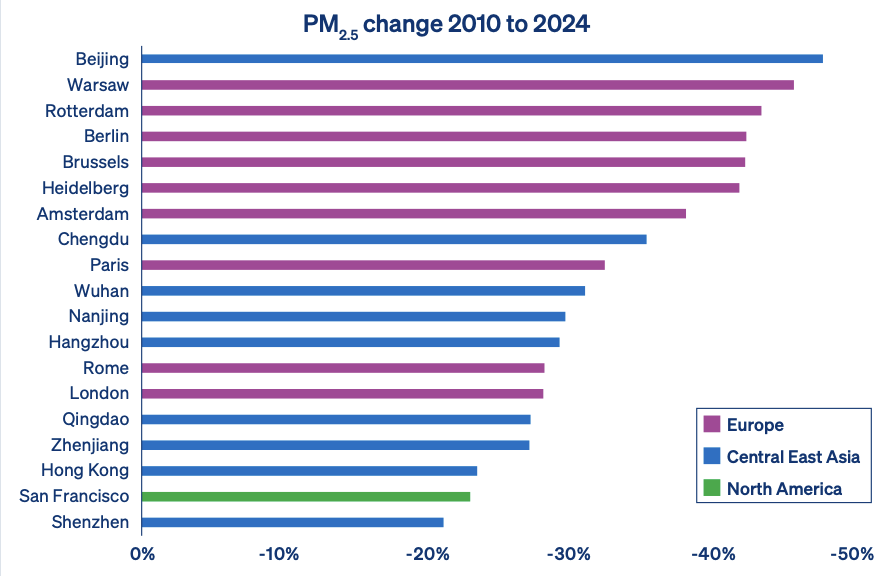
The list includes nine European cities, nine Asian cities, and one North American city. According to the researchers, the cities share several common approaches, making it possible for them to reduce air pollution.
Amongst them are developing air quality monitoring and emissions analysis, reshaping urban space in favour of clean mobility, modernising their public transport systems, accelerating the transition to electric vehicles, implementing low-emission zones to limit access for high-emitting vehicles, transitioning to clean fuels for cooking and heating, and translating city leadership into systemic change.
With regard to Brussels, initiatives such as the doubling of the length of its dedicated bike lane network, pedestrianising a large part of the city centre, and turning the entire city into a low-emission zone were highlighted and praised.
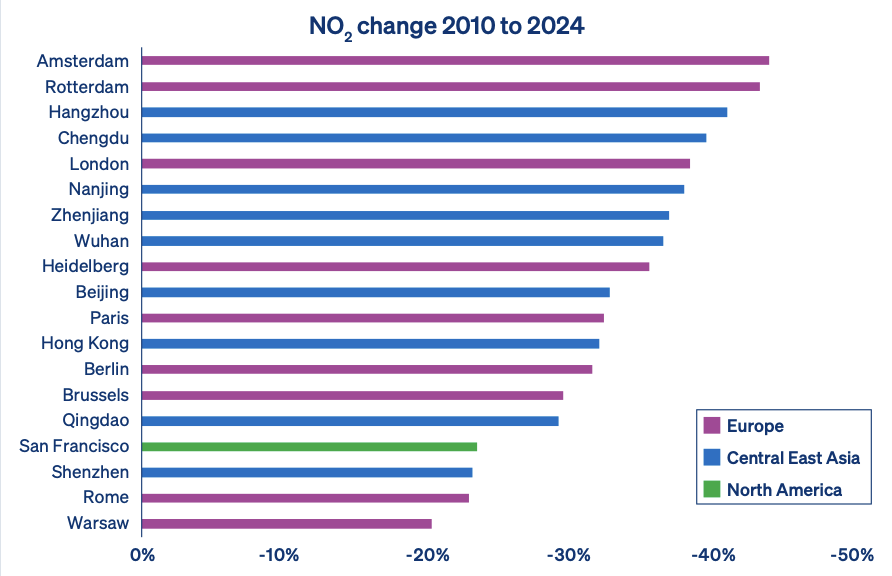
“The evidence highlights two key points. First, substantial reductions can be achieved within 15 years. Second, progress does not happen automatically; it requires deliberate, coordinated action sustained over time”, the report states.
According to the research, the results of the study are particularly interesting because they show that economic growth does not inevitably mean prolonged pollution if clean infrastructure and regulatory reform are embedded early. With rising public health pressures and climate risks, the 19 cities should be considered as examples in the transition towards healthier cities.