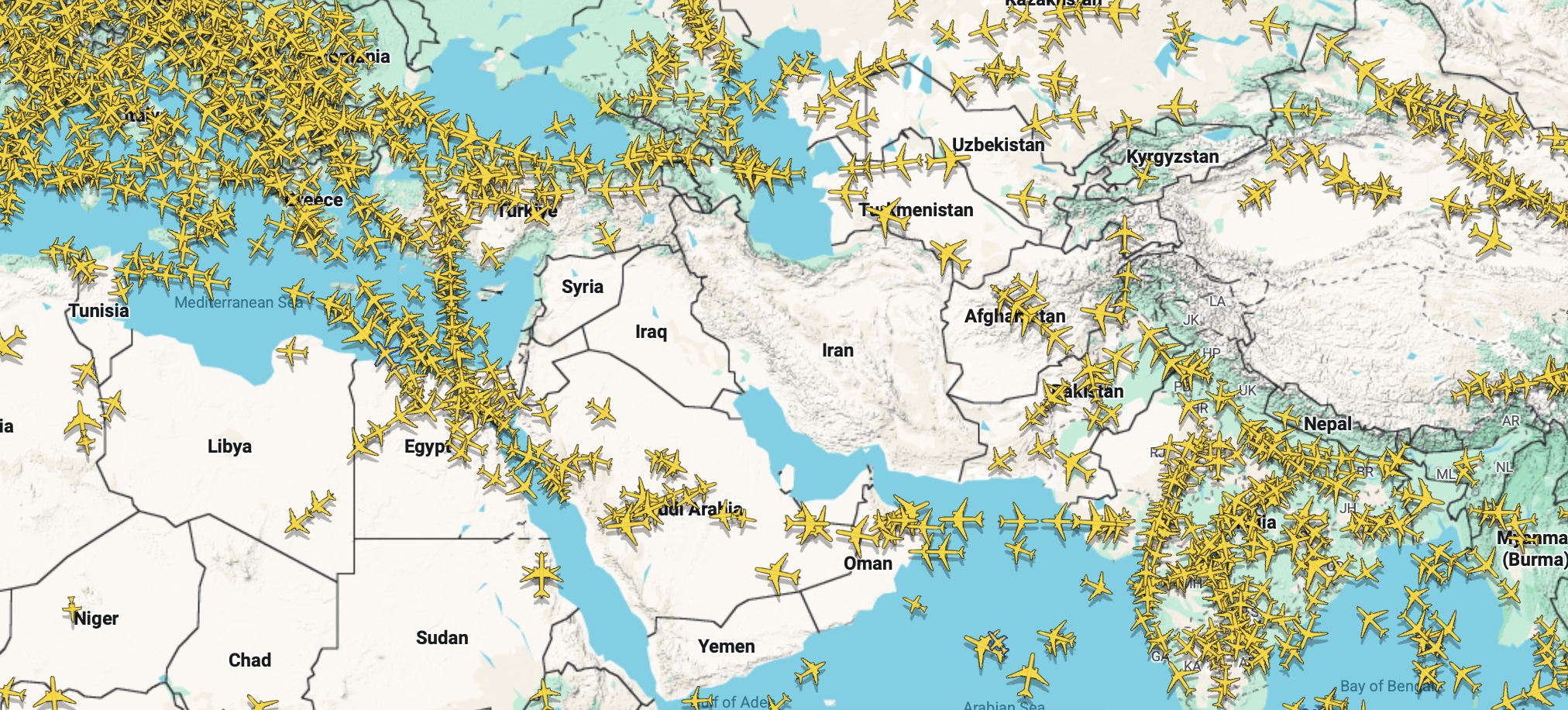



Tens of thousands of passengers have been stranded across the Middle East after widespread airspace closures followed US and Israeli strikes on Iran and a wave of retaliatory missile and drone attacks that sent shockwaves through the region’s aviation network. Israel reported hundreds of incoming projectiles, while explosions were also reported in Qatar, the United Arab Emirates, Saudi Arabia, Bahrain and Kuwait, prompting further airspace closures and airport shutdowns.
Cirium and FlightAware report that over 1,800 flights were cancelled on Saturday and 716 more on Sunday, while global delays have surged past 19,000 due to widespread airspace closures.
More than 3,400 flights have been cancelled today across seven airports in the Middle East (DXB, DOH, AUH, SHJ, KWI, BAH, DWC), as many airspaces remain closed for security reasons. pic.twitter.com/L48tAlVmGU
— Flightradar24 (@flightradar24) March 1, 2026
The situation on Monday 2 March remains critical with major hubs like Dubai and Doha expected to stay restricted, forcing airlines like Emirates and FlyDubai to preemptively suspend operations until at least Monday afternoon.
The scale of the disruption is significant: the ’ME3’ airlines, Emirates, Qatar Airways and Etihad, alone handle roughly 90,000 transiting passengers daily.
Airspace over Iran, Iraq, Bahrain, Qatar and other Gulf states has been closed or heavily restricted. The closure of Iranian airspace has been officially extended to at least 3 March via NOTAM.
Qatar’s Civil Aviation Authority announced the ‘temporary suspension of air traffic as part of a series of precautionary measures’, prompting Qatar Airways to suspend all flights to and from Doha due to the closure of Qatari airspace. Travellers stranded at Doha airport were evacuated by bus to hotels outside the city centre.
Currently more than 2,000 flights to and from seven key airports (DXB, DOH, AUH, SHJ, KWI, BAH, DWC) in the Gulf area have been cancelled. pic.twitter.com/qZ9XSIl2dM
— Flightradar24 (@flightradar24) March 2, 2026
One passenger, posting on X under the name OdieuxBoby, wrote: “We were transferred to a hotel by bus. It’s a huge hotel with lots of families”. He described the atmosphere as calm, with food aplenty and morale holding up.
Meanwhile, Syria partially closed its southern air corridors for 12 hours, and Jordan’s air force stated that the aircraft flying over the kingdom were carrying out ‘routine flights within their operational missions’ to preserve the security of Jordanian airspace and prevent any infiltration attempts or illegal activity.
Dubai International – one of the world’s busiest transit hubs – was notably impacted by Iranian missile strikes on Saturday, leading to an indefinite suspension of operations. Before the airport was hit, Mike Boreham, whose BA flight from Dubai to London got cancelled at the last minute, told The Independent from inside the airport terminal that chaos ruled. “Just imagine 100 flights getting off at once. It’s hundreds of people; I’ve never seen the airport like it.”
⛔️Dubai Airport now‼️
— Dr.Sam Youssef Ph.D.,M.Sc.,DPT. (@drhossamsamy65) March 1, 2026
pic.twitter.com/ANLfzN3hqn
Airlines across Europe, the Middle East and Asia have rapidly adjusted their operations.
Swiss and Lufthansa have suspended flights to and from Tel Aviv, Beirut, Amman, Erbil and Tehran until 7 March. Lufthansa also suspended its Dubai and Abu Dhabi routes.
Air France KLM cancelled flights to Tel Aviv and Beirut, citing ‘the security situation at destination’, and later expanded the cancellations to include Dubai and Riyadh.
British Airways confirmed cancellations to Tel Aviv, Dubai and Bahrain until 3 or 4 March, as well as suspending services to Amman, reiterating that ‘safety is always our highest priority’. Norwegian has also paused services to Dubai until 4 March.
Turkish Airlines has suspended flights to ten Middle Eastern countries, and Air India has halted all flights to the region.
Dear Passengers,
— TK HelpDesk (@TK_HelpDesk) February 28, 2026
Due to the current situation which affects flight operations to the United Arab Emirates, Qatar, Bahrain, Kuwait, Dammam and Riyadh additional rights have been granted to our passengers.
You can access up‑to‑date information about your flights on our Flight… pic.twitter.com/LOGyvHLmjB
Ben Gurion Airport will remain closed until at least 3 March. Israir has cancelled all international and domestic services until Monday morning.
🌍 Flights cancelled. Ben Gurion deserted.
— Real Global News (@FelastoryMedia) June 13, 2025
❗️Emirates, the Middle East’s largest airline, canceled flights to and from Iraq, Jordan, Lebanon, and Iran, with several Friday flights and one Saturday Tehran flight listed as canceled on its website.
❗️Qatar Airways, Qatar’s… pic.twitter.com/0zn33EGGMk
Russia’s aviation authority has suspended commercial flights to Iran and Israel “until further notice”.
All Kazakh airlines have suspended flights to the Middle East until 3 March.
Travel advisories have been heightened across much of the Middle East. With major hubs expected to remain restricted into the week, airlines are warning that disruptions are likely to continue. On Sunday, both US President Donald Trump and Israeli Prime Minister Benjamin Netanyahu signalled that the conflict could be prolonged, adding to uncertainty over when normal flight operations may resume.