

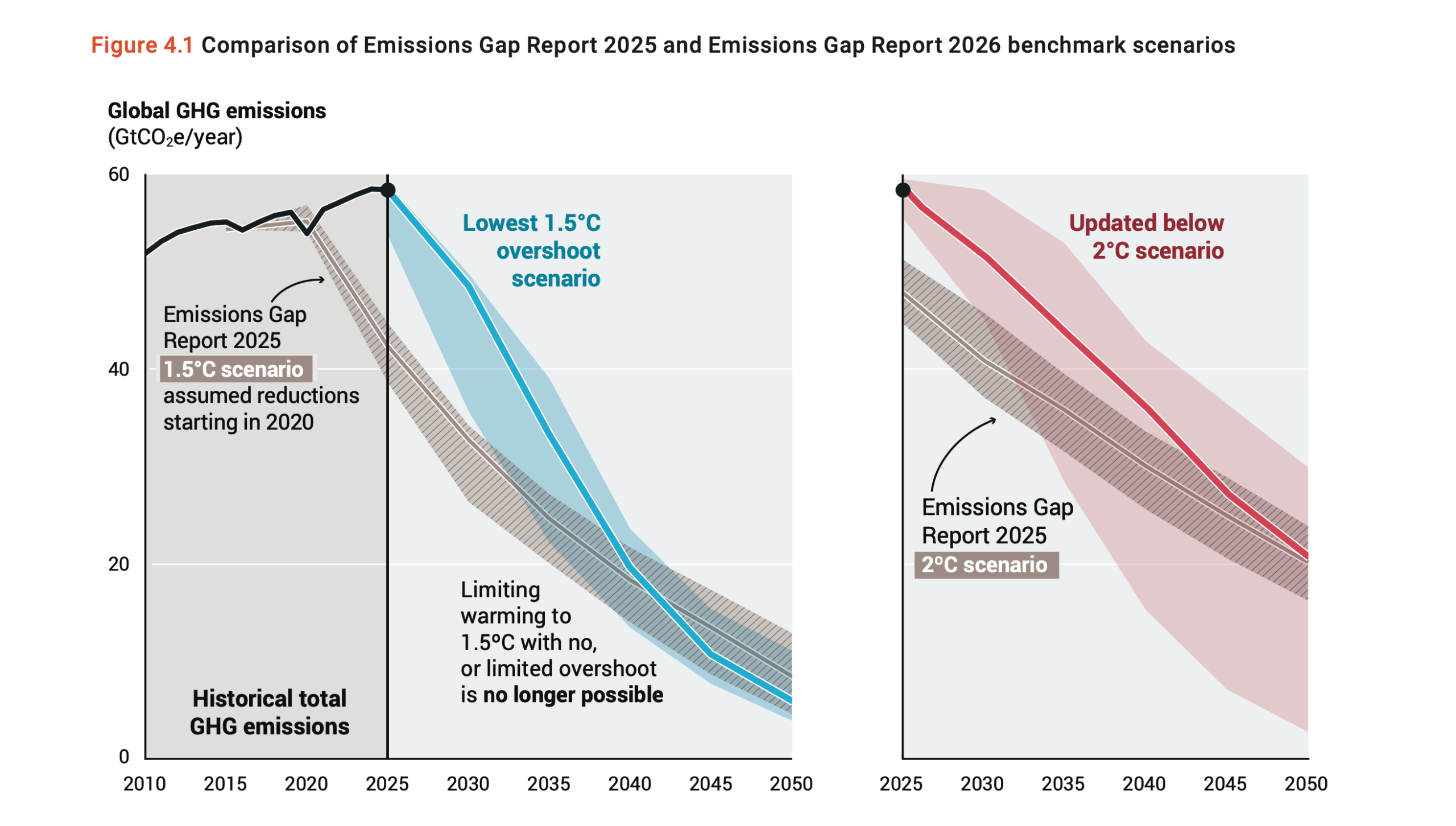
In a new report, the UN Environment Programme has laid out a timeline that would potentially allow for the ‘lowest possible’ 1.5°C overshoot scenario. Over the next four years, the world would have to cut back its carbon emissions by nearly a fifth compared to 2025 levels.
“Overshoot is not surrender. We can still keep it as small and as short as possible – and bring temperatures back below 1.5 degrees by the end of the century,” UN Secretary-General António Guterres stated.
Although a 1.5°C overshoot compared to preindustrial levels was the main goal of the Paris climate agreement in 2015, a UN Environment Programme (UNEP) report from earlier this year established that objective was no longer feasible. The organisation estimated global heating would reach at least 1.8°C.
Global warming will overshoot 1.5°C in the coming years. There’s still a chance to bring temperatures back down, but the window is closing fast. This is the point of return. #EmissionsGap https://t.co/VDXkg0JPtQ
— UN Environment Programme (@UNEP) October 21, 2026
However, the newly-published Emissions Gap Report 2026: The Point of Return paints a scenario in which the overshoot could be limited to 1.7-1.8°C around the middle of the century before returning to 1.5°C by 2100. If the guidelines put forward in the report were to be followed, UNEP estimates the chance of success at around 50%.
“Every additional fraction of a degree and additional year of warming above 1.5°C increases climate impacts and risks, such as the deadly floods, heatwaves and wildfires that have plagued many nations this year. So, we must pull out all the stops to minimize peak warming and return to 1.5°C by the end of the century. This is possible,” said Inger Andersen, Executive Director of UNEP.
According to the report, a return to a 1.5°C overshoot by the end of the century would be possible if global greenhouse gas emissions were to be reduced by 18% by 2030, 45% by 2035 and 69% by 2040, all relative to 2025 levels. However, to reach these emission cuts, the world would have to go above and beyond the Nationally Determined Contributions (NDCs), which would only reduce emissions by 5-8% by 2030 and 11-15% by 2035, relative to 2025 levels.
While this may sound ambitious, the report leaves room for optimism. According to the researchers, there have never been as many opportunities to accelerate action. Compared to 2015, when the Paris Agreement was adopted, renewable energy has boomed, the total energy supply from coal and oil has grown slower than initially projected, and climate policies have cut emissions in many places.
“We have a wealth of success stories showing that emissions can be cut quickly. It is now up to nations to urgently put in place policies that spark fast, deep and sustained emissions reductions, and put the world on track for a more stable climate and more stable economies and societies,” Inger Andersen added.
However, if the current policies were to continue, global warming could reach 2.8°C before the end of the century and would continue to increase afterwards. That number would be limited to 2.6°C if all NDCs were delivered and similar efforts were to continue. Even in the most optimistic scenario, if all NDCs plus additional net-zero targets were to be achieved, global warming would only be limited to 2.1°C in this century. Due to the withdrawal of the US from the Paris Agreement as well as revised estimates of historical emissions, the projection has worsened over the past year.
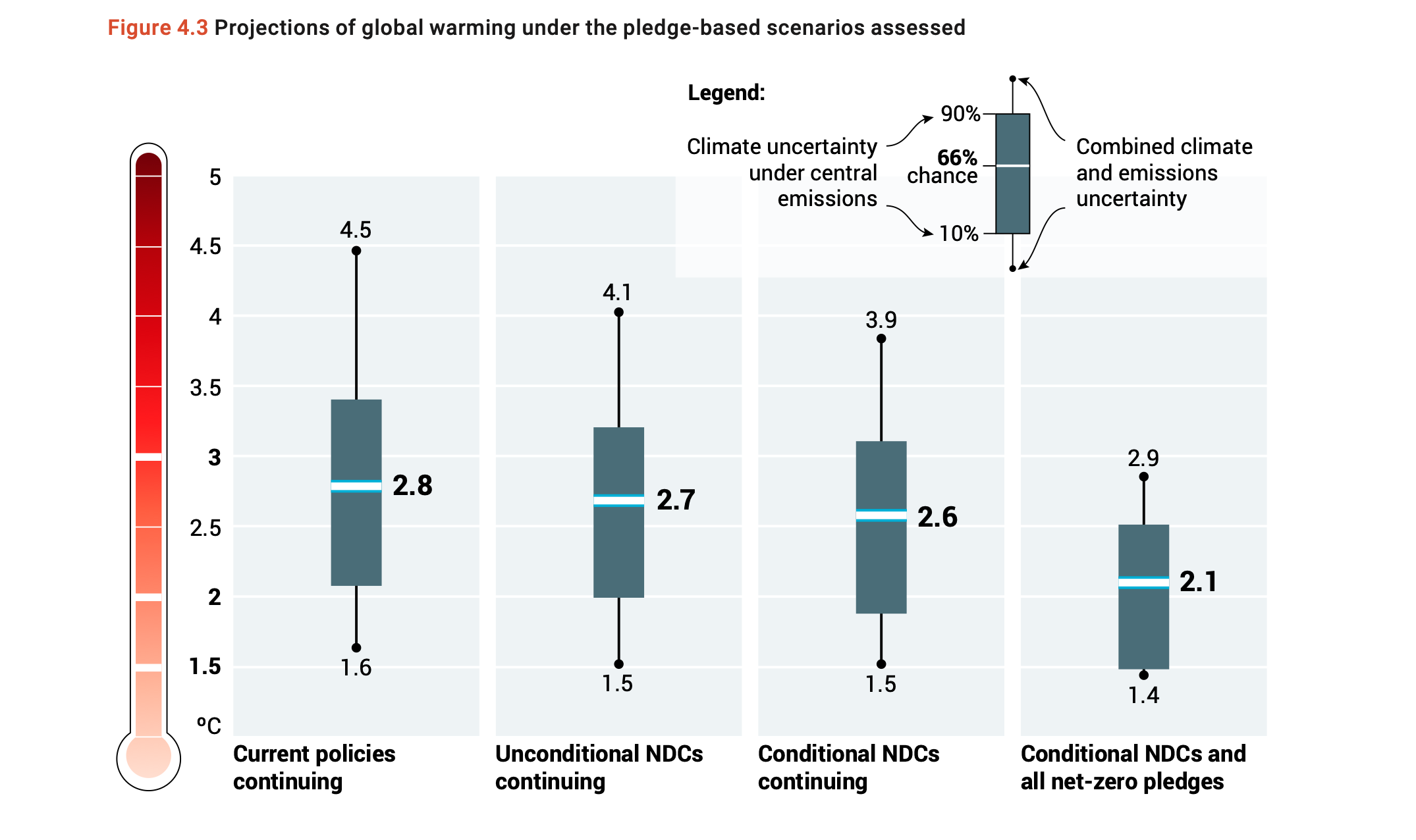
According to the UNEP, keeping peak warming below 1.7 to 1.8°C will quickly become impossible if no urgent action is taken. Every five years of CO2 emissions at current levels push peak warming up by around 0.1°C.
The report comes shortly after August 2026, which proved to be the world’s joint hottest month ever recorded. As the global average surface air temperature reached 16.96°C, temperatures climbed 1.65°C above the estimated 1850–1900 pre-industrial average.