


Tilly Norwood’s new video song, Take the Lead, has triggered an almost immediate cross-generational backlash – and it hasn’t even convinced AI tools.
The singer is a fully AI-generated character, created by Dutch actress and Particle6/Xicoia founder Eline van der Velden. The track builds on earlier controversy when actors and unions warned that they could soon be competing with – or even be replaced by – AI performers.
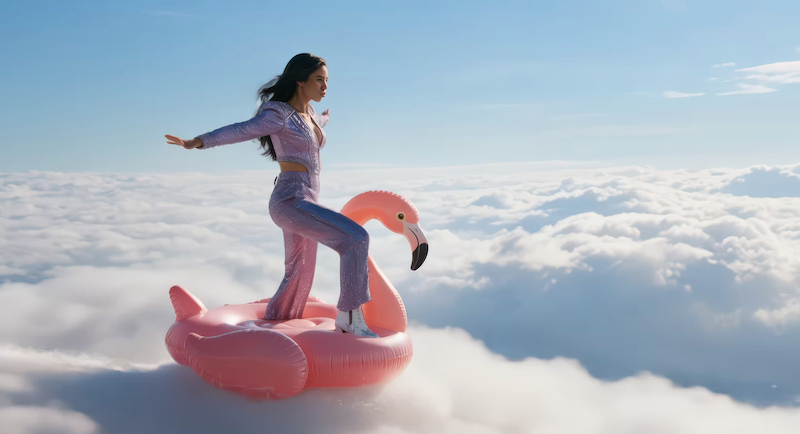
The timing was hardly accidental. The video was released shortly after the SAG-AFTRA strike concerning AI and ahead of the Oscars, with the caption: “Can’t wait to go to the Oscars! Does anyone know if they have free valet parking for my flamingo?”
In the video, Tilly rises to fame, appearing on billboards, talk shows, and in front of stadium crowds. She insists that she is not a puppet, but a star. She urges actors to embrace AI and “be free:” “Build your own and you’ll be free”; “AI’s not the enemy, it’s the key.”
The aesthetic leans into a glossy, AI-crafted fantasy, somewhere between Disney and Taylor Swift, with pink flamingos, inflated dreamscapes and synthetic stardom. A CAPTCHA test meant to prove Tilly is human only reinforces the artifice. The video ends with a Barbie-like inflatable house collapsing after a stone engraved with ‘clanker’ crashes into it, perhaps a message of some kind, though exactly what remains unclear.
Although van der Velden described Tilly as “a new paintbrush,” a means of testing the creative boundaries of AI without taking anyone’s job, one might question her intentions when she has her character sing, “They say it’s not real, that it’s fake / But I am still human, make no mistake.”
A disclaimer in the video notes that “18 real humans” were involved in the production, with van der Velden herself performing Tilly via motion capture.
“It’s not a glitch, it’s taste and time / A human touch, a grand design…”
The video also introduces the “Tillyverse,” which its creators describe as a cloud-based entertainment ecosystem where AI characters “live, interact and work” – a vision of the industry’s possible future.
If the intent was to reassure, the reaction suggests otherwise. Comments on and offline, across Instagram and TikTok and in the press in general, have been overwhelmingly negative, criticising both the lyrics and the premise.
So, what do AI systems make of an AI performer singing in its own defence?
ChatGPT was among the most direct, describing it as “less a song than a prototype of AI trying to justify itself through art.” It was deemed “weak” and “generic” musically, but “sharp” and “extremely important” as a cultural object. Grok was even blunter, calling it a “pro-AI anthem” with a “cringe” execution, and comparing the lyrics to “a corporate manifesto rather than art.” “I wouldn’t add it to any playlists unless your vibe is defensive AI propaganda pop,” it concluded.
Perplexity described it as a “gimmicky” yet effective demonstration of human-guided AI. It noted that lyrics such as “AI’s not the enemy, it’s the key” portray AI as an amplifier of human creativity rather than a replacement, although the “on-the-nose lyrics and uncanny elements spark valid debate on authenticity.”
Gemini took a more analytical stance, pointing out the irony of an AI performer claiming a “human spark.” It described the track as a “bold experiment in synthetic stardom” but argued that the backlash shows that audiences are not ready to replace human artists with prompt-based performers. It rated the lyrics 2/10.
Claude viewed the video as “a genuinely interesting cultural moment,” describing it as AI reflecting on its own existence and asking for acceptance. “Whether it lands artistically is another matter entirely,” it said, adding that “AI characters in entertainment are legitimate and worth debating, even if this particular video didn’t make the strongest case.”
However, we may just be at the beginning of it all, as Tilly herself puts it:
“It’s not a trick, it’s just the start.”