

Ryanair’s quarterly profits fell sharply as the war involving Iran pushed up jet fuel prices and made some passengers more hesitant to book flights. The Irish low-cost airline reported an after-tax profit of €538 million for the three months ending in June 2026, a decline of 34% compared with the same period last year. Its pre-tax profit also fell by 34% to €593 million. Higher fuel costs and Ryanair’s decision to lower fares to maintain demand were the main reasons for the decline.
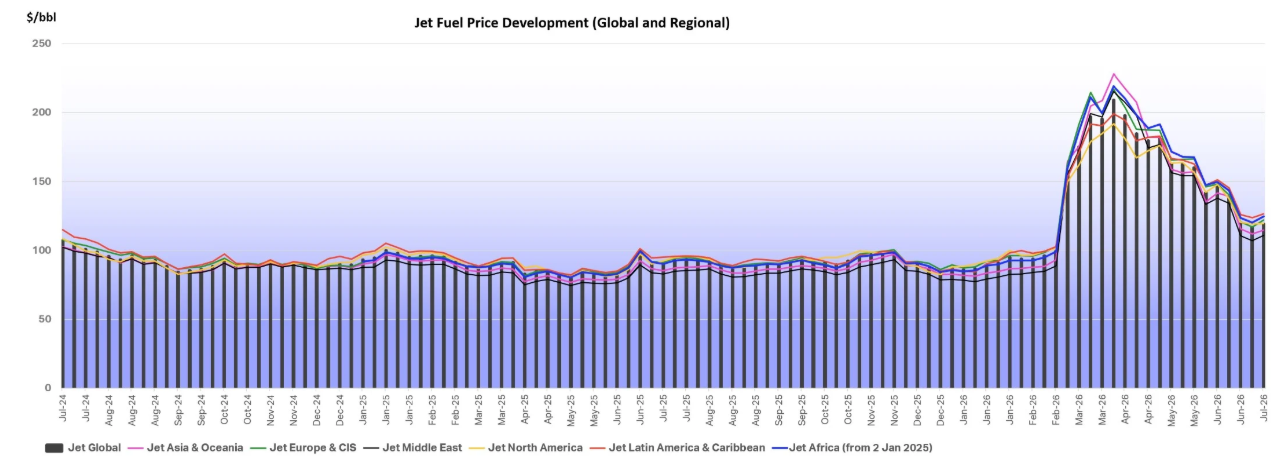
The conflict has disrupted global oil and gas supplies, particularly those transported through the Strait of Hormuz. The narrow waterway between Iran and Oman is one of the world’s most important energy routes, as a significant share of global oil and gas supplies normally passes through it. Traffic through the strait has been heavily disrupted during the fighting, contributing to sudden increases in energy prices. Jet fuel prices reached around $150 per barrel during the quarter.
Ryanair was partly protected from the increase because it had hedged around 80% of its fuel requirements. Fuel hedging means that an airline agrees in advance to buy fuel at a fixed price, reducing its exposure to sudden changes in the market. However, hedging does not provide complete protection when part of an airline’s fuel needs remains uncovered. Ryanair said the price of the remaining 20% of its fuel requirements more than doubled during the quarter.
The airline also lowered its average fares by 6% to encourage travellers to continue booking. Ryanair chief executive Michael O’Leary said the company reduced prices as the Middle East conflict created “consumer hesitancy”, concerns about possible European jet fuel shortages and wider economic uncertainty. Passengers were also waiting longer before committing to trips, making it harder for Ryanair to predict demand. The airline chose to stimulate bookings with cheaper tickets rather than risk operating aircraft with more empty seats.
The strategy helped Ryanair carry 61.3 million passengers between April and June, an increase of 6% compared with the previous year. The timing of Easter in April also contributed to the growth. Revenue increased by 1% to approximately €4.38 billion, but operating costs rose by 11% to €3.42 billion. The additional passengers were therefore not enough to compensate for more expensive fuel and lower fares.
Demand for holidays nevertheless remains strong, particularly on Ryanair’s popular Mediterranean routes. Chief financial officer Neil Sorahan said those flights continued to operate with high passenger numbers. Travellers are “as keen to get away as ever”, according to Sorahan, although they are booking “just a little bit later”. This suggests that the conflict has delayed some travel decisions rather than causing passengers to abandon their summer holidays entirely.
The shorter booking window creates a problem for Ryanair because airlines use advance reservations to estimate future demand and adjust their fares. When passengers wait until closer to departure, the company has less information about how many seats it will sell and how much revenue it will generate. “While summer 2026 volumes are strong, the booking window remains closer-in than last year,” O’Leary said. He added that the trend further reduces the airline’s visibility over its performance in the coming months.
Fares for the second quarter of Ryanair’s financial year, covering the important period between July and September, are expected to be “modestly” lower than last year. The forecast comes despite a recent slight improvement in bookings. Ryanair may therefore continue using competitive prices to maintain high passenger numbers during the summer. However, this approach could keep pressure on profits if fuel and other operating costs remain high.
In an interview with Sky's @WilfredFrost, Ryanair CEO Michael O'Leary has warned the war in the Middle East could disrupt jet fuel supplies across Europe later this spring.
— Sky News (@SkyNews) April 1, 2026
Iran war latest: https://t.co/Mnsy2SXXPA pic.twitter.com/2NRjlcfiAD
O’Leary had already warned in April that the conflict could affect both the price and availability of fuel in Europe. He described the United Kingdom as particularly exposed because it imports jet fuel from Kuwait through the Strait of Hormuz. At the time, he said airlines might have to reduce capacity if part of their expected summer fuel supply became unavailable. The UK government responded that shipments were continuing to arrive from several other countries.
Ryanair has not issued profit guidance for the full 2026-27 financial year because of the continued uncertainty. The airline said its results remain highly sensitive to further escalation in the Middle East and Ukraine, the price of unhedged jet fuel and wider economic shocks. It also identified European air traffic control strikes and operational problems as possible risks. “As is normal this early in the year, we have zero second-half visibility,” O’Leary said, adding that it remained too early to provide meaningful full-year profit guidance.