


With the 2026 FIFA Men’s World Cup now over, football fans around the world may be feeling the familiar post-tournament emptiness. Fortunately, the countdown to the next global show is already underway. In 2030, Europe will once again welcome the World Cup, with Spain, the new champion, Portugal and Morocco sharing hosting duties after preliminary centenary matches taking place in Argentina, Paraguay and Uruguay.
Developers in Portugal appear set to cash in on the 2030 event, as plans have been unveiled for a new 80-hectare attraction to be built near the historic town of Santarém, just 40 minutes from the Portuguese capital, Lisbon.
According to developers Zul Virani and JFA Group, the new theme park, to be named “Viva Mundo,” would be split into six areas and boast 28 football-based experiences, such as a 4D cinema, a log flume, dual “racing” rollercoasters, and a Las Vegas-style sphere.
Billed as “the world’s first destination dedicated to football” and a place “Made for every football fan” where there will be “No flags. No clubs. A space where the only identity that matters is a love of the game,” the park is expected to cost €450 million and to be ready by the end of April 2029, well before the World Cup kick-off in June.
Santarém, an historic city with a multicultural past and a vibrant, stylish local food scene, is sometimes referred to as the capital of Portuguese Gothic, thanks to the proliferation of Gothic architecture spanning nearly all styles and eras in the town. The town is built on a prominent limestone and sandstone bluff along the right bank of the Tagus (Tejo) River. Its cliffs and valleys boast geological records from the Miocene and Pliocene epochs, making it a significant environmental site.
Critics of the plan have raised concerns over an alleged lack of transparency in how the land was transferred and the privatisation of public community space, with protests from citizens’ groups at official project meetings pointing to potential strain on the local environment, existing infrastructure, traffic, and housing in the Ribatejo region.
Despite that historical and environmental sensitivity, feasibility studies for the football theme park have already been undertaken, and the project has progressed to the design stage, with a master plan approved by local authorities, amid expectations that the park might attract 1.5 million visitors a year and generate between 800 and 1,000 direct jobs.
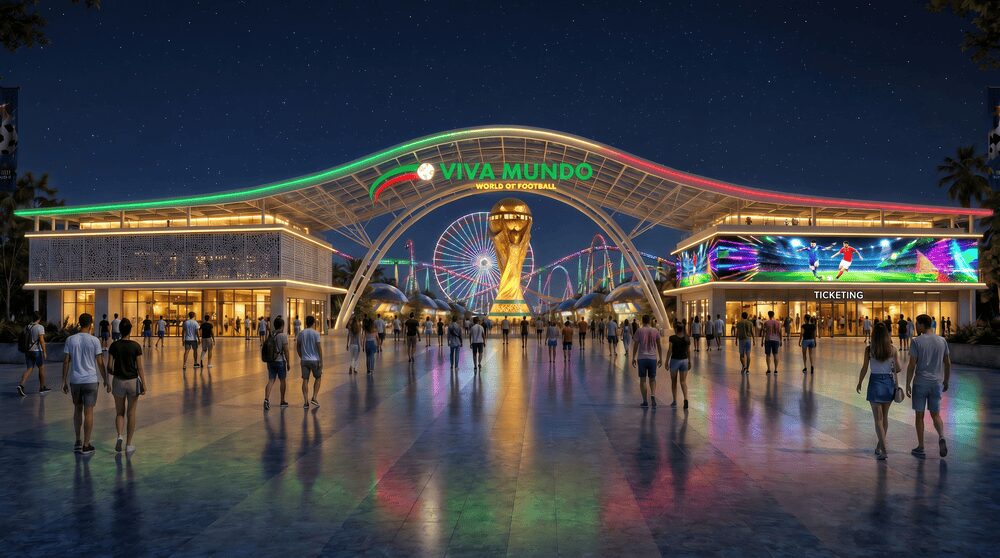
Renderings reveal a vast main entrance concourse, spanned by an elliptical arch that frames a huge golden monument in the shape of the World Cup itself. The concourse is shown lined with neon-filled retail spaces, while the park’s six proposed sections include “Memory” (where a shop and museum will showcase footballing history and memorabilia); “Flavours,” where refreshments and restaurants will be located; and a ”Fans” zone, intended to capture the atmosphere of match day. A 300-room hotel is planned too, allowing fans to stay on-site, Disney-style.
The complete design is forecast to be ready by January 2027, and the developers are seeking a licence to break ground by the end of the following month.