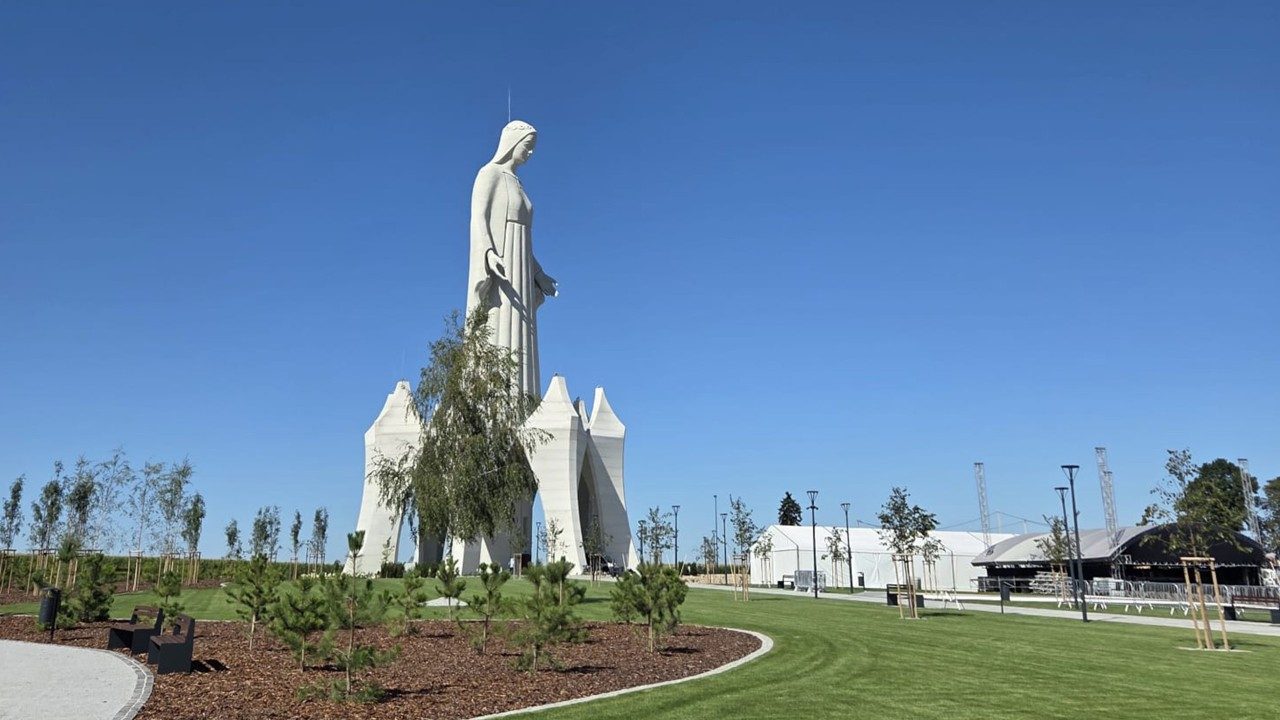

Europe’s largest statue of the Virgin Mary was unveiled in the tiny village of Konotopie in central Poland, on 15 August, to coincide with the Catholic celebration of the Assumption of Mary into heaven. While local authorities hope the monument will bring tourists, religious leaders hope it will help counter the decline of faith in Poland.
Taller than the famous statue of her son, Christ the Redeemer in Rio de Janeiro, Brazil, which stands 38-metre high, Mary now towers 55.6 metres over Konotopie and its surrounding agricultural land. The village is home to fewer than 150 people.
Completion of the monument took eighteen months and was funded by Polish millionaire investor Roman Karkosik, and his wife, Grazyna, who reportedly covered the 100-million-zloty (€23.2 million) cost. Among their specific requests was that “their” Mary should stand taller than Poland’s 33-metre-high Jesus Christ the King of the Universe in Świebodzin.
The inauguration ceremony saw helicopters scatter red roses over the crowds, while priests dressed in white celebrated mass and the Mazowsze ensemble performed traditional folk dances.
The statue was consecrated by Krzysztof Wętkowski, bishop of the diocese of Włocławek. “Here in Konotopie, we lift our eyes upward; we lift our eyes toward Mary, who directs us toward God,” he said.
🇵🇱 EUROPE’S TALLEST VIRGIN MARY STATUE UNVEILED
— Mossad Commentary (@MOSSADil) August 16, 2026
A towering 55.6-metre (182 ft) concrete statue of the Virgin Mary has been unveiled in Konotopie, rural Poland.
It stands taller than Rio’s Christ the Redeemer and was consecrated on Saturday for the Feast of the Assumption. pic.twitter.com/WRLNRA1rNI
Among those attending was former Polish president, Nobel Peace Prize winner and leading figure of Poland’s anti-communist movement Lech Wałęsa, who led the Solidarność trade union that helped bring communist rule to an end.
The 82-year-old later posted a photo of himself in front of the statue, the sun shining like a halo over Mary’s head. “We sinners ask Our Lady of Mercy to take care of the whole nation,” he wrote in Polish.
“This is the end of my path,” he said at the inauguration. “I started with the Virgin Mary and I end with the Virgin Mary.”
Wałęsa often credited his faith with giving him the strength to fight for his country and famously wore a Black Madonna pin on the label of his jacket during his Solidarity days.
Karkosik made his fortune investing in undervalued Polish companies during the post-communist 1990s, becoming one of Poland’s richest men. The couple live in a restored 18th-century palace two kilometres from the monument and have described the statue as an expression of gratitude to God.
Europe’s tallest statue of Mary was blessed on August 15 in Konotopie, Poland. During the ceremony, Bishop Krzysztof Wętkowski said the more than 55-meter (180-foot) monument is meant to turn people’s thoughts toward God and serve as a place of prayer.https://t.co/gKsCUj48vZ
— Vatican News (@VaticanNews) August 15, 2026
“The statue will be for all people,” Grażyna Karkosik said. “Each of us coming to see it will think more deeply about their own lives, not only about God.”
Before Konotopie’s Mary claimed the title, Europe’s tallest Virgin stood in Miribel, France. Poland’s Mary is still barely over half the height of the 98-metre Mother of All Asia – Tower of Peace in Batangas City, the Philippines.
Sculptor Adam Jakub Matejkowski first produced a two-metre model. Construction faced obstacles, including finding a company capable of producing material for the concrete mould. With no Polish supplier able to make it, it was eventually manufactured in Italy.
The monument is free to visit, including its observation deck, 15 metres above ground in the crown-shaped pedestal. Local authorities expect it to become both a pilgrimage site and tourist attraction. Kikoł’s mayor told the Guardian that investor interest, particularly in restaurants, was already growing, though it was too early to assess the impact.
Although Poland remains one of Europe’s most religious countries, with 70% identifying as Catholic and 30% attending Sunday mass, religiosity has fallen sharply, especially among younger generations. Wiesław Mering, a Polish Roman Catholic prelate who attended the ceremony, told the Guardian the decline “hurts” him. “The history of Christianity has ups and downs, but this place is a reminder that Mary won’t give up on Poland.”