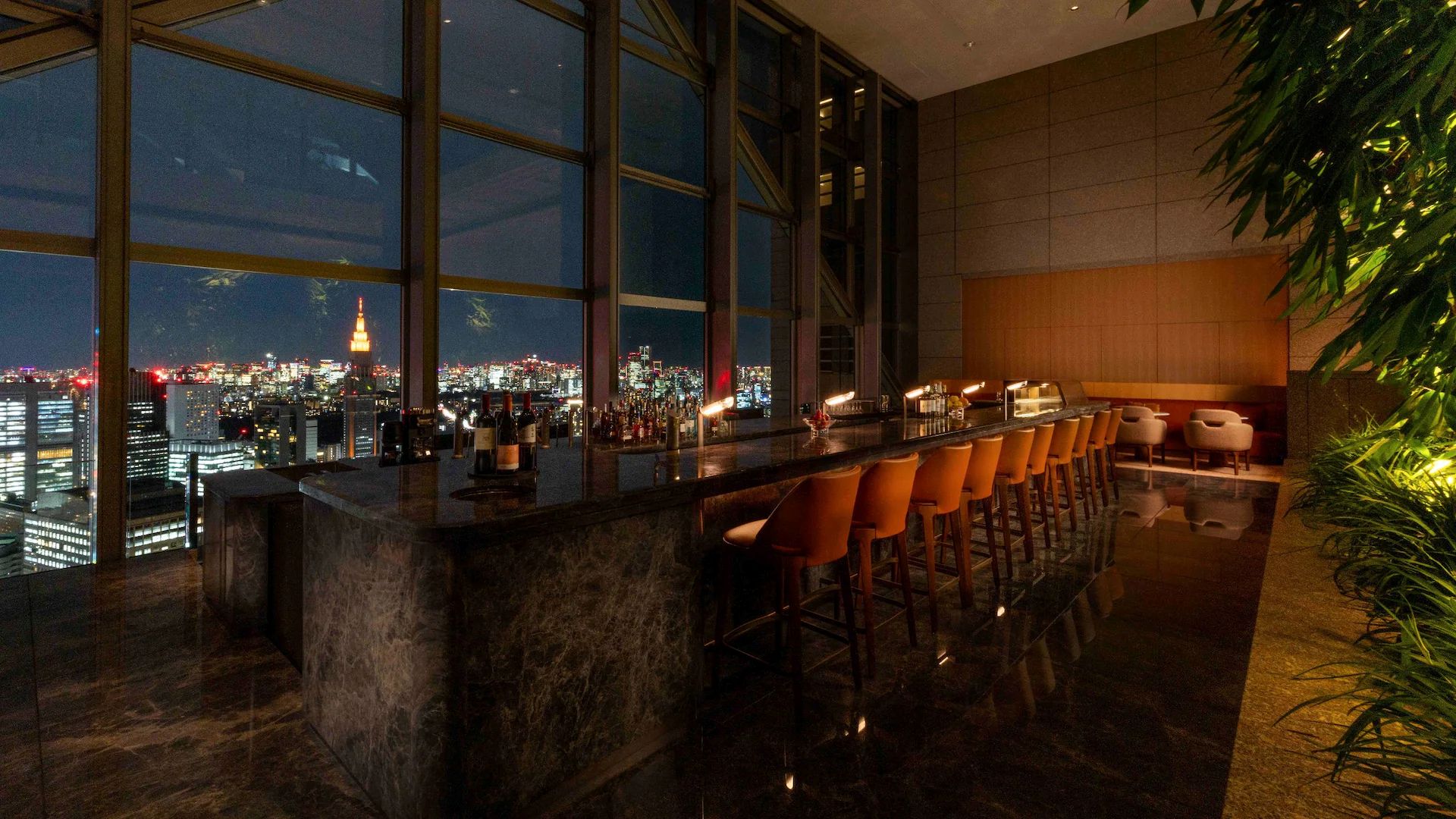



After 19 months of renovation works, the Park Hyatt Tokyo hotel has reopened its doors to the public. Paris-based design studio Jouin Manku approached the project as a natural evolution instead of a complete overhaul, preserving its cinematic essence.
Soon after it opened in 1994, the Park Hyatt Tokyo hotel turned into something of a local landmark. Situated inside the Shinjuku Park Tower, designed by Kenzo Tange and with interiors designed by John Morford, the glass structure and the city views enjoyed from inside became part of Tokyo’s skyline and overall experience.
However, the hotel was really projected into cinematographic eternity with Sofia Coppola’s ‘Lost in Translation’. The movie featuring Bill Murray and Scarlett Johansson, which appeared in 2003, quickly became a classic and piqued the curiosity of many a traveller, especially those who were taking their first steps into the travel world around that time.
Thus, although a renovation was necessary after being in business for approximately 30 years, renovating the Park Hyatt Tokyo hotel was no matter to be taken lightly. The task was given to Paris-Based design studio Join Manku, and their objective was clear: how to change exactly enough, without doing too much?
“There are places that do not ask you to transform them, but to listen. The Park Hyatt Tokyo is one of those places. A hotel suspended in the sky, formed by Kenzo Tange, inhabited by the quiet restraint imagined by John Morford, and marked forever by the luminous melancholy of Lost in Translation. A place where the city is as much sensed as it is seen. Where each step invites not only forward movement, but a turn inward,” Patrick Jouin and Sanjit Manku explain.
Tour the hotel
The Peak Lounge, situated on the 41st floor and one of the first things guests get to see when entering the hotel, was simply purified during the renovation. Lines were made more subtle, colours softened. Yet the overall feeling remains the same, as does the splendid view over the city.
“When we were given the commission, the question was never what shall we change, but rather how has time itself already changed this place, and what can we reveal of that silent maturation. It was not about adding novelty. It was about discerning what needed to remain untouched, what called for transformation, and what simply hoped to be carried forward with greater gentleness,” Patrick Jouin and Sanjit Manku say.
It is perhaps in the rooms that the renovation of the hotel becomes most clearly visible. While the shapes of the spaces remained untouched, the inside flow was facilitated through the use of muted tones, subtle light additions, and custom-made furniture. The central cabinet, one of the hotel’s characterising features, was kept yet softened.
As far as the suites are concerned, the Tokyo Suite was restored to its original design, the Diplomat, Governor’s, and Presidential Suites were given an overhaul, and the new Park Suite was added to the list of options.
“The Park Hyatt Tokyo is not only architecture. It is an atmosphere. A particular way of being in the world. A verticality that soothes. A light that absorbs. A silence that holds. We sought to prolong that presence, to make it more human, more tactile, to free the hotel from what felt too austere without ever weakening its inner strength. To understand this transformation, one must follow a visitor, perhaps the one from the film, perhaps another, arriving for the first time or returning after twenty years, and sensing in every space a different vibration, as if the hotel itself had learned to breathe in a new way,” Patrick Jouin and Sanjit Manku conclude.
The 5-star Park Hyatt Tokyo, with its 171 rooms (including 29 suites), pool, and unbeatable views, is once again open for business. Room rates start at about $800-$1,000 per night.