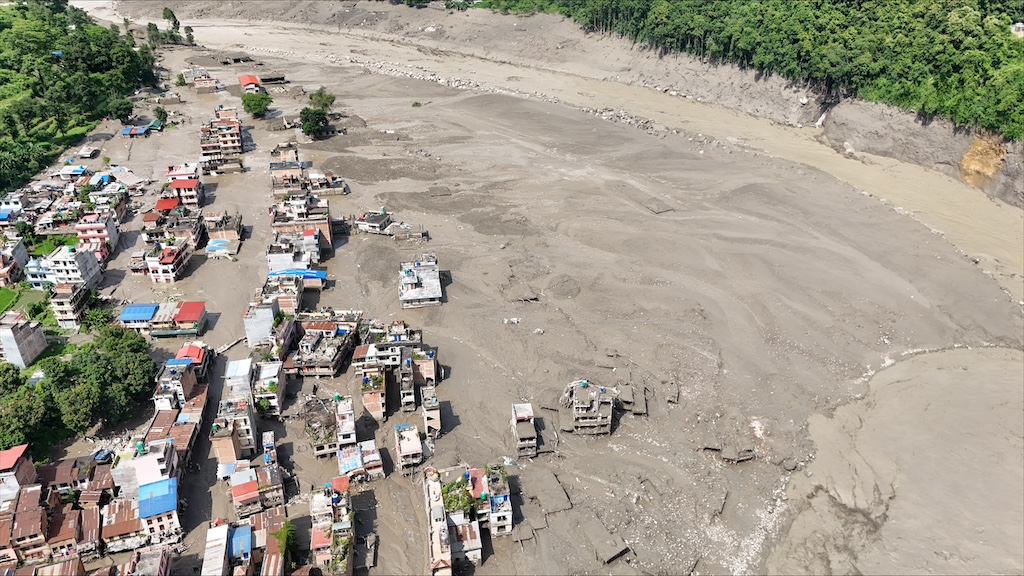



Nepal is urging international tourists not to cancel their travel plans following the catastrophic flash floods that have killed more than 1,100 people, as the country seeks to protect a tourism industry already facing hundreds of millions of euros in losses.
Tourism Minister Khadakraj Paudel appealed directly to foreign travellers on Tuesday, stressing that much of the Himalayan country remains accessible despite the destruction caused by the 26 August disaster.
“Our mountain trails and trekking routes are still waiting for you,” Paudel said in a video message.
“Your coming to Nepal this time does not mean only a holiday. It’s a big support to the country fighting this catastrophic tragedy of flash floods.”
The minister said only some areas of Nepal had been affected and that airports, hotels and tourist destinations elsewhere in the country remained operational.
“Please do not take Nepal off your travel list if you have already planned a trip,” he added. “Your visit will help sustain our tourism industry. It’ll help our guides, hoteliers and all the workers whose livelihoods depend on tourism.”
NEPAL IS CALLING🇳🇵
— Nepal Tourism Board (@nepaltourismb) September 1, 2026
In an appeal to friends of Nepal, Honourable Culture Tourism and Civil Aviation Minister Khadak Raj Paudel 'Ganess'has called upon travellers to continue visiting Nepal and to stand with the country during this time.
Come and explore the hidden side of Nepal. pic.twitter.com/1DMOwLPcUU
More than 1,100 dead
The appeal comes as Nepal continues to deal with the enormous human and economic consequences of the floods.
A massive deluge triggered by a mountain and glacier collapse near the Nepal-China border swept through communities on 26 August, destroying buildings, roads and bridges. At least 1,114 people had been confirmed dead in Nepal by Wednesday, while nearly 4,000 remained missing.
Among those unaccounted for were 583 foreign nationals from 38 countries, including almost 250 Indians, 85 Americans and 36 British citizens.
🇳🇵 Disaster in Nepal..⚠️🚨
— sustainme.in® (@sustainme_in) August 27, 2026
New Released video, captured more than 50 km downstream from the site of the glacier collapse, shows the rapid arrival of the flood wave, obliterating everything in its wake.#Nepal #NepalFlooding #Floods #Rasuwa #flasfloods #NepalFloods… pic.twitter.com/3Ofw8n7OBA
On the other side of the border, Chinese authorities had confirmed 16 deaths and 546 people missing in Tibet.
As Travel Tomorrow previously reported, scientists have warned that the Himalayan region is becoming increasingly vulnerable to floods, landslides, avalanches and other disasters as rising temperatures transform glaciers and destabilise mountain environments.
Research by the Global Mountain Safeguard Research programme (GLOMOS), part of the United Nations University Institute for Environment and Human Security, has found that floods in the region have become five times more frequent since 1950.
Terrifying footage shows a flash flood sweeping through the Nepal–Tibet border, trapping people on rooftops and balconies. At least 469 have been killed, with hundreds still missing. pic.twitter.com/xRgRWmwut7
— Weather Monitor (@WeatherMonitors) August 28, 2026
Tourism sector suffers heavy losses
Beyond the immediate human tragedy, the floods have dealt a severe blow to Nepal’s economy and particularly its tourism industry.
Losses to the sector have been estimated at more than 50 billion Nepalese rupees, equivalent to approximately €300 million.
Paudel told a parliamentary committee that 142 hotels, 57 restaurants, 141 vehicles linked to tourism businesses and 27 heritage sites had been lost or damaged. Tourism businesses have been asked to submit detailed assessments of the damage they suffered.
Across the economy, total losses from the disaster have been estimated at around $5 billion, equivalent to approximately one-tenth of Nepal’s annual economic output. Hydropower infrastructure, another major area of investment for the country, has also suffered extensive damage.
Nepal has been deeply affected by the recent natural calamity. And at this difficult moment, we have a simple message for the world:
— Nepal Tourism Board (@nepaltourismb) September 1, 2026
NEPAL IS NOT CLOSED.
This is a time to stand with Nepal.
This is a time to visit Nepal.
Nepal is calling.
👉Read more: https://t.co/ca5vadT3CM pic.twitter.com/eFOMjMcN0T
That economic impact helps explain the government’s determination to prevent the disaster from triggering a nationwide collapse in international visitor numbers.
Tourism is one of Nepal’s most important sources of income and employment, supporting guides, porters, accommodation providers, restaurants, transport companies and communities across the country.
More than one million international tourists visited Nepal in 2025, attracted by its Himalayan landscapes, cultural heritage and some of the world’s most famous trekking and mountaineering routes, including Mount Everest.
Travelling as a form of support
Paudel’s message effectively presents continued tourism as part of Nepal’s recovery effort, asking visitors to distinguish between areas directly affected by the disaster and destinations elsewhere in the country that remain open.
The approach reflects a challenge faced repeatedly by tourism-dependent destinations after natural disasters. While safety concerns can understandably lead travellers to stay away, a prolonged fall in visitors can compound the economic consequences for communities that have escaped the physical destruction but depend heavily on tourism income.
For Nepal, that balance is particularly delicate given the magnitude of the disaster and the number of foreign tourists still missing.
Meanwhile, international assistance continues to arrive. China is preparing to send another team of DNA identification specialists and further emergency supplies to Nepal, including temporary bridges, communications equipment and mortuary refrigerators.
A second flight has just taken off, carrying 37.5 tonnes of HADR material, medicines & food packets for Nepal.
— Dr. S. Jaishankar (@DrSJaishankar) August 27, 2026
India remains in close and continuous touch with the Nepalese authorities. We will continue to strongly support the ongoing relief efforts.
🇮🇳🇳🇵 pic.twitter.com/4m46leqfkC
Beijing has also been coordinating with foreign embassies over missing international visitors, while evacuations of stranded residents and pilgrims continue.
Nepal’s appeal is therefore not a declaration that the crisis is over. Rescue, recovery and reconstruction efforts are continuing across affected areas. Instead, the government is asking travellers not to treat the disaster as a reason to abandon the entire country.
For the millions of Nepalese whose livelihoods depend directly or indirectly on visitors, the tourism minister’s message is simple: coming to Nepal now is not just a holiday, but a contribution to the country’s recovery.