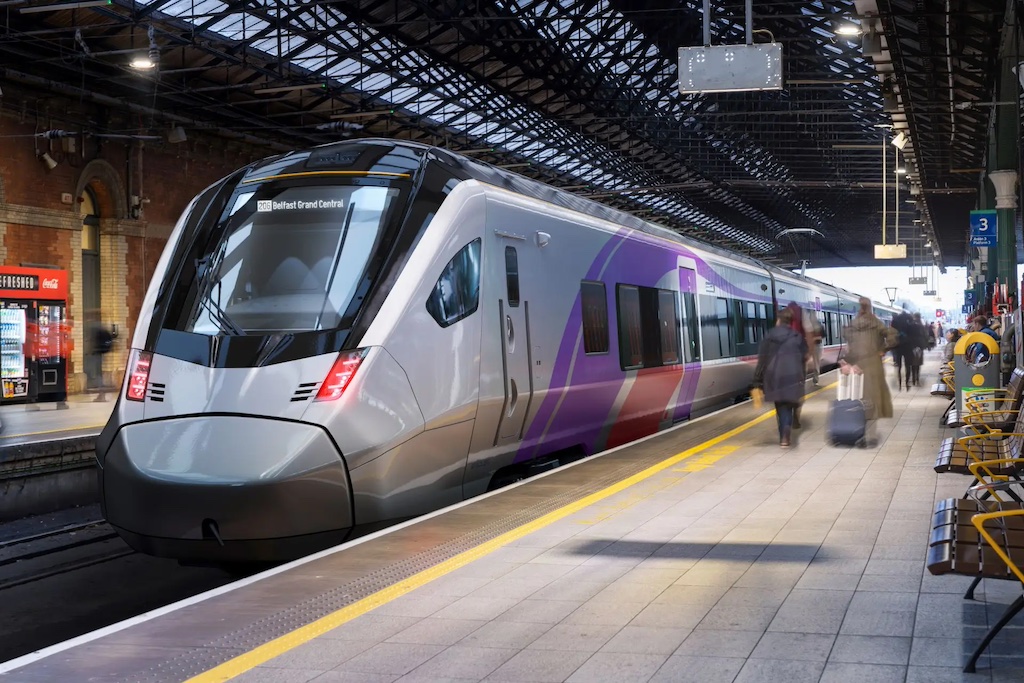



Massive improvements are on their way for rail commuters between the island of Ireland’s two capital cities, according to plans unveiled on 7 May by Ireland’s Taoiseach Micheál Martin and Northern Ireland’s First Minister Michelle O’Neill at a launch ceremony held at Belfast Grand Central station.
A €700-million investment in Enterprise train services will see major upgrades to the cross-border route, ensuring reduced journey times, more departures, and enhanced facilities, coming as soon as 2028. Eight new trains will be made by Swiss manufacturer Stadler, allowing up to 16 daily departures.
The 180-km trip between Dublin and Belfast currently takes two and a quarter hours, calling at Drogheda, Dundalk, Newry, and Portadown. But, driven by an appetite for the rail connection proven since the introduction of hourly departures two years ago, with customer numbers up 40%, it’s soon to be all change for the new service.
Coinciding with the one-time steam operation’s 81st anniversary, a partnership between Translink and Iarnród Éireann will enable the journey to be completed in under two hours, aboard new trains with a 400-seat capacity, power sockets, USB charging points, plus dining and bar areas. Accessibility will also be improved thanks to step-free interiors and unaided boarding.
A tri-mode system, which can run on electric, diesel and battery power, will ensure quieter journeys and slash carbon emissions, on the way to what will eventually be “full electrification”, the companies have said.
The initiative is to be jointly bankrolled by the Irish Government and the Northern Ireland Executive to the tune of €698 million. PeacePlus, a UK government and European Union funding program, will be contributing €165 million towards that sum.
Speaking to the press before the start of the Belfast launch event, Taoiseach Micheál Martin hailed the positive economic impacts and boost to employment that the railway development will bring to the two million people who now live in what he called the Dublin-Belfast “economic corridor.” The new service will provide “a significant new chapter for cross-border rail connectivity,” he said. He also trailed further Shared Island funding on the way for the Northern Irish network.
“These projects will bring high-frequency trains, better journey times and sustainability benefits which will simply transform our rail system for passengers and wider society across the island,” he told reporters.
O’Neill echoed that sentiment, saying the investment will bring “better connectivity” to and “simply faster, better journeys between Belfast and Dublin.”