

The closure of Middle East airspace due to US and Israeli strikes on Iran and Iranian retaliation is significantly affecting the region’s travel and tourism sector. Over 5,000 flights were wiped from schedules within 48 hours of the first missile and drone attacks, leaving travellers marooned. Governments around the world have advised citizens in the region to register their presence and shelter-in-place.
The duration and effect of the conflict are uncertain, with President Trump varying estimates from weeks to longer, but we can base predictions for the travel and tourism sector on expert analyses.
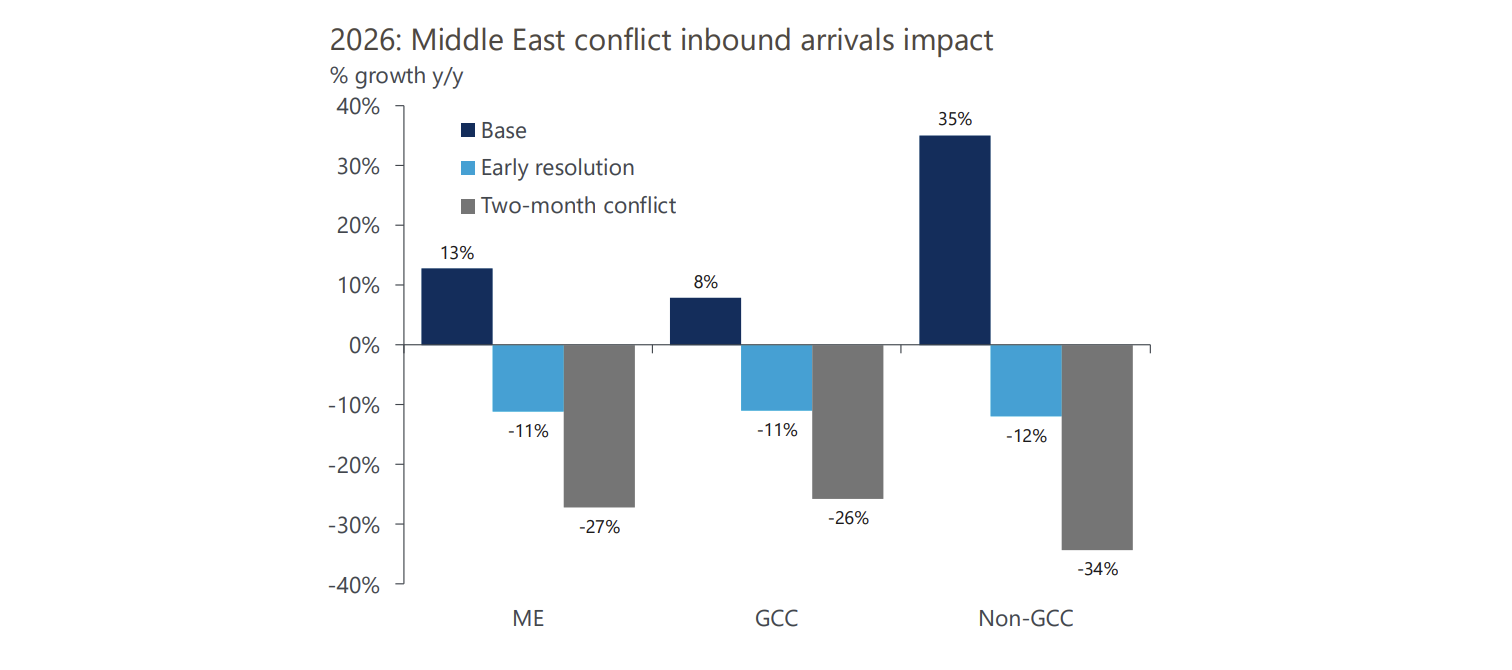
Oxford Economics analyst Jessie Smith predicts that in a one-to-three week “early resolution” scenario, there would be “significant airspace disruption and infrastructure damage throughout March 2026.” Initial flight resumption would “prioritise stranded holidaymakers and expats.” The negative influence of the conflict on travel sentiment would last at least into the second quarter (Q2) of the year, with “substantial” impact (probably into quarter three) for Iran, Israel, and Lebanon. For Gulf Cooperation Council (GCC) countries (Bahrain, Kuwait, Oman, Qatar, Saudi Arabia, and the United Arab Emirates), sentiment is anticipated to improve through Q2, and for the rest of the Middle East, the sentiment impact would be less severe again, fading through Q2.
4 Days, Trump’s War vs Iran
— Robert A. Pape (@ProfessorPape) March 4, 2026
— Iran escalating, not collapsing
— Middle East in chaos
— Americans flee en mass
— 3 US embassies hit
— Gulf states struck, unrest rising
— death toll in region = 1000+
EPIC Fury is normal failure of air power alone to topple regimes pic.twitter.com/izOtQpXdEI
In a longer “two-month” conflict, the significant airspace disruption and infrastructure damage would extend into April 2026, with repatriation flights again the priority when flights resume. In addition, Smith notes, “schedules will take longer to recover as sentiment in travel to the region takes time to recover.” That includes deeper, longer negativity for GCC countries and the rest of the Middle East into Q3 and Q2, respectively, and negative consumer sentiment through to the end of 2026 for Iran, Israel, and Lebanon.
Overall, the conflict could mean between 23 and 38 million fewer travellers to the Middle East than expected over the year, triggering losses of between $34 and $56 billion from a visitor spend worth around $194 billion in the region last year, according to World Travel & Tourism Council figures.
GCC countries are predicted to suffer the largest losses, “as they are the largest destinations in the region which have previously relied on perceptions of safety and stability,” Smith said. Nonetheless, for Israel and Iran, the damage to their anticipated recovery from previous conflicts could also be significant.
Ryanair boss Michael O’Leary appeared to confirm the initial analyses and pointed to potential gains from the conflict for other destinations. “There’s a big collapse in bookings to the Middle East,” he told the press on 3 March, noting strong pre-Easter bookings for Italy, Greece, and Portugal. Benjamin Jacobi, TUI’s German chief, has also agreed there will be a “dip in demand” for the Middle East. He saw Asia, Europe and particularly the western Mediterranean, benefitting instead.
But O’Leary offered some hope, minimising how long-term the effects of the conflict might be. “I suspect it won’t go on long and therefore I suspect it won’t have any long-term trends, but I think there’s no doubt that it has undermined confidence in air travel to the Gulf.”
With tourism in the Middle East valued at $367 billion annually, the region’s newfound image as a destination offering luxury shopping, experiences, and stays has, however, been hit. Footage has spread across social media showing tourists cowering away from debris, fire, and smoke in high-end hotels such as the Burj Al Arab. Rental cancellations hit nearly 8500 on the first day of the conflict alone, AirDNA said.
And with major cruise ports and hubs affected, including the world’s busiest international airport in Dubai, the knock-on consequences and delays to travel and connections beyond the immediate region are inevitable.