

Europe’s aviation network saw year-on-year growth for summer 2025, with traffic returning to pre-COVID-19 levels, improved punctuality, and records set, including the busiest weekend and week ever, a new report reveals.
The European Aviation Trends Report from air traffic coordinator EUROCONTROL shows overall year-on-year growth for the period from 1 June to 15 September 2025 of 3.3% and a reduction in en-route delays per flight of 31%, with arrival punctuality up 6.4 percentage points to 71.6% for the period.
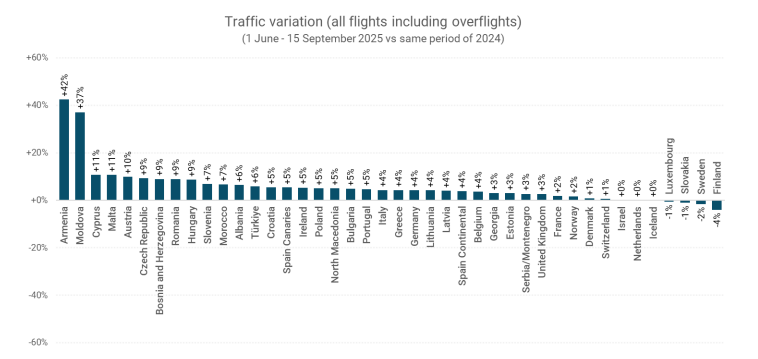
Traffic growth across the network was uneven, with year-on-year increases of over 5% across the South-East axis and the South-West axis, as well as in Poland. Traffic over Armenia (+41%) and Moldova (+37%) grew the most.
Meanwhile, one of Europe’s busiest and most complex airspace areas recorded its busiest summer in the five years since the pandemic. The Maastricht Upper Area Control Centre (MUAC), which manages the upper airspace (from 24,500 to 66,000 feet) over Belgium, the Netherlands, Luxembourg, and north-west Germany, oversaw 677,010 flights between June and September 2025.
July was MUAC’s busiest month, and 4 July 2025 marked the busiest daily traffic, reaching 5,831 flights, more than 200 above the month’s daily average of 5,600 movements. August movements grew the most year-on-year, up 3% compared with 2024. MUAC also played a key role in terms of climate action. It told 7,200 flights to reduce arrival speed into major hubs, including Amsterdam, Gatwick, Heathrow, and Paris. A measure that “helps cut time spent in fuel-intensive holding patterns, lowering emissions,” explains Aviation24.
Records established over the summer include the busiest Saturday and Sunday ever on 9 and 10 August 2025, when, respectively, 33,987 flights and 35,009 flights were handled. The busiest week ever came at the end of the month, from 25-31 August 2025, witnessing 250,291 flights, an average of 35,756 per day.
The report’s authors attribute the reduction in delays and improvement in punctuality to favourable weather conditions over the summer, with weather-related delays down 41%. In addition, the report cites efforts by Air Navigation Service Providers (ANSPs) to enhance their operational readiness and address structural issues such as air traffic controller shortages.
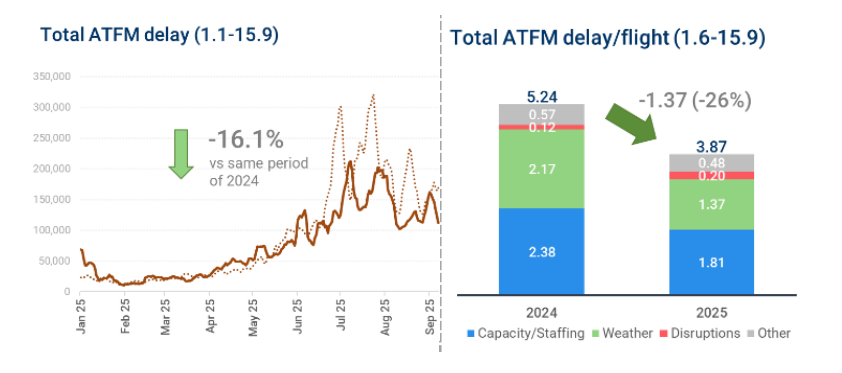
Nonetheless, “delays remain high and above target levels” the report notes. As a result, steps to prepare for summer 2026 include further weather and capacity management measures, staff recruitment and improved rostering, airspace modernisation, increased integration of airports, and digitalisation of the network. Commenting on the findings, Peggy Devestel, Director of MUAC, said: “Looking ahead, increasing traffic will pose capacity challenges, but our planning efforts are focused on meeting the needs of all our airspace users.”