


The European Union and Kazakhstan have signed a long-awaited aviation agreement that will expand air connectivity between the two partners and open new opportunities for European airlines, passengers and businesses.
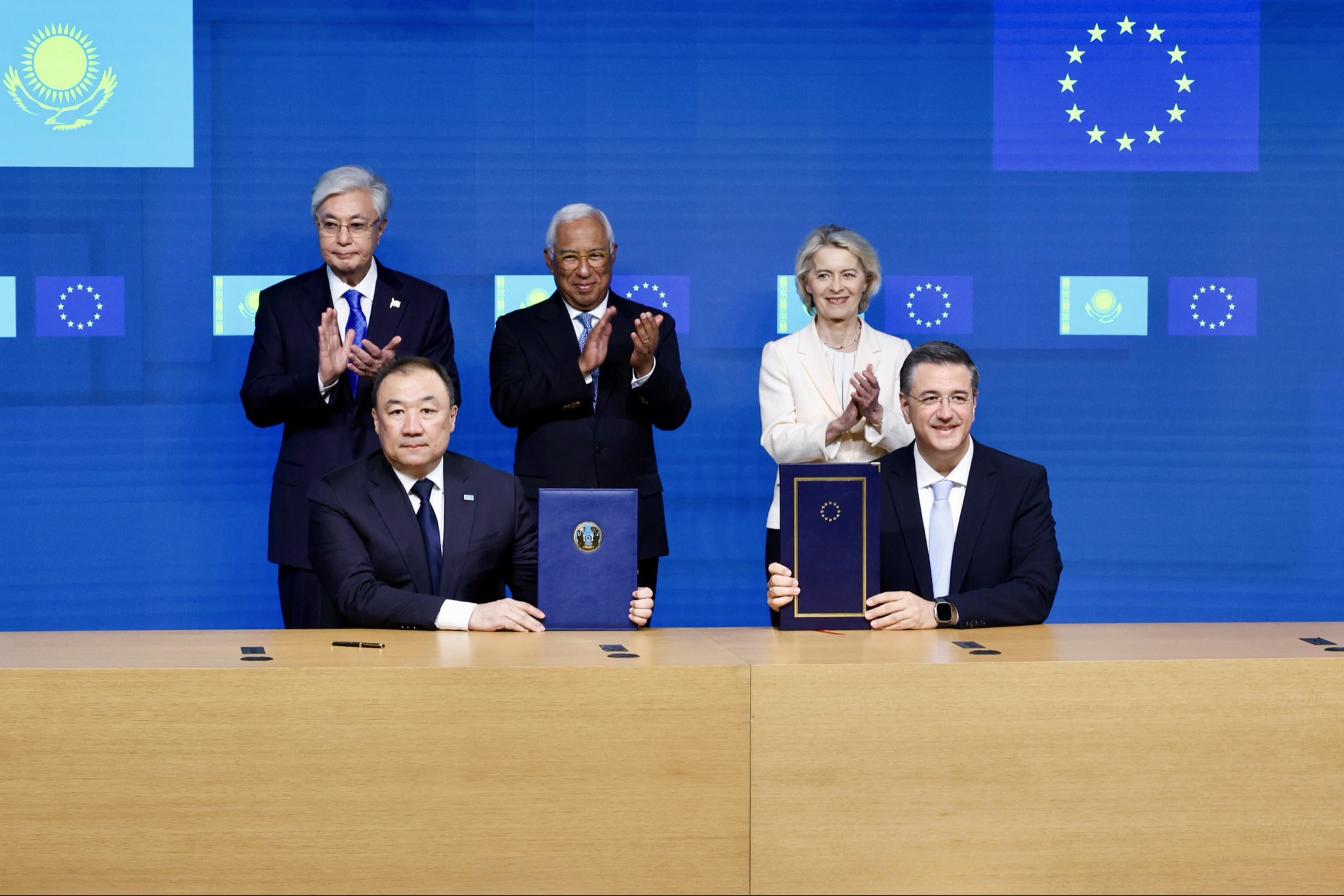
The Horizontal Aviation Agreement was signed in Brussels by European Commissioner for Sustainable Transport and Tourism, Apostolos Tzitzikostas, and Kazakhstan’s Minister of Transport, Nurlan Sauranbayev, during the visit of Kazakh President Kassym-Jomart Tokayev to the Belgian capital.
The signing took place in the presence of European Commission President Ursula von der Leyen and European Council President António Costa, as part of a broader package of agreements aimed at strengthening the strategic partnership between the European Union and Kazakhstan.
The agreement will allow any eligible EU airline to operate flights between Kazakhstan and any of the 17 EU Member States that already have bilateral air services agreements with the Central Asian country. Until now, access to these routes was generally restricted to airlines owned or controlled by nationals of the respective Member State or Kazakhstan.
By extending market access to all EU carriers, the agreement is expected to promote competition, increase connectivity and create greater legal certainty for airlines operating between the two markets.
“This milestone reflects our shared commitment to strengthening cooperation, enhancing connectivity between our regions, and bringing our people and economies closer together,” Commissioner Tzitzikostas said following the signing.
“By opening new opportunities for air services, the agreement will support growth, investment, and exchanges on both sides.”
According to the European Commission, the agreement covers Austria, Belgium, Bulgaria, Cyprus, Czechia, Denmark, Estonia, Finland, France, Germany, Hungary, Latvia, Lithuania, Luxembourg, the Netherlands, Poland and Sweden.
More than two decades in the making
The aviation agreement represents a significant breakthrough in EU-Kazakhstan relations, with negotiations having continued for more than twenty years.
Kazakhstan’s Ambassador to the European Union, Roman Vassilenko, described the agreement as an important step in improving air links between the two sides.
“One of the deals is a Horizontal Aviation Agreement designed to widen air services rights between the EU and Kazakhstan,” Vassilenko said.
“Under the agreement, any EU airline will be able to operate flights between Kazakhstan and any of the 17 EU member states that already have bilateral air services agreements with Kazakhstan, rather than limiting access mainly to airlines owned and controlled by those specific States.”
The agreement will now undergo the respective internal ratification procedures of both parties before entering into force.
Part of a broader strategic partnership
The aviation deal formed part of a wider set of agreements signed during President Tokayev’s visit to Brussels.
Among the other initiatives announced were a framework loan agreement of up to €150 million between the European Investment Bank and Kazakhstan’s national road company to support the development of the Trans-Caspian Transport Corridor, as well as cooperation on critical raw materials through the establishment of an internationally accredited chemical analytical laboratory in Astana.
The European Union and Kazakhstan also concluded negotiations on a Visa Facilitation Agreement and a Readmission Agreement. Once adopted, the visa facilitation measures will simplify procedures for Kazakh citizens seeking short-stay visas to the EU.
The leaders also highlighted growing economic ties between the two partners. The European Union remains Kazakhstan’s largest trade and investment partner, accounting for approximately one third of the country’s external trade.
During an EU-Kazakhstan business roundtable held alongside the leaders’ meeting, Kazakhstan signed an agreement to acquire up to 50 Airbus aircraft, further underlining the growing commercial relationship between the EU and Central Asia’s largest economy.
The latest agreements build on the Enhanced Partnership and Cooperation Agreement between the EU and Kazakhstan, which entered into force in 2020, and follow the first EU-Central Asia Summit held in Samarkand in 2025, where both sides elevated their relationship to a strategic partnership.